Fifteen minutes later, Livius stopped, held his hand up. We dropped to the ground as one. Between the trees, I could see the edge of the clearing housing the exercise headquarters. After a long five minutes, Livius sent Gorlius and Pelo forward to check out the approach. It was such a classic trick to stake out the base camp approach. So near our goal, no way did we want the embarrassment of falling for a classic. I watched the two of them walk in, circling back to back, across the innocent-seeming twenty metres. The remaining four of us took shallow breaths and readied ourselves for reaction.
‘Clear,’ came Gorlius’ disembodied voice.
I signed Livius to cross next with Allia; Paula and I brought up the rear.
The exercise gate passed, we checked in at the admin desk with the sergeant, one of the few women Allia had seen. Her dark blonde hair was plaited and piled up on top of her head, almost like a Roman. Something familiar yet repelling about her distracted me. Nothing in her face was wrong; she smiled pleasantly enough, her light eyes shone with interest. She noted everything down efficiently; her checklist was marked up neatly, spare pens in perfect parallel to each other. I rolled my shoulders to disperse my unease; I had so much else to do. But still…
Behind her stood an older man, around fifty, built like a block of muscle. He reminded me of our former primipilus, the senior centurion. He wore a leather band on his wrist with a crested metal badge, so a traditionalist, but the standard uniform button tab showed he was a warrant officer, like a top sergeant. I glanced at his name tab as he nodded to me.
‘Morning, Major.’
‘Mr Johnson.’
‘Enjoyed yourself?’
‘Oh, I think so.’ I grinned and he smiled back, one per cent off a smirk. Yeah, just like the primipilus.
‘You’ll find fresh food for your team in the mess tent.’ They’d reached the tent first while I’d been doing the nicely-nicely with Johnson. Livius beckoned me over to the table they were clustered around and he thrust a plate of some kind of brown meat stew, potatoes and vegetables toward me. I poked at it.
‘It’s all right, Bruna, it’s dead,’ Paula Servla said. ‘Quite tasty, in fact,’ and followed her words by loading a spoonful into her mouth. The others laughed at my expression, even Allia and Pelo who were very junior. My friend and comrade for nearly fifteen years, Paula had used my nom de guerre – Bruna – with ease as she teased me. But she was right, the stew was good.
Afterwards, I told them to go grab a few hours’ rest. I settled down to write my report. I was finishing the first draft when a shadow fell across the table.
‘Major Mitela.’
‘Lieutenant Wilson.’ I looked up at him. He winced.
Damn. I’d used the American pronunciation. The Brits hated that.
‘Have you recovered?’ No harm being polite.
He snorted. ‘That was an illegal procedure and I intend to report it to my and your senior command.’
I shrugged. ‘Fine by me. Do it.’ I bent my head back down to my report. He had no choice but to go. I watched through my eyelashes as he stomped off to the command tent. Gods, some of them took it so badly. Tough. We trained like every exercise was a live operation, usually without any blood, and used all the techniques, equipment and training at our disposal. When it came to it, a live operation unfolded like an exercise, but sometimes included casualties. A hard way, but successful. Sometimes a little too robust for outsiders.
More of our teams drifted in through the afternoon and I went and spoke to them as they settled down to their food. Two hadbeen brought in as captives, so commiserations to them. Overall, though, we’d acquitted ourselves well.
A joint senior staff mop-up meeting was held before the evening meal where I had the impression we’d won a few friends, one unfriend and a decent amount of respect. Nobody said a word about our unorthodox methodology.
Making my way over to the wash tent later, a tingle ran across the back of my neck. I whirled around but nobody stood behind me, nor anywhere in the clearing. I stood completely still and listened. But I knew somebody was watching, and purposefully. I pulled the outside flap aside slowly. Nobody. No sound of water falling. I checked all the canvas-sided cubicles. Only the smell of soap, and the sheen of wastewater with a few surviving bubbles in corners of the trays. But I still felt uneasy. After a few moments, I decided that I was being ridiculous. Maybe it was tiredness. I shrugged and chose one of the cubicles to the right.
As I dressed afterward, I glanced up at the sign ‘Female showers’. How had showers acquired gender? You didn’t get that ambiguity in Latin, even in the 21st century.
Early next morning, I went for a run with Flavius. Now a senior centurion, he and I had met fourteen years ago on an undercover operation. He was smart, aware and physically tough. He wasn’t a pretty boy like Livius; his light brown hair and mid-brown eyes together with the other standard features you got in a face made a pleasant, but not outstanding combination. This was a great asset for a spook as nobody remembered the average. But when he smiled his soul shone out from his eyes. He gave me balance, sometimes quite starkly, other times humorously. He was my comrade-in- arms, but above all a friend.
‘How do you think it’s going?’ I asked.
He grinned at me. ‘I heard you pulled one of your little tricks.’ He ducked my flying hand.
‘All perfectly routine,’ I said.
‘Yeah, but this lot play by the rules, generally. Rules of engagement, they call it.’
‘I bet they don’t when they’re in the middle of some covert op in the African mountains,’ I snorted.
‘Well, I gather we’re making a good impression, at least in comparison to the Americans and the Prussians.’
I showered and went for breakfast, getting waylaid in the mess tent by one of their captains, called Browning. His long sculptured face was lightened up by a charming smile. I had a penchant for blond hair, which in his case topped blue eyes and, curiously, a scattering of freckles over his nose.
‘Salve Carina Mitela,’ he began and went on, in slow but correct classic Latin. ‘Your forces fight well, with much courage and cunning.’
‘Thank you, tribune,’ I replied, trying my best to match his formality of voice. ‘I accept your praise on behalf of my troops. Your Latin is excellent, very cultured. May I enquire where you learnt to speak so well?’
‘Universitas Sancti Andreae.’ He smiled at my puzzled look and reverted to English. ‘It’s a university in Scotland. I tried it out on some of your people, but I quickly realised it hadn’t moved on since Augustus.’ He smiled ruefully and led me towards an empty table.
‘Hey, no problem,’ I said. ‘I’m happy to speak English – good to pick up on my native language.’
His turn to look confused.
‘I was raised in the Eastern States, you know, America. I lived there until I was twenty-four. My mother was Roma Novan so when I emigrated there, I re-joined her family. I became a member of the PGSF a little later.’
‘Fascinating! Do you go back much?’
‘Only twice in the past fourteen years, the last time a year ago. I found it quite weird – a lot had changed.’
Yeah, and apart from the cleanliness, not for the better. Or maybe it was me. Time to switch subjects.
‘Are you going to try out the Roman games later? I’d be happy to take you through some of them.’
‘I think I’ll watch first.’
I grinned, finished the mug of strong tea the Brits drank, piled my dirty plate on the service table and made my way back to our admin tent.
Flavius was designating teams for the games this afternoon. We were giving our hosts a demonstration just for fun, but he wanted it to be perfect and was choosing carefully.
‘Ah, Major,’ he caught my approach, cast his eye down at his el-pad and asked, ‘can I put you down for the link fight?’ His half- smile was a little too knowing.
The guards fidgeting in a cluster around him, eager to find out their assignments, stopped. The chatter dried up instantly and two dozen pairs of eyes focused on me.
He knew I was the most experienced link-fighter. He also knew I loved it. I’d been practising it with Daniel, now Colonel Daniel Stern and deputy legate, for years before it became legal. It had been an illicit pleasure we’d both relished but contests had been banned for years because of the lethally high casualty rate. I was knocking on the door of forty, for Juno’s sake, but if I said no, Flavius would needle me about it for months. Worse, I’d be letting the detachment down in front of foreigners. If I said yes, I’d have to win or lose face. Asking me in front of the troops meant I couldn’t refuse.
Crafty bastard.
‘Of course, Senior Centurion, I’d be devastated with delight. Now do tell me, who have you volunteered as my partner?’
He had the grace to look away, but after a second found a beaming smile to throw at me. ‘Your choice, ma’am. Centurion Livius is a possibility, or perhaps Pelo.’
Livius! The fittest soldier in the unit. He was raving. And Pelo was a younger version of him.
‘And yourself, Flavius?’ I smiled as sweetly as I could without causing a stampede for sick bags.
‘Oh, I think I’ll be needed to supervise everything. I must regretfully decline your invitation.’
I sighed. ‘Tell Livius to report to me and we’ll practise a few moves.’ I looked at my watch; we had four hours before lunch. I might get lucky and break my leg before the games started.
Read the third excerpt here.
Read the first excerpt here.
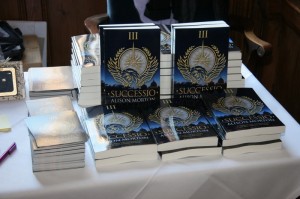
Alison Morton is the author of Roma Nova thrillers, INCEPTIO, and PERFIDITAS. Third in series, SUCCESSIO, is out next Tuesday!
If you enjoyed this post, do share it with your friends!
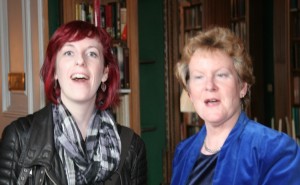
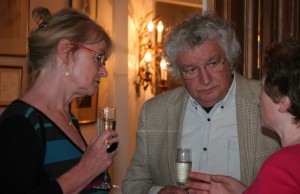
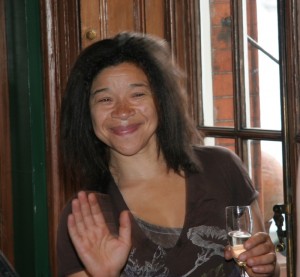
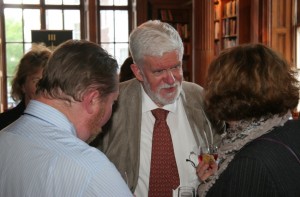
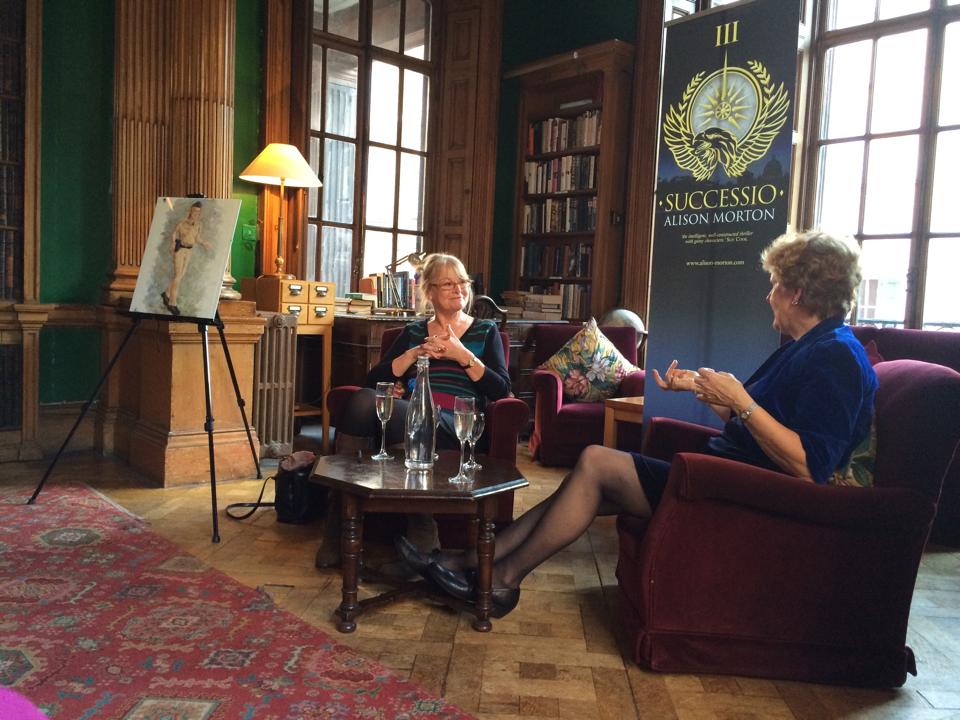
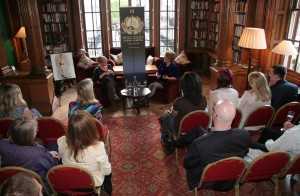 Friends, Roma Novans and colleagues lent me their hours. The bubbly flowed in the glorious library at the University Women’s Club in Mayfair as we gathered to celebrate the publication of the third thriller in the Roma Nova series.
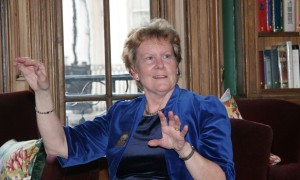 Then she asked me about how my own past had influenced my writing of heroine Carina and I admitted to abseiling out of helicopters and doing NATO training and a lot of crawling around in mud with a gun in my hand during my time in uniform. ‘Ah,’ she said, ‘now I understand better where Carina comes from.’ I just grinned.
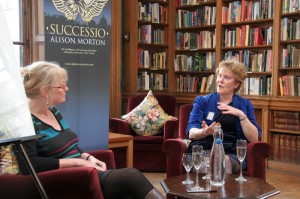 ‘And why was Carina from (a rather different) America?’, Sue pressed. I explained that I wanted as much contrast as possible between the New World where Carina was brought up and the very old European Roma Nova.
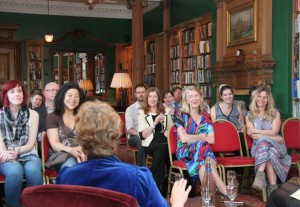 Questions from the audience followed, mostly about writing and research. When writing alternate history, you have to research thoroughly at the point in history when you decide to split from the real timeline so that you have a good basis. I explained I had a good enough general grounding of the period and culture, so tended to concentrate on getting the story out – ‘bashing it out’. Historical detail, the intricacies of sub-plots and editing can came at a later stage.