 I’m honoured and delighted to welcome Elisabeth Storrs to the blog today – a longstanding historical fiction writing friend. Elisabeth has a great love for history and myths. She is the award-winning author of A Tale of Ancient Rome trilogy which was endorsed by Ursula Le Guin, Kate Quinn and Ben Kane.
Now her obsession lies with Trojan treasure and twisted Germanic prehistory in her new release, Fables & Lies: A World War II Novel. Elisabeth is also the founder of the Historical Novel Society Australasia and the $155,000 ARA Historical Novel Prize. She lives in Sydney with her husband in a house surrounded by jacarandas.
I was keen to read Elisabeth’s new novel Fables & Lies set in 1930s and 1940s Germany as my MA dissertation investigated the status of young women who entered the German armed forces at the time. The whole role of women changed radically over the period. But the real lessons are about how people can be misled and seduced politically and when disillusion sets in, how to survive as a woman under a repressive and misogynistic society.
Over to Elisabeth!
Fables & Lies follows the journey of Freyja Bremer; a Berlin museum assistant who is a child of the Reich. Her eyes are opened when she falls in love with archaeologist, Darien Lessing, who shows her the rot beneath the Nazi Regime’s lies. Their love story, and efforts to safeguard their nation’s treasures, form the spine of the novel.
A plethora of WW2 books tell stories from the Allied perspective, many of which are set in the Western theatres of war. Given my story was about Berlin museum curators, I was faced with the challenge of writing my book from the perspective of an ‘everyday’ German. To do so, I read numerous books and journal articles examining whether ordinary Germans were victims of an oppressive regime or fervent adherents of Nazism. The answer is far from black and white. To consider an entire population as a monolith is to ignore the diversity of motivations of millions of individuals. My solution was to depict the Bremer family whose four members represented different responses to the circumstances leading up to the Third Reich and its subsequent rule: Conrad, (the father) a disabled veteran whose Christian beliefs lead to resistance; Elze (the mother) who’s struggled through WW1 and its aftermath and welcomes Hitler’s pathway to a better life; the sister, Volla, the fanatic; and finally, Freyja, indoctrinated throughout her schooling, but unsettled by the oppressions of the Regime.
The rise of Hitler and his National Socialist Party did not happen in a vacuum. Germany suffered terribly after WW1 due to the sanctions imposed on it by the Allied powers under the Treaty of Versailles, including the payment of millions in war reparations. There was a profound sense of shame in defeat as well as a bitter grievance that previously held Polish and Russian lands were surrendered. An unfounded conspiracy theory known as ‘the stab in the back’ asserted the German army had not been defeated in 1918 but instead the country had been brought down by Jews, socialists, and corrupt Weimar Republican politicians who fomented civil rebellion.
Post WW1 Germany saw industrial heartlands taken over by the French and Polish, the German armed forces neutered, and crippling hyperinflation. The Great Depression fuelled the flames of discontent higher. A huge influx of rural people seeking work in the cities led to severe overcrowding together with widespread unemployment. Russian Jews fleeing pogroms sought refuge in Germany, exacerbating existing deep-rooted antisemitism and the conspiracy Jews were overrunning the country. Add fears of a Bolshevik takeover inspired by the Russian Revolution, a fractious parliament cobbled together from various coalitions, and a veritable perfect storm was brewing.
In the beginning, the National Socialists did deliver relief to various echelons of society, supported rural communities, assisted veterans, and provided employment opportunities for disaffected youth. The welfare provided, however, was reserved for ‘valuable Germans’. This Nazi Utopia disintegrated into totalitarian rule when Hitler turned Germany into a one-party state. The reign of terror begun.
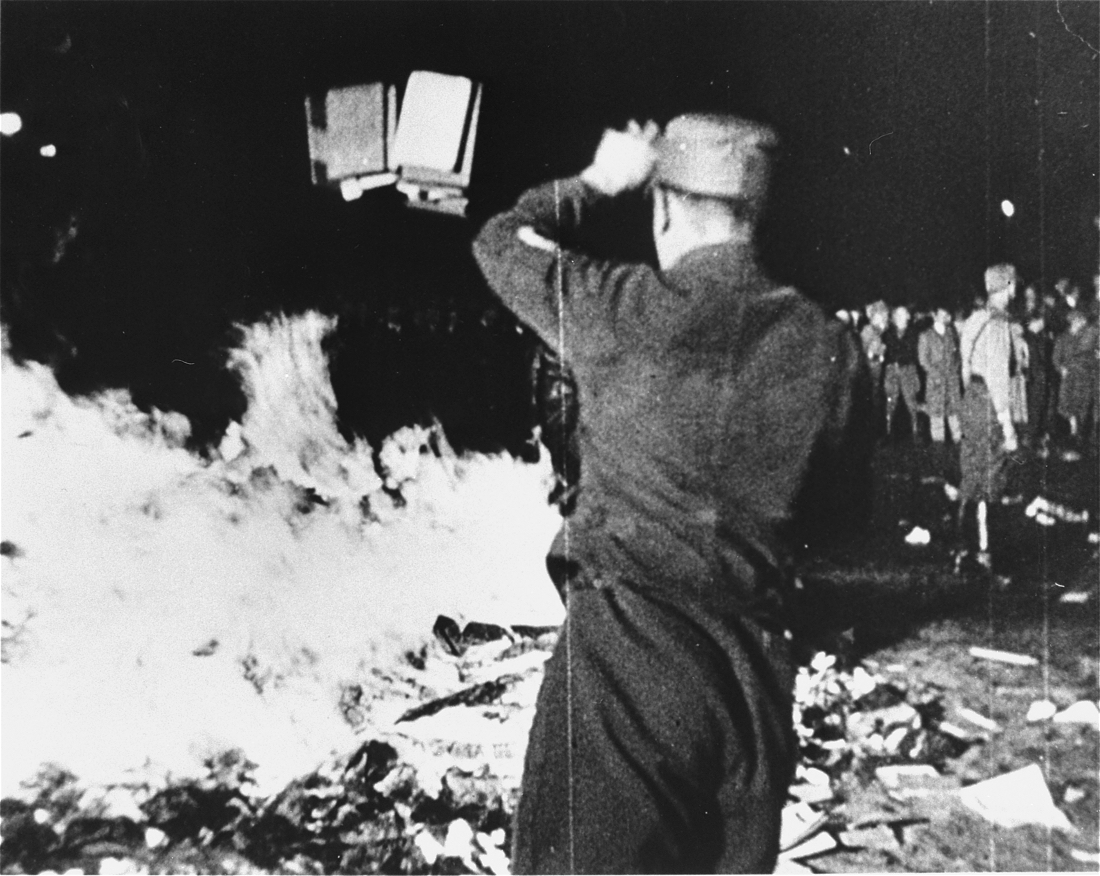
A member of the SA throws confiscated books into the bonfire during the public burning of “un-German” books on the Opernplatz in Berlin. (US Holocaust Memorial Museum, Public Domain)
Deprived of the chance to read or hear foreign news, Germans were subjected to unrelenting propaganda. Foreign books were banned and subsequently burned. People were restricted to listening to radio programs transmitted via wirelesses limited to local frequencies. Loudspeakers were installed in public spaces to blast out government edicts. SS and SA troops ran rampant with unchecked violence. Political dissidents, journalists and intellectuals were interned in concentration camps as ‘enemies of the State’. Surveillance was imposed through Party ‘Block Wardens’ monitoring neighbourhoods. People were encouraged to turn on each other leading to a wave of denunciations to the Gestapo. And of course, failure to perform the Nazi salute was punishable by severe penalty.
As the climate of fear grew, the onslaught of policies that eroded or eliminated public institutions and civil liberties led to a degree of apathy among many. Overwhelmed, citizens passively accepted the changes, feeling powerless or afraid to stop the abuses of power. In other words, ‘good people did nothing.’
Of course, a huge number of Germans were true believers ready to blindly follow the Führer and support the Reich. And there is no avoiding the fact antisemitism was entrenched in every level of society in varying degrees which led in turn to indifference, complicity or culpability for the escalating persecution of the Jews.
Hitler saw the importance of indoctrinating children. The education system was immediately attacked with only Nazi teachers employed. The curriculum was limited, with physical fitness a priority. Girls were destined to be wives and mothers, boys to be soldiers. I found a poster which depicted the Nazi ‘Life Plan from Cradle to Adulthood’ setting out the roles expected within each age group, all of which emphasized the limitations placed on women to be ‘Mutter und Hausfrauen’.
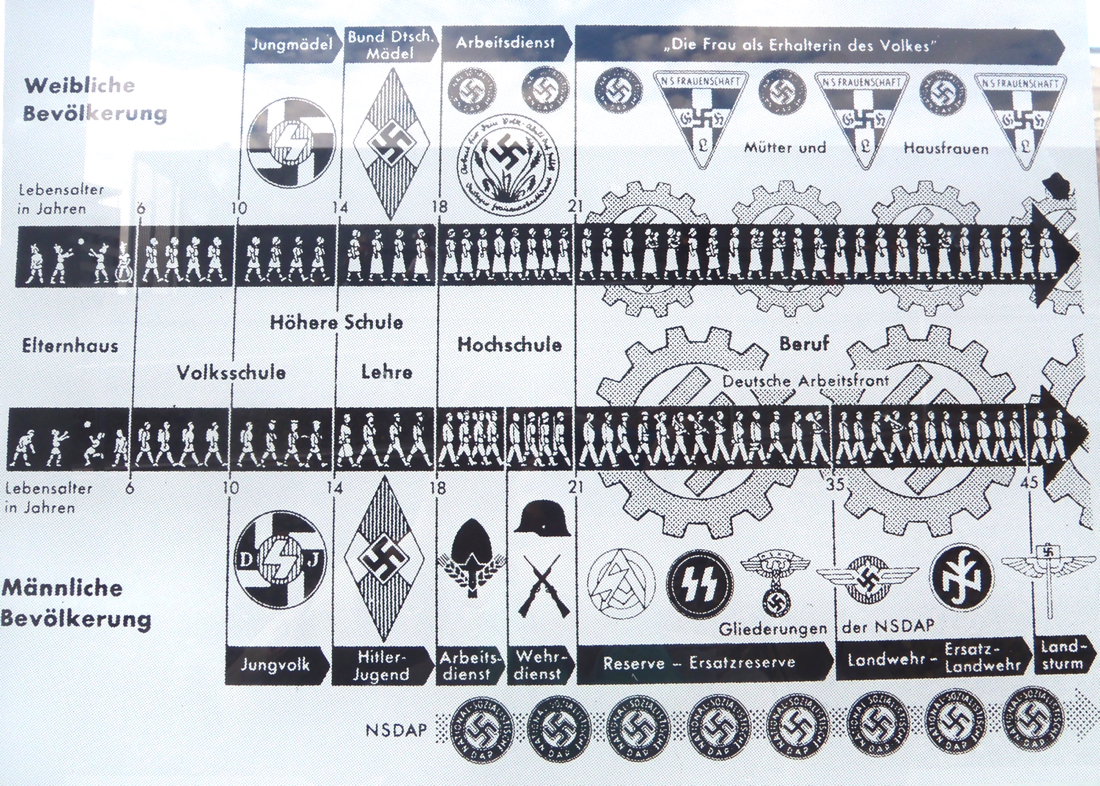
Nazis worked hard to alienate children from parents who may have harboured anti- Nazi sentiment, actively encouraging them to inform on them. Between the age of 10 – 18, both boys and girls were required to attend programs run by the Hitler Youth or the League of German Maidens. German exceptionalism was already prevalent but the belief in German supremacy was further stoked by the ‘Aryan Myth.’ Children were brainwashed they were part of the ‘Master Race’ who were superior to ‘sub-humans’ i.e. Romani, Slavs, People of Colour and, most particularly, Jews. ‘Aryans’ were superior ‘bearers of culture’ who were destined to be rulers. In comparison, the sub-humans were there to ‘destroy’ German culture by overbreeding – an example of virulent replacement theory which lay the grounds for genocide.
Learning this gave me greater context to depict Freyja – a girl who is briefly exposed to pre-Nazi education (via her grandmother) but then comes under total domination of Nazi teachings through the League of German Maidens. However, Freyja has the benefit of living with her father whose Christian beliefs lead him to secret rebellion through the Confessing Church movement. There is also an undercurrent of dissatisfaction in her about the future offered to women. As a result, she is prepared to listen to the alternative views of an outsider like Darien Lessing who is German but educated at Cambridge. Darien sees no such limitations for females, appreciating Freyja’s intelligence, and encouraging her to look beyond the Fascist creed. When Freyja meets Darien’s sister, Parisa, who is married to a Jewish doctor, her awakening leads to a dangerous resistance in aiding this ‘mixed-race’ couple.
From my research, it appears the majority of Germans were dismayed when Hitler sparked another war, but widespread support followed as the Wehrmacht swiftly recovered lost territory from hated enemies. Yet the impact on civilians from Hitler’s voracious thirst for conquest of Western countries was immediate. The Allies blockaded ports resulting in strict rationing. It was also a shock when RAF squadrons finally reached Berlin as Goering had reassured them the distance from England was too far for planes to fly. His boast ‘Call me Meyer’ i.e. a ‘Monkey’s Uncle’ should such attacks occur became a running joke. Air raid sirens were thereafter called ‘Meyer’s Bugle.’
Germany’s lighting fast victories stalled after Hitler overcommitted resources to invade Russia and Ukraine. With the tide of the war turning, the Regime viciously prosecuted critics with the offence of ‘undermining the war effort.’ Listening to foreign radio was forbidden. The death penalty was employed for the barest infractions with the ‘falling axe’ used overtime to guillotine offenders.
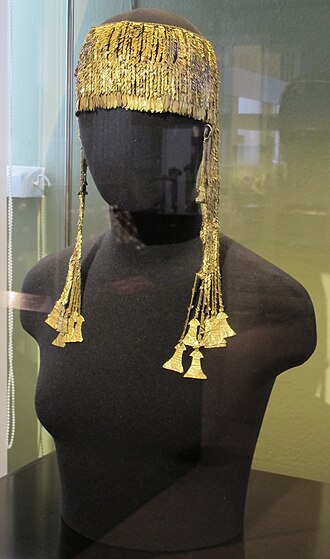
The “big” diadem from Priam’s Treasure, excavated By Heinrich Schliemann on the supposed site of Troy. Looted from Berlin in 1945 by the Soviets, the majority of the artefacts are currently in the Pushkin Museum in Moscow. (Photo by Sailko, Creative Commons)
As the war progressed, air raids became incessant, mirroring the Luftwaffe’s own relentless blitzes. Hitler had ‘sown the wind’ and now Germans must ‘reap the whirlwind’. The RAF employed ‘saturation’ bombing while the American’s ‘blockbusters’ obliterated entire city blocks. From 1944, Berliners faced twice daily raids – US in the day and RAF at night.
A once glorious city was reduced to rubble with hundreds of thousands killed, maimed and made homeless. With the air thick with ash after each blitz, Berliners were forced to live in shelters eking out a miserable existence. Freyja and her family struggle to survive these air campaigns, increasing deprivations, as well as Nazi oppression. Throughout, she risks her life frantically packing her museum’s exhibits for safekeeping in the small windows between the daytime and night time bombings.
At the bitter end, Hitler considered Germans had failed him and their country. He refused to surrender, preferring his people face annihilation. Bridges were destroyed to prevent escape from Berlin, leaving Berliners trapped in the ‘Devil’s Cauldron’ pummelled by Russian artillery fire. SS squads set up ‘gallows alleys’ to hang citizens who displayed a white flag. The terrifying fate awaiting German women is well documented. Soviet retribution was particularly monstrous given they sought vengeance for the starvation, slaughter and dispossession of 20 million Slavs in the East.
When I started the book over ten years ago, I never thought to see our world turning to more authoritarian leaders, with democracy undermined by similar strategies from the Nazi playbook. History is repeating in disturbing ways. I feel Fables & Lies is a novel for our times and will give readers a better understanding of how a populace can fall under the spell of zealots – and how devastating the consequences are when apathy, fear or complicity stifles free speech. And, with a glimmer of light, I hope historical fiction fans will enjoy learning about the quest to save not only Germany’s, but the world’s, great antiquities from destruction.
___________
Connect with Elisabeth
| Website | Triclinium blog | |
| Goodreads | Amazon | |
| Bookbub |
Subscribe to her newsletter for monthly inspirational interviews.
What’s Fables & Lies about?
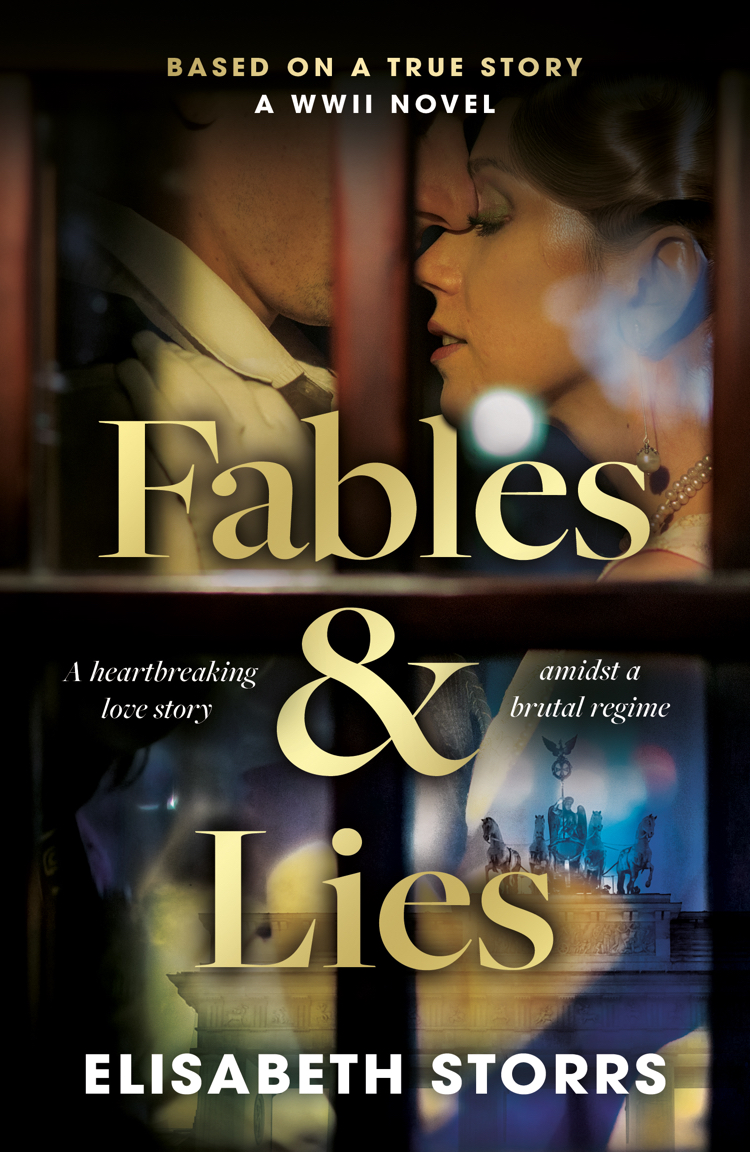 Under a brutal regime, what price must be paid to preserve truth, treasure and love in a world built on lies?
WWII Berlin. Freyja Bremer, a patriotic museum assistant, marries Kaspar Voigt, an ambitious SS scholar, to protect her father. Yet she is unaware her husband is instrumental in Himmler’s twisted quest for Aryan supremacy.
As she strives to safeguard the priceless Priam’s Treasure from air raids, Freyja falls in love with Darien Lessing, an archaeologist who exposes the moral decay beneath the Regime’s myths. Her awakening drives her into perilous resistance – aiding a Jewish doctor and his wife, Darien’s sister – while uncovering Kaspar’s role in the SS’s darkest programs, which subvert history to justify invasion, abduction and murder.
As Berlin collapses into chaos and bloodshed, Freyja, caught between duty, deception and desire, must risk everything to preserve truth in a world built on lies.
A heartbreaking yet triumphant love story, Fables & Lies shines light on lesser-known aspects of the Nazi Regime. It gives voice to the complex moral struggles of German women, the forgotten resistance of Gentiles married to Jews, the dangers of contested history, the evils of Himmler’s racial studies program and the unsung bravery of German museum curators who saved their nation’s treasures.
___________
Available in ebook, paperback and audio editions
https://elisabethstorrs.com/buy-books/buybooks-fables-lies/
___________
My thoughts
Elisabeth Storrs has indeed broken the mould by writing ‘from the other side’. Evocative, detailed and heart-rending as the heroine journeys through disillusion and danger in the Third Reich. We rarely get such a vivid a glimpse of the Second World War from an ordinary civilian on ‘the other side’. Even rarer from the point of view of a young girl having grown up considering the Third Reich as normal. Her gradual disillusionment is heartbreaking and helps us to understand the shattering effect of the destruction of personal lives and family dynamics, always supposing that family members survive.
Freyja does what many of us would do; she marries an attractive man, she continues to enjoy her work and later, she keeps her head down steering her way through the increasingly appalling environment. And we live every moment thanks to excellent research by the author.
This is a long read, sometimes a painful one, yet there is redemption and fortitude. Elisabeth Storrs’s sound writing takes us on a worthwhile and ultimately rewarding journey. Highly recommended.
Alison Morton is the author of Roma Nova thrillers – INCEPTIO, CARINA (novella), PERFIDITAS, SUCCESSIO, AURELIA, NEXUS (novella), INSURRECTIO and RETALIO, and ROMA NOVA EXTRA, a collection of short stories. JULIA PRIMA and EXSILIUM, set in the late 4th century, tell the story of Roma Nova’s foundation. Audiobooks are available for four of the series. Double Identity and Double Pursuit start a new contemporary thriller series. The third, Double Stakes is now out.
Find out more about Roma Nova, its origins, stories and heroines and taste world the latest contemporary thriller Double Identity… Download ‘Welcome to Alison Morton’s Thriller Worlds’, a FREE eBook, as a thank you gift when you sign up to Alison’s monthly email update. As a result, you’ll be among the first to know about news and book progress before everybody else, and take part in giveaways.







Leave a Reply