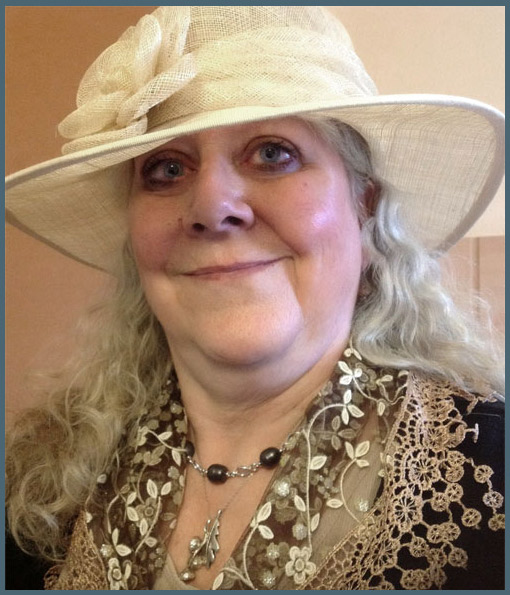
Today, I’m delighted to welcome J G (Jane) Harlond to the blog to tell us about writing historical fantasy stories. Today, I’m delighted to welcome J G (Jane) Harlond to the blog to tell us about writing historical fantasy stories.
Secret agents, skulduggery, and sea voyages… Creator of the infamous Ludo da Portovenere, J.G. Harlond writes page-turning historical crime novels set during the 17th Century and the Second World War. Each story weaves fictional characters into real events. Jane also writes Viking-age historical fantasy drawing on Norse myths and legends.
Prior to becoming a full-time fiction author, Jane was involved in international education and wrote a number of school textbooks for Oxford University Press. After travelling widely – she has visited or lived in most of the locations in her novels – she is now settled in her husband’s home province of Andalucía, Spain.
We all know it’s different from alternative history stories but what IS historical fantasy? Over to Jane!
Most readers of any fictional form knowingly suspend disbelief and accept what they read as real for the duration of the novel. Readers of quality historical fiction trust the author to tell stories involving real people and events, and accept the fictional element required to create scenes and relationships between protagonists.
Historical fantasy – such as novels by Guy Gavriel Kay, or G.R.R. Martin’s Game of Thrones (which rests on a good deal of real history) – involves a slightly different transaction. As readers we become more actively engaged because to a lesser or greater extent we have to make-it-up in our own mind’s eye. Something those of us with an over-active imagination can really enjoy.
I came to historical fantasy late in my writing career. Friends had recommended books by G.G. Kay, but I didn’t start reading them until a couple of years ago. I’ve always enjoyed fantasy of the Lord of the Rings kind, but Kay’s books are much more about people living in a similar yet very different world to ours. A world with two moons for a start. They also contain a lot of history. The Lions of Al-Rassan, for example, is classified as fantasy but it’s one of the best books on Spanish history I’ve ever read. Kay captures the power politics, racial and religious struggles of Moorish Spain so well that I lived every word, sensing that this is what it must have been like.
This, for me, is where historical fiction and fantasy come together, offering a clearer insight or meaning to the past.
Writing my new historical fantasy series involves much the same process as my historical crime fiction. I do a lot of background reading, follow up curious events or details, and make reams of notes. This is then consciously, or otherwise, modified for my story. Compelling content is vital, but the devil is in the small details required to make something entirely unknown credible.
 Runestone, Uppsala, Sweden My new Doomsong series is set in an imaginary early-medieval period; what used to be known as the Dark Ages. Like mainstream hist-fic, it includes an issue modern readers can relate to. This, I believe, is one of the strengths of historical fiction in any of its sub-genres – crime, romance, war. The past can be presented in such a way that it sheds light on what is happening now. If the author is any good, the reader will empathise with the protagonist(s) and understand their hopes, fears and challenges.
This all sounds very academic, and I certainly didn’t set out to do this in The Doomsong Voyage. Initially, I was writing a story loosely linked to The Doomsong Sword for my grandchildren. But the idea did come to me after I reviewed a Viking history Children of Ash and Elm by Neil Price (Basic Books, 2020). I then went on to read other non-fiction on the Viking epoch, largely because I spend time in Sweden each year, and I grew up on a Viking battlefield.
The novel opens with the threat of a major climate catastrophe caused by the eruption of a volcano, which actually happened in the early-medieval period. The ash cloud made life for Scandinavians even more difficult than it already was, bringing in a Fimbulwinter – a never-ending winter – forcing people to seek a new home on fertile land.
With this threat looming (in the story), a young man named Finn sets sail on a Baltic trading knarr (a type of Norse merchant ship used by the Vikings) to locate a pirate named Ice-heart in the Middle Sea. The pirate is a clan leader, who has the knowledge and personality required to persuade his people to leave all they know and cross the ocean to find a better life. Finn is accompanied by a strange girl with amber-green eyes, who is always nearby when something drastic happens. And as the pirate is not called Ice-heart without reason, dangers abound. . . To say more would be a spoiler.
 Vejer de la Frontera Having lived on the Mediterranean coast in Italy and Spain for more than half my life, I was familiar with how the Vikings sailed and raided as far as the Levant, and how they established camps in Frankia and Hispania. The fictional voyage also includes a version of Al-Andalus. My independent state of Barbalus came from staying in the hill-top town of Vejer de la Frontera.
Gradually, as I was writing, more and more documented history crept into the story and it stopped being only for young adults. There is good deal of magic in it, though. Back in those so-called Dark Ages people firmly believed in magic, shape-shifting, enchantments, and the inexplicable power of gods such as Odin/Woden.
The story developed in a number of un-planned ways, and it wasn’t easy to get right. Once it was finished, however, I could see how it would make a series – and, very fortunately, so could my publisher.
The next story is taking me back home to North Devon in the British West country. As I mentioned, I grew up on a Viking battlefield. Historians dispute who fought whom and when, but there is little doubt there were at least two battles on the stretch of land between Northam and Appledore on the River Torridge.
Whether Hubba (Ubbe) really did lead thirty-three dragonships into the estuary (as stated in the Anglo-Saxon Chronicle) I do not know, but it makes for a terrific story.
_________
Connect with J G Harlond
Website: https://www.jgharlond.com
Twitter: @JaneGHarlond https://twitter.com/JaneGHarlond
Facebook author page: https://www.facebook.com/JGHarlondauthor
Penmore Press: www.penmorepress.com
____________
What’s The Doomsong Voyage about?
 It is long ago in the Cold North, in a time when folk believed in the power of the gods and magic, when families lived on freezing land and some set off a-viking for treasure. It is long ago in the Cold North, in a time when folk believed in the power of the gods and magic, when families lived on freezing land and some set off a-viking for treasure.
Master Odo, the Wanderer, tells young Finn the Tale-maker that a terrible weather catastrophe is about to happen. Finn must find a pirate named Ice-heart, currently raiding somewhere in the Middle Sea, and return with him. Ice-heart is a clan-leader, only he can lead his people to safety.
Master Odo gives Finn the legendary Doomsong Sword, and a warning. His voyage will be perilous, he will be tested, and a powerful enemy will try to stop him.
But Finn has help along the way – from a strange girl with amber eyes.
Buy the The Doomsong Voyage here: https://books2read.com/u/mBLNOv
and its predecessor The Doomsong Sword here: https://books2read.com/u/bwOE2Y
Alison Morton is the author of Roma Nova thrillers – INCEPTIO, CARINA (novella), PERFIDITAS, SUCCESSIO, AURELIA, NEXUS (novella), INSURRECTIO and RETALIO, and ROMA NOVA EXTRA, a collection of short stories. Audiobooks are available for four of the series. Double Identity, a contemporary conspiracy, starts a new series of thrillers. JULIA PRIMA, Roma Nova story set in the late 4th century, starts the Foundation stories. The sequel, EXSILIUM, is now out.
Find out more about Roma Nova, its origins, stories and heroines and taste world the latest contemporary thriller Double Identity… Download ‘Welcome to Alison Morton’s Thriller Worlds’, a FREE eBook, as a thank you gift when you sign up to Alison’s monthly email update. As a result, you’ll be among the first to know about news and book progress before everybody else, and take part in giveaways.
If you enjoyed this post, do share it with your friends!Like this:Like Loading...

As in previous years, reading books has given me enormous pleasure. Let’s be honest, I’ve been a voracious reader since I was five. This year, I published a new historical novel, EXSILIUM, the sequel to JULIA PRIMA in the late 4th century plus spent a lot of the year participating in events and drafting the next Mel/Mélisende story in the ‘Doubles’ series
Enough of me, the writer; here I’m writing as a reader.
This is not a beauty contest nor a selection. I chose the books in the image totally at random. The list below contains books I’ve read this year and enjoyed. Some made me catch my breath, others made me weep with joy or sorrow and others appalled me. But I loved the experience of reading them all.
I’m not mentioning those I didn’t enjoy or part-read – that’s not fair to the authors concerned as I’m probably not their ideal reader.
I’m a fussy reader. I use Amazon’s ‘Send a free sample’ service mercilessly, especially if it’s an author new to me. But I have discovered some real gems that way.
Oh, and I’ve read a few non-fiction for research, ‘professional development’ and for fun…
Fiction
Rubicon (Gordianus the Finder 7), Steven Saylor
When We Were Gods, Colin Falconer
Shadows in the Ashes, Christina Courtenay
Britannia’s Interests, Antoine Vanner
Prophecy (Giordano Bruno 2), S J Parris
The English Spy (Gabriel Allon 15), Daniel Silva
Dying for Rome: Lucretia’s Tale, Elisabeth Storrs
Among Sea Wolves, Jean Gill
The Ides of April, Lindsey Davis (Flavia Albia 1) re-read
Shadow of the Eagle (Borderlands 1), Damion Hunter
The Ashes of London, Andrew Taylor
The Bookseller’s Wife, Jane Davis
Semper Fidelis (Ruso 5), Ruth Downie
The Shadow Network, Deborah Swift
Legionary, Gordon Doherty
Time’s Prisoner, Linda Gillard
Yellowface, Rebecca F Kuang
While I Was Waiting, Georgia Hill
Tabula Rasa (Ruso 6), Ruth Downie
The Other Gwyn Girl, Nicola Cornick
The Three Graces, Amanda Craig
Driven to Murder (Sophie Sayers 9), Debbie Young
Empire’s Edge (Borderlands 2), Damion Hunter
Babylon Berlin (Gereon Rath 1), Volker Kutscher
The Orchid Hour, Nancy Bilyeau
The Quantum Curators and the Fabergé Egg, Eva St.John
The Darkest Sin (Cesare Aldo 2), D V Bishop
Stasi State (Oberleutnant Karin Müller 3), David Young
Sanctus, Simon Toyne
Blood and Sand (Run and Hide 5), J J Marsh
Their Castilian Orphan, Anna Belfrage
The Quantum Curators and the Enemy Within, Eva St.John
Caesar’s General (Mark Antony 2), Alex Gough
Ostler (Cambridge Hardiman 1), Susan Grossey
Birds of Prey (Borderlands 3), Damion Hunter
Avalon, Anya Seton (re-read)
The King’s Intelligencer, Elizabeth St.John
Bonjour Sophie, Elizabeth Buchan
Belshazzar’s Daughter (Inspector Ikmen 1), Barbara Nadel
The Quantum Curators and the Missing Codex, Eva St.John
The Sword of Jupiter, Travis Starnes
The Ottoman Secret, Raymond Khoury
Blackshirt Rebellion, Jason Monaghan
The Chase, Ava Glass
Memory of Murder, Helen Hollick
Legacy of the Runes, Christina Courtenay
Stasi 77 (Oberleutnant Karin Müller 4), David Young
Doing Time (Time Police 1), Jodi Taylor
Courage for the Cabinet Girl, Molly Green
A Spy Alone (Oxford Spy Ring 1), Charles Beaumont
Death at the Old Curiosity Shop (Curiosity Shop 1), Debbie Young
Death on the Tiber (Flavia Albia 12), Lindsey Davis
The Fugitive’s Sword (Lord’s Learning 1), Eleanor Swift-Hook
Stasi Winter (Oberleutnant Karin Müller 5), David Young
Lake of Widows, Liza Perrat
The Collector (Gabriel Allon 23), Daniel Silva
Katherine, Anya Seaton (re-read)
Guards, Guards! (Discworld 8), Terry Pratchett
Queen High, C J Carey
The Stasi Game (Oberleutnant Karin Müller 6), David Young
Venator, A M Swink
The Velvet Cloak of Moonlight, Christina Courtenay
Traitor’s Game, Rosemary Hayes
Non-fiction
The Roads to Rome, Catherine Fletcher
Outlive: The Science and Art of Longevity, Peter Attia MD, Bill Gifford
The Indie Author Game Plan, J T Lawrence
The Accidental Apostrophe, Caroline Taggart
The Later Roman Empire: AD 354-378, Ammianus Marcellinus, Andrew Wallace-Hadrill
Meditations for Mortals, Oliver Burkeman
Alison Morton is the author of Roma Nova thrillers – INCEPTIO, CARINA (novella), PERFIDITAS, SUCCESSIO, AURELIA, NEXUS (novella), INSURRECTIO and RETALIO, and ROMA NOVA EXTRA, a collection of short stories. Audiobooks are available for four of the series. Double Identity, a contemporary conspiracy, starts a new series of thrillers. JULIA PRIMA, Roma Nova story set in the late 4th century, starts the Foundation stories. The sequel, EXSILIUM, is now out.
Find out more about Roma Nova, its origins, stories and heroines and taste world the latest contemporary thriller Double Identity… Download ‘Welcome to Alison Morton’s Thriller Worlds’, a FREE eBook, as a thank you gift when you sign up to Alison’s monthly email update. As a result, you’ll be among the first to know about news and book progress before everybody else, and take part in giveaways.
If you enjoyed this post, do share it with your friends!Like this:Like Loading...

Celebrating any anniversary is an excuse for joy, bubbly and dancing. Celebrating a special anniversary for a book warms the heart of the author to sun-like temperature. I experienced this for INCEPTIO’s 10th in March 2023 and published a special edition hardback.
So imagine how Helen Hollick is feeling celebrating the 25th silver anniversary of her powerful novel Harold the King (I am the Chosen King in Canada/USA)!
Today, I’m spotlighting her great success of telling the events that led to the Battle of Hastings and the Norman conquest of England in 1066 from the English point of view.

Two men – One crown
England, 1044. Harold Godwinesson, a young, respected earl, falls in love with an ordinary but beautiful woman. In Normandy, William, the bastard son of a duke, falls in love with power.
In 1066 England falls vulnerable to the fate of these two men: one, chosen to be a king, the other, determined to take, by force, what he desires. Risking his life to defend his kingdom from foreign invasion, Harold II led his army into the great Battle of Hastings in October 1066 with all the honour and dignity that history remembers of its fallen heroes.
In this beautifully crafted tale, USA Today bestselling author Helen Hollick sets aside the propaganda of the Norman Conquest and brings to life the English version of the story of the man who was the last Anglo-Saxon king, revealing his tender love, determination and proud loyalty, all to be shattered by the desire for a crown – by one who had no right to wear it.
Praise for Helen Hollick:
“Helen Hollick has it all! She tells a great story, gets her history right, and writes consistently readable books” ~ Bernard Cornwell
“A novel of enormous emotional power” ~ Elizabeth Chadwick
“Thanks to Hollick’s masterful storytelling, Harold’s nobility and heroism enthral to the point of engendering hope for a different ending…Joggles a cast of characters and a bloody, tangled plot with great skill” ~ Publisher’s Weekly
“Don’t miss Helen Hollick’s colourful recreation of the events leading up to the Norman Conquest.” ~ Daily Mail
“An epic re-telling of the Norman Conquest” ~ The Lady
“If only all historical fiction could be this good” ~ Historical Novel Society Review
Buy Harold here:
Universal eBook link, Harold The King: https://books2read.com/u/4jOdYj
Harold the King (UK): https://viewbook.at/HaroldTheKing
I Am the Chosen King (US): https://viewBook.at/ChosenKing
Also available on #KindleUnlimited (excerpt in US & Canada)
Published by Taw River Press (UK) Sourcebooks Inc (USA)
All about Helen
 First accepted for traditional publication in 1993, Helen became a USA Today Bestseller with her historical novel, The Forever Queen (titled A Hollow Crown in the UK) with the sequel, Harold the King (US: I Am The Chosen King) being novels that explore the events that led to the Battle of Hastings in 1066. First accepted for traditional publication in 1993, Helen became a USA Today Bestseller with her historical novel, The Forever Queen (titled A Hollow Crown in the UK) with the sequel, Harold the King (US: I Am The Chosen King) being novels that explore the events that led to the Battle of Hastings in 1066.
Her Pendragon’s Banner Trilogy is a fifth-century version of the Arthurian legend, and she writes a nautical adventure/supernatural series, The Sea Witch Voyages.
She has also branched out into the quick read novella, ‘Cosy Mystery’ genre with her Jan Christopher Mysteries, set in the 1970s, with the first in the series, A Mirror Murder incorporating her, often hilarious, memories of working as a library assistant. The fifth in the series, A Memory Of Murder, was published in May 2024.
Her non-fiction books are Pirates: Truth and Tales and Life of A Smuggler. She is currently writing about the ghosts of North Devon, and Jamaica Gold for her Sea Witch Voyages.
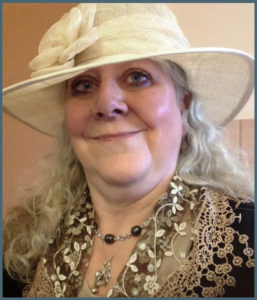
Recognised by her stylish hats, Helen tries to attend book-related events as a chance to meet her readers and social-media followers, but her ‘wonky eyesight’ as she describes her condition of glaucoma, and severe arthritis is now a little prohibitive for travel.
She lives with her family in an eighteenth-century farmhouse in North Devon with their dogs and cats, while on the farm there are showjumper horses, fat Exmoor ponies, an elderly Welsh pony, geese, ducks and hens. And several resident ghosts.
Connect with Helen
Website: https://helenhollick.net/
Amazon Author Page: https://viewauthor.at/HelenHollick
Facebook: https://www.facebook.com/helen.hollick
Blog, supporting authors & their books: https://ofhistoryandkings.blogspot.com/
Bluesky: https://bsky.app/profile/helenhollick.bsky.social
Twitter / X: https://x.com/HelenHollick
Monthly newsletter: Thoughts from a Devonshire Farmhouse:
Start Here: January 2024 https://ofhistoryandkings.blogspot.com/2024/01/thoughts-from-devonshire-farmhouse.html (posted on her blog)

Alison Morton is the author of Roma Nova thrillers – INCEPTIO, CARINA (novella), PERFIDITAS, SUCCESSIO, AURELIA, NEXUS (novella), INSURRECTIO and RETALIO, and ROMA NOVA EXTRA, a collection of short stories. Audiobooks are available for four of the series. Double Identity, a contemporary conspiracy, starts a new series of thrillers. JULIA PRIMA, Roma Nova story set in the late 4th century, starts the Foundation stories. The sequel, EXSILIUM, is now out.
Find out more about Roma Nova, its origins, stories and heroines and taste world the latest contemporary thriller Double Identity… Download ‘Welcome to Alison Morton’s Thriller Worlds’, a FREE eBook, as a thank you gift when you sign up to Alison’s monthly email update. As a result, you’ll be among the first to know about news and book progress before everybody else, and take part in giveaways.
If you enjoyed this post, do share it with your friends!Like this:Like Loading...
 When I started this scribbling business in 2009, I sat down one morning in front of my computer and typed for ninety days. When I started this scribbling business in 2009, I sat down one morning in front of my computer and typed for ninety days.
As a professional translator, I knew I would have to edit anything I produced. I joined a writers’ group and survived the terror of reading my offering aloud for the first time and receiving comments and criticism.
Then I had to toughen up. I ordered and consumed books on writing, I swapped with other members in the writing group. Next, I put out feelers to find out how to publish. I went along to seminars, listened to talks. Basically, I put on my big girl pants and set off on my way.
How naïve I was!
My first manuscript’s heroine was established in her role, she knew her world, she had a significant other and she duly saved the day. I had built a coherent setting for her and her fellow characters. What could be wrong?
But after one writers’ group evening, the discussion confirmed a doubt which had wormed its way into my head by the back door a week or two earlier. Why had I started where I had? Why hadn’t I started at the beginning of my heroine’s story?
I explained to myself and the group that I would publish an earlier part of her story later. I had started right in the middle of the action. Wasn’t that where you were supposed to start without a lot of background at the beginning?
I had learned one lesson but not the right one
Agreed, the way to hook the reader from the first sentence, then the first paragraph and the first page, a good place to begin is in media res, a posh way of saying slap bang in the middle of the action.
However…
We should not confuse or repel readers by dumping an indigestible superabundance of assumptions on them. Some assumptions, yes, in order to create an atmosphere, but not on the scale of a Roman Saturnalia.
Neither should the story start at absolute beginning of the heroine’s or hero’s life, unless that is a dramatic moment in itself and an essential part of the story. (But is it that essential on page one?)
 Jane Austen had it dead right in Pride & Prejudice: Jane Austen had it dead right in Pride & Prejudice:
‘It is a truth universally acknowledged that a single man in possession of a good fortune must be in want of a wife.’
She gives us so much in that sentence:
1. Irony – who actually acknowledges that? (Modernspeak equivalent – ‘it’s on social media so it must be true.’ Really?)
2. A new wealthy plum for the picking (Fresh meat in the ‘hood)
3. Social play about to start (Who’s going to bag him – rumour and tension all round)
4. Does he have any say in this? (Social coercion – let’s all watch the victim wriggle)
And off it goes… We don’t need to know about the Bennets’ marriage, Mr Bennet’s youth, the sisters’ adventures as children, only where they are in life now and about Mrs Bennet’s strong desire to settle them. It’s all there. On page one, her news opens the circle that will be closed on the last page.
The ideal place is the moment the trigger of their first adventure/case/ revelation/pivotal point in their life strikes
Back to my own mis-start… I saw the logic of my writing group’s opinions and of my own inner voice and took another three months to draft the first part of my heroine’s story. Several versions later, I submitted it to the Romantic Novelists’ Association New Writer’s Scheme and received terrific feedback plus a load of points to work on. In 2013, this was published as INCEPTIO, a title that actually means the beginning(!). Page one starts in the middle of the heroine’s day, but at the exact moment that triggers the cascade of events that change her life over that book and the following three books.
The boy lay in the dirt in the centre of New York’s Kew Park, blood flowing out of both his nostrils, his fine blond hair thrown out in little strands around his head. I stared at my own hand, still bunched, pain rushing to gather at the reddening knuckles. I hadn’t knocked anybody down since junior high, when Albie Jolak had tried to put his hand up my sobbing cousin’s skirt. I started to tremble. But not with fear – I was so angry. (INCEPTIO first lines)
But what of that story I wrote first – the later part of her story? The one I cut my teeth on. I dug it out of the archive, printed it out and wept. It was crap – accurate technical term. The story was basically sound and logically followed INCEPTIO but, dear gods, the words: clichés, telling, dough, fluff, gratuitous scenes, sag, cardboard characters.
So out came the machete, the cliché-o-meter was cranked up and the stomper readied. I left some sentences and even the odd paragraph untouched. New sentences, paragraphs and even chapters were added. I convinced myself it would be over before Christmas. It wasn’t, but the bulk of the honing and slicing was done by then. This infinitely improved turned into PERFIDITAS, now the third book in Carina’s strand in the Roma Nova series.
‘Captain Carina Mitela?’
‘Yes,’ I said. ‘Who is this?’
‘Custodes XI Station. An emergency token with your code has been handed in. We’re holding the presenter.’
Juno.
I dropped everything and headed for the tunnel connecting our headquarters to the police station. The duty sergeant, with a typical cop’s bland expression but trying to conceal a speculative gleam in her eyes, handed me the token without a word. (PERFIDITAS first lines)
I realised that putting that first manuscript aside, I learnt so much and practised so much more
My writing rose to a different level altogether and importantly, I could see that. By the time I sent my fourth novel to my developmental editor, I felt so much more confident and knew the words were flowing so much more easily. That wonderful editor sent me back her shortest report yet, ending with, “There is so little to improve. You no longer need me.”
Wow!
Of course, I still needed a copy editor and proofreader for the final pre-publication stages, and I still sent my manuscript to my eagle-eyed critique writing partner, but I realised that I had taken off on my own wings.

Alison Morton is the author of Roma Nova thrillers – INCEPTIO, CARINA (novella), PERFIDITAS, SUCCESSIO, AURELIA, NEXUS (novella), INSURRECTIO and RETALIO, and ROMA NOVA EXTRA, a collection of short stories. Audiobooks are available for four of the series. Double Identity, a contemporary conspiracy, starts a new series of thrillers. JULIA PRIMA, Roma Nova story set in the late 4th century, starts the Foundation stories. The sequel, EXSILIUM, is now out.
Find out more about Roma Nova, its origins, stories and heroines and taste world the latest contemporary thriller Double Identity… Download ‘Welcome to Alison Morton’s Thriller Worlds’, a FREE eBook, as a thank you gift when you sign up to Alison’s monthly email update. As a result, you’ll be among the first to know about news and book progress before everybody else, and take part in giveaways.
If you enjoyed this post, do share it with your friends!Like this:Like Loading...
 I’m delighted to welcome Rosemary Hayes to my writing blog today as part of her book tour organised by the Coffee Pot Book Club. She’s written over fifty books for children and young adults. She writes in different genres from edgy teenage fiction, historical fiction, middle grade fantasy to chapter books for early readers and texts for picture books. Many of her books have won or been shortlisted for awards and several have been translated into different languages. I’m delighted to welcome Rosemary Hayes to my writing blog today as part of her book tour organised by the Coffee Pot Book Club. She’s written over fifty books for children and young adults. She writes in different genres from edgy teenage fiction, historical fiction, middle grade fantasy to chapter books for early readers and texts for picture books. Many of her books have won or been shortlisted for awards and several have been translated into different languages.
Rosemary has travelled widely but now lives in South Cambridgeshire. She has a background in publishing, having worked for Cambridge University Press before setting up her own company Anglia Young Books which she ran for some years. She has been a reader for a well-known authors’ advisory service and runs creative writing workshops for both children and adults.
Rosemary has now turned her hand to adult fiction and her historical novel ‘The King’s Command’ is about the terror and tragedy suffered by a French Huguenot family during the reign of Louis XIV. Traitor’s Game, the first book in the Soldier Spy trilogy set during the Napoleonic Wars, has recently been published.
Over to Rosemary to tell us all about 19th century spying!
When I was asked to write a series of novellas set during the Napoleonic Wars, I decided to concentrate on the secret war against Napoleon. That underbelly of every war where agents pass information to their handlers through secret channels, where things are not always what they seem, where the most unlikely people turn out to be working for the enemy. So, the work of spies is the main focus of my stories.
There was a network of Royalist spies in France collaborating with the British Government and which organised uprisings against the Republic which were brutally suppressed by the Minister of Police, Joseph Fouché. There were several attempts to assassinate Napoleon, one of which very nearly succeeded. It was the world’s first car bomb (or cart bomb). Britain was closely involved in the plot, which was almost certainly controlled from London.
 The plot of the rue Saint-Nicaise, an assassination attempt on the life of the First Consul of France, Napoleon Bonaparte, in Paris on 24 December 1800 (Public domain) Although there was high level espionage, there were also many ordinary French citizens, including fishing families, shopkeepers and others who wished to undermine Napoleon’s rule.
Then there were those who regularly crossed the Channel, legally, spying for their country’s enemies in plain sight. And, of course, there were double agents, too, one of whom is the mysterious traitor mentioned in my story.
Spies were active in every theatre of war but this first story of my trilogy is set only in France and England. Inevitably, both smugglers and fishermen (often one and the same) were involved in helping spies. At one point there was a spying headquarters in Jersey and one Jersey fisherman made nearly 200 trips over to France delivering spies, letters and money; he was eventually caught and executed but never revealed the names of his contacts.
Smuggling had always taken place along the South coast of England, too, and it was rife during the Napoleonic wars when contraband was taken both ways across the Channel as were spies and escaped prisoners of war. Hastings had a long tradition of smuggling and many of the fishing families augmented their incomes with smuggling activities. As part of my research I visited St Clement’s Caves, a large network of caves in Hastings where contraband was concealed and from where boats set off across to France.
The Alien Office, based in London, was the first comprehensive British secret service in the modern sense, and therefore the forerunner of not only the Special Operations Executive (S.O.E.) but also of MI5 and MI6. Although ostensibly part of the Home Office, the wider remit of The Alien Office included the domestic and external surveillance of foreign people of interest. John Reeves (one of the real people who appears in my story) was head of the Alien Office from 1803-1814 and had a network of agents who sent information back to their handlers. Messages were often written in code and/or in special inks to try and ensure that their contents would not be revealed should they be intercepted. Each intelligence agency had its own ciphers and ink composition.
For information on the spies and their networks, I consulted Tim Clayton’s excellent and extensively researched book ‘This Dark Business – The Secret War Against Napoleon. And, of course, Tom Williams’ series – the James Burke books. I’ve also visited the Hastings caves and been to Portugal and seen where Napoleon and Wellington had their headquarters at one time, staring at each other across the River Douro.
This, then, is the background to the first book in the Soldier Spy stories, Traitor’s Game, and in it we meet Will Fraser, bitter, disgraced and desperate to clear his name. In London he seeks out his brother, Jack, only to find that Jack has vanished and, in order to track him down, Will reluctantly becomes entangled in the murky world of espionage.
Would any of these methods of spying be relevant today? The advance of technology has obviously made everything more sophisticated but, in essence, has the sort of person recruited to spy for his or her country changed?
________
Connect with Rosemary
Website: www.rosemaryhayes.co.uk
Twitter: https://twitter.com/HayesRosemary
Amazon Author Page: https://www.amazon.co.uk/Rosemary-Hayes/e/B00NAPAPZC
________
What’s Traitor’s Game about?
 1808. Captain Will Fraser has just returned from the Front in the Peninsular War. He is disgraced and penniless, the victim of a conspiracy led by a jealous and influential officer. Falsely accused of insubordination and cowardice, he’s been dismissed from his regiment. 1808. Captain Will Fraser has just returned from the Front in the Peninsular War. He is disgraced and penniless, the victim of a conspiracy led by a jealous and influential officer. Falsely accused of insubordination and cowardice, he’s been dismissed from his regiment.
Fraser and Duncan Armstrong, his wounded sergeant, arrive in London to seek out Will’s brother, Jack, who works for King George’s Government.
But Jack has disappeared. No-one has seen him since he vanished from his lodgings a week ago. Friends and colleagues are baffled by his disappearance as is the young woman, Clara, who claims to be his wife.
Will is viciously attacked, seemingly mistaken for his brother, and only just escapes with his life. When news of this reaches Jack’s colleagues in government, Will is recruited to find his brother. He and Armstrong set out to follow a trail littered with half-truths and misinformation.
For their task is not quite what it seems.
Will closely resembles his brother and it becomes evident that he is being used as a decoy to flush out Jack’s enemies. These are enemies of the state, for Jack Fraser is a spy and his colleagues believe he has uncovered evidence which will lead to the identity of a French spymaster embedded in the British Government.
Will’s search leads him to France but in this murky world of espionage, nothing is straightforward. The soldier turned spy must unmask a traitor, before it’s too late.
Buy this book here:
Universal Link: https://books2read.com/u/bwwEee
Also available on #KindleUnlimited

My thoughts
A cracking story! Hero Will caught my attention immediately. He refuses to wallow in self-pity although I think he has plenty of grounds to do so. He knows he’s been treated unfairly but he refuses to complain even though his career has been peremptorily ended. We see how Will copes with street danger, a deeply emotional encounter with his brother’s wife whom he has loved since childhood, and the world of trickery, danger and slippery characters.
The period detail is rich and authentic, not only in the description of the London he lands in, but the practical side of life like washing, watching the pennies and renting a room. You walk through the street with Will and his sidekick, Armstrong, and see it as it is in vivid detail. The secondary characters, from actresses to the powerful, are deftly drawn.
The author handles the plot well, with good pacing. I held my breath several times! Although shorter than a standard novel, it’s an excellent read and I will be looking forward to the next episode, crossing my fingers that such an honourable, courageous hero.
The story is so good that I hesitate to mention that there are some editing issues. However, that is the responsibility of the publisher and should be remedied. I hope the next Will Fraser adventure is served better – the character certainly merits better treatment.
Alison Morton is the author of Roma Nova thrillers – INCEPTIO, CARINA (novella), PERFIDITAS, SUCCESSIO, AURELIA, NEXUS (novella), INSURRECTIO and RETALIO, and ROMA NOVA EXTRA, a collection of short stories. Audiobooks are available for four of the series. Double Identity, a contemporary conspiracy, starts a new series of thrillers. JULIA PRIMA, Roma Nova story set in the late 4th century, starts the Foundation stories. The sequel, EXSILIUM, is now out.
Find out more about Roma Nova, its origins, stories and heroines and taste world the latest contemporary thriller Double Identity… Download ‘Welcome to Alison Morton’s Thriller Worlds’, a FREE eBook, as a thank you gift when you sign up to Alison’s monthly email update. As a result, you’ll be among the first to know about news and book progress before everybody else, and take part in giveaways.
If you enjoyed this post, do share it with your friends!Like this:Like Loading...
|
Subscribe to Blog via Email
Join 368 other subscribers.
Categories
Archive
|