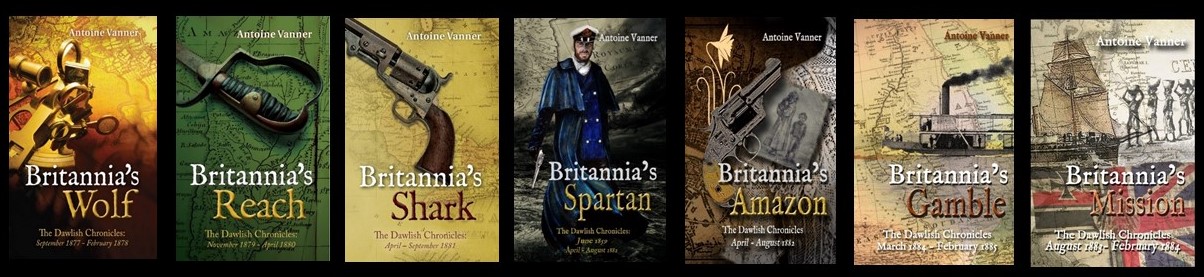
I’m delighted to welcome Antoine Vanner, author of the Dawlish Chronicles, for a return visit to the blog. Set in the late Victorian period, the series of naval adventures are linked closely to real historical events, and sometimes personalities, of the period and in most feature a high degree of moral ambiguity and ethical dilemmas.
The settings vary enormously – the Ottoman Empire, Paraguay, Gilded-Age USA, Cuba, Korea, the Sudan and, in the latest book, East Africa. The period is one of unprecedented social, political, scientific and technological change and the first cracks are appearing in Britain’s position as a leading power. Old animosities with France and Russia persist, Germany, Japan and the United States are emerging as major players.
This is the world in which the Royal Navy officer Nicholas Dawlish (1845-1918) and his formidable wife Florence (1855-1946) must fight for career advancement and social acceptance while still retaining their integrity.
Over to Antoine!
Writing the opening sentence of any novel is likely to be more difficult than producing an entire chapter later. For his masterpiece, The Go-Between L.P. Hartley crafted a superb sentence that has become one of the best known in modern literature, so much so that many who quote it do not know its origin.
“The past is a foreign country: they do things differently there.”
It’s more than a book opening – it should be the motto, the guiding light, the dictum that anyone writing historical fiction should constantly have in mind. It is also however a truth honoured more in the spirit than in the letter. Ignoring it results in novels which are little better than pastiches, pageants populated by twenty-first century characters clad in re-enactors’ costumes and motivated by twenty-first-century values and attitudes.
For the past is indeed a foreign country, even if that past is as recent as the lives of our deceased parents or grandparents. L.P. Hartley’s narrator knows this – he’s an old man, looking back to the England he knew when he was thirteen years old.
It’s not just a question of external detail – writers, like re-enactors, often agonise over achieving absolute accuracy as regards clothing, weapons and everyday articles – for unless the characters’ mindsets are consistent with the values and beliefs of the era portrayed the story will never be convincing.
And those mindsets can be very uncomfortable to enter into
There’s somewhat of a paradox here. It’s not too difficult to achieve realism when portraying psychopathic tyrants or villains – their actions are the embodiment of their malignancy. It’s far harder to admit that a virtuous and admirable individual, whether actual or fictitious, can have held beliefs or values which we find repugnant today, and that they saw nothing wrong, and that it was even admirable, in acting in accordance with them. Seen through the lens of the early twenty-first century – a lens that will itself change significantly in the decades to come – the world-views and preoccupations that governed our ancestors are difficult to comprehend and harder still to reflect in fiction.
Instances abound from every era of history but it’s as good an example as any to take the Early Modern period, say 1450 to 1650. Portrayal of characters in fiction set in this time must take account of the belief of the Devil as an active player in human affairs, often physically manifest, and of hellfire and eternal damnation as appropriate punishments for holding views considered in any way heretical. Regardless of whether regions were dominated by Catholics, Lutherans or Calvinists, the division between temporal and religious authority was blurred, and sometimes non-existent. Persecutions, hideous tortures, massacres, witch hunts and imposition of social control at levels comparable to those in twentieth century totalitarian states, all followed. For a major portion of most populations these measures were considered fully justifiable, even praiseworthy, while for those whose questioning could be regarded as what Orwell later describe as “thought crime” the penalties could be extreme – and seen by most as well justified.
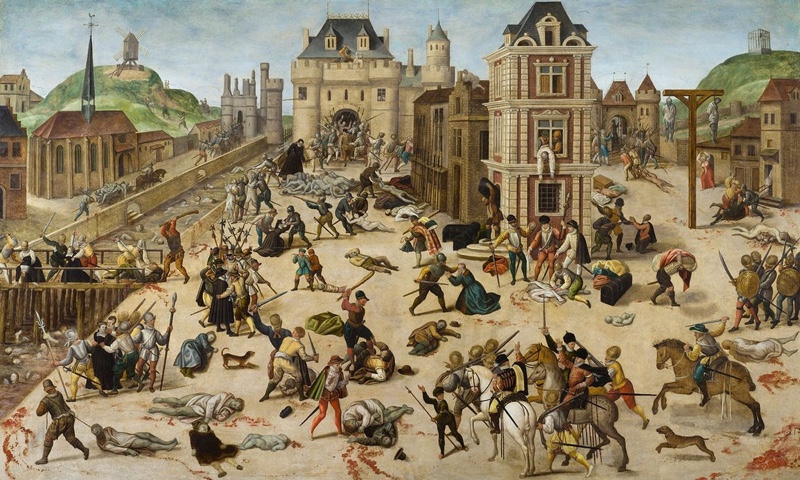 St Batholomew’s Day Massacre 1572 (François Dubois, 1529– 1584). Public domain The believers, fervent or otherwise, were not necessarily evil people but they were complicit in crimes as massive, for example, as the witch hunts that were estimated to have between 40,000 to 60,000 lives in Europe in the 15thand 16thCentury. Nobody was safe from accusations of witchcraft and the fact that the scientific revolution was beginning helped little. Johannes Kepler (1571-1630), the mathematician and astronomer who discovered the laws of planetary motion, spent fourteen months defending his imprisoned mother against the charge of being a witch. This would have ended in her burning had he not been successful – a textbook example of state-sanctioned superstition confronting the earliest stirrings of the still far-off Enlightenment.
Any fiction written about this period needs to face the fact that people who were considered moral – or even enlightened – by the standards of their own day, lived in a climate of fear, not just about the here and now, but about all eternity. To cope with that, they countenanced, supported or actively implemented controls, including torture and savage execution, which one would have thought repugnant to any rational or compassionate human being at any time in history. And yet by their own lights these people saw themselves as decent and upright.
The modern novelist’s dilemma
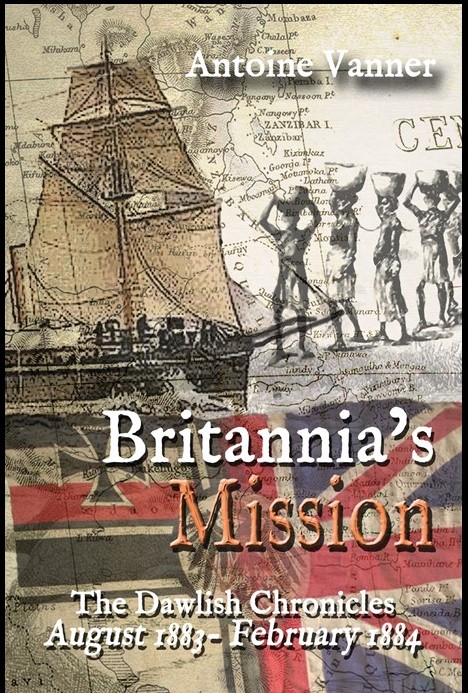
I encountered the problem of getting into the mindsets of a wholly different era when writing my own most recent novel, Britannia’s Mission, the seventh of the Dawlish Chronicles series. Writing as I do about the late nineteenth century, I am always faced with such challenges. In this book however, set in East Africa in 1883, in which the protagonist, the Royal Navy Captain Nicholas Dawlish, must deal with both Catholic and Protestant missionaries, the task was especially daunting. Having lived for many years in Africa I was aware of the massive impact such missionaries had in Sub-Saharan Africa in the late nineteenth and early twentieth centuries, an impact that is still important today. Selfless, indomitable, sometimes naïve but always heroic, often to the point of madness, these missionaries were responsible for the fastest and largest mass-conversion in history. Anyone familiar with contemporary Africa cannot but be impressed by the exuberance and sincerity of the Christianity that flourishes there in so many forms and how integral it is in community life. It is touching also to see how often the memory of missionaries long dead is still revered. But when I came to research these heroic – though somehow forbidding – people in more detail for my book, reading biographies or memoirs, identifying hymns written expressly for the mission field, I was struck by how greatly different they were in thought and behaviour to myself and my contemporaries, even to those of strong religious convictions.
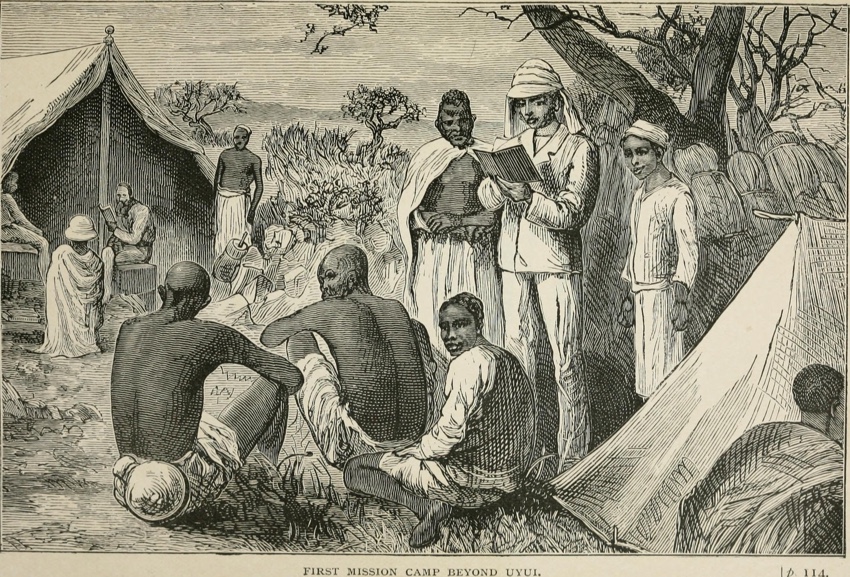 The idealised Victorian ideal of a missionary in Africa – the actuality was considerably less pleasant (Mackay of Uganda). Public domain The missionaries’ legacy
Judged by today’s standards, such 19thCentury missionaries are easy to caricature to the point of ridicule, but they left a legacy not only in the field of religious belief but in medical care, education and raised awareness of the value of human life. Whether poorly educated, as were so many of the men and women from humble backgrounds who volunteered to meet challenges they could barely imagine beforehand – and such people feature in Britannia’s Mission – or representatives of better-funded undertakings by well-established religious bodies – who also feature – they cheerfully accepted the risk of death by violence or disease and the certainty of long years of privation or loneliness. Within the context of a novel of naval adventure, whose other main themes include suppression of the slave trade and the emergence of Imperial Germany as an aspirant colonial power, and featuring conflict on land and on water, I hope that I have done these missionaries justice by the standards of their own time.
And that’s perhaps what we need to aim at in historical fiction. For the past is indeed a foreign country…
Thank you, Antoine. Such strong belief is often difficult for a modern audience to understand, but you have provided a nuanced background to the missionaries’ activities as well as the challenges of writing about them. Currently enjoying this latest Nicholas Dawlish adventure!
What’s Britannia’s Mission about?
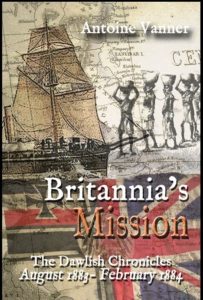 1883: The slave trade flourishes in the Indian Ocean, a profitable trail of death and misery that leads from ravaged African villages to the insatiable markets of Arabia. Britain has been long committed to the trade’s suppression but now a firebrand British preacher is pressing for yet more decisive action. Seen by many as a living saint, but deliberately courting martyrdom, he is forcing the British government’s hand by establishing a mission in the path of the slavers’ raiding columns. His supporters in Britain cannot be ignored and are demanding armed intervention to protect him. 1883: The slave trade flourishes in the Indian Ocean, a profitable trail of death and misery that leads from ravaged African villages to the insatiable markets of Arabia. Britain has been long committed to the trade’s suppression but now a firebrand British preacher is pressing for yet more decisive action. Seen by many as a living saint, but deliberately courting martyrdom, he is forcing the British government’s hand by establishing a mission in the path of the slavers’ raiding columns. His supporters in Britain cannot be ignored and are demanding armed intervention to protect him.
This ostensibly simple task is assigned to Royal Navy Captain Nicholas Dawlish and the crew of the cruiser HMS Leonidas. But this new mission quickly proves that it’s not going to be as straightforward as it seemed back in Britain . . .Two Arab sultanates on the East African coast control access to the interior. Overstretched by commitments elsewhere, Britain is reluctant to occupy these territories but cannot afford to let any other European power do so either. And now the recently-proclaimed German Empire is showing interest in colonial expansion, and its young navy is making its appearance on the world stage . . .
“Antoine Vanner is the Tom Clancy of historical naval fiction” – Author and nautical historian Joan Druett
Amazon UK Amazon US
Watch a video in which Antoine discusses Britannia’s Mission!
Connect with Antoine:
The Dawlish Chronicles: https://dawlishchronicles.com
Twitter: @AntoineVanner https://twitter.com/AntoineVanner
Facebook: https://www.facebook.com/DawlishChronicles/
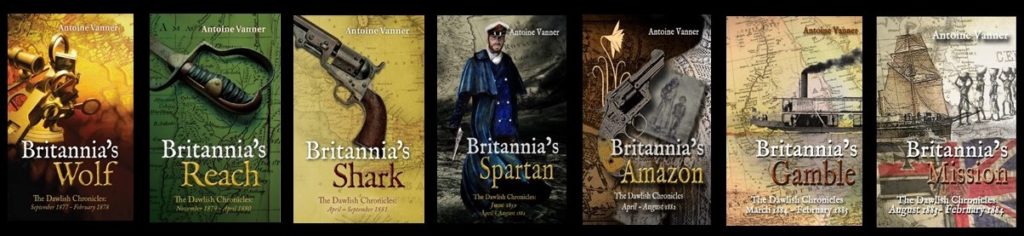
All seven (to date) Dawlish Chronicles are available in paperback or kindle formats – and subscribers to Kindle Unlimited and Kindle Prime can read them for no extra charge. Click here for details: https://amzn.to/2PlEraR
Alison Morton is the author of Roma Nova thrillers – INCEPTIO, PERFIDITAS, SUCCESSIO, AURELIA, INSURRECTIO and RETALIO. CARINA, a novella, and ROMA NOVA EXTRA, a collection of short stories, are now available. Audiobooks are available for four of the series. NEXUS, an Aurelia Mitela novella, will be out on 12 September 2019.
Find out more about Roma Nova, its origins, stories and heroines… Download ‘Welcome to Roma Nova’, a FREE eBook, as a thank you gift when you sign up to Alison’s monthly email newsletter. You’ll also be first to know about Roma Nova news and book progress before everybody else, and take part in giveaways.
If you enjoyed this post, do share it with your friends!
 Today my guest is Stephanie Churchill, author of The Scribe’s Daughter and The King’s Daughter. Today my guest is Stephanie Churchill, author of The Scribe’s Daughter and The King’s Daughter.
Being first and foremost a lover of history, Stephanie’s writing draws on her knowledge of history even while set in purely fictional places existing only in her imagination.
Inspired by gothic romance novels like Jane Eyre, epic fantasy stories like The Lord of the Rings and The Game of Thrones, as well as the historical fiction of authors like Sharon Kay Penman, Anya Seton and Bernard Cornwell, Stephanie’s books are filled with action and romance, loyalty and betrayal. Her blend of historical-feeling fantasy fiction combined with elements of gothic romance ensures that her books should please readers of historical fiction and epic fantasy literature alike.
Stephanie grew up in Lincoln, Nebraska in the US. After graduating from college, she worked as an international trade and antitrust paralegal in Washington, D.C. She now lives with her husband, their two children, and her dog-who-thinks-he-is-a-child in Minneapolis, Minnesota.
Over to you, Stephanie!
“I was pretty clueless the day I started my first book. The Scribe’s Daughter, began as an experiment. I had written two other full-length manuscripts, but I didn’t love the voice in either of them so abandoned them. What, I asked myself, would happen if I wrote from a first-person perspective? As it turns out, a published book, apparently. I hadn’t intended my experiment to turn into a book, but once I discovered the magic of first person, the spark ignited, and that fire produced something worth publishing.

That’s how my writing journey started, but as I befriend more and more authors over the years, I’ve discovered just how odd my path to authorship was. Most people know they want to be a writer before they write a book. They know it at an early age and pursue that goal by pursuing an education – either formally or informally.
I wanted to go to law school and didn’t get a clue until I was in my thirties.
Most authors practice the craft of writing during those early years by writing. Many of them write their first book as teenagers.
I just read other people’s books.
Other authors create a neat plan to publish a series, write full drafts of each novel, build a platform, plan a release, then have an accelerated launch into authorship, one book at a time, one year at a time.
 I wrote a scene, then another scene, and those scenes turned into a book, and then I decided to write a second book, but that book was really tough because I’d written myself into several corners with the first (unplanned) book, so I had to fix those problems, and oh-by-the-way I need a platform, so let’s make one of those, and I probably should write a couple of blog posts and then maybe write some guest posts for other people in order to do some marketing and promotion which I really should do too, and hey, wouldn’t it be great to write a third book… (big gasp for air) I wrote a scene, then another scene, and those scenes turned into a book, and then I decided to write a second book, but that book was really tough because I’d written myself into several corners with the first (unplanned) book, so I had to fix those problems, and oh-by-the-way I need a platform, so let’s make one of those, and I probably should write a couple of blog posts and then maybe write some guest posts for other people in order to do some marketing and promotion which I really should do too, and hey, wouldn’t it be great to write a third book… (big gasp for air)
I like to think it’s worked out well enough, but I don’t recommend “The Stephanie Churchill Method of Becoming an Author” for most people. That being said, the reality for me was that I likely would not have stumbled upon the path except the backward way.
 A wiser method, and the more commonly recommended one, is the way my friend Kim Barton is doing it. She knew from an early age she wanted to write. And now years into it, she is still writing her trilogy. She planned out all three books, wrote and is now editing all of them, and she still hasn’t published one. Despite the successes of those around her, the sales figures and the communal excitement, she is staying focused. Yes, she tells me, it’s really, really hard not to be impatient. She is dying to see her name on a book, but her path will be trekked with patience. A wiser method, and the more commonly recommended one, is the way my friend Kim Barton is doing it. She knew from an early age she wanted to write. And now years into it, she is still writing her trilogy. She planned out all three books, wrote and is now editing all of them, and she still hasn’t published one. Despite the successes of those around her, the sales figures and the communal excitement, she is staying focused. Yes, she tells me, it’s really, really hard not to be impatient. She is dying to see her name on a book, but her path will be trekked with patience.
Now that I know these things, I can appreciate the benefits of planning:
- You know ahead of time the who, what, when, where and why of each and every character and plot element. You won’t write yourself into a corner (raises hand) like I did.
- You can publish each book in the series more quickly following the last one, thereby leveraging the momentum by building readership and sales.
- It’s easier to sell the idea of a series to an agent or publisher because they can see that you have more books in you, making you a better investment.
This is all well and good, but it wouldn’t have worked like this for me. I had to do it backward because I didn’t know I could write a book and publish it until I wrote a book and published it. The process was the teacher for me, and the thing I needed most was the confidence that completion produced. I had to do what I did to know I could do what I did.
 And for the maybe half percent of the writers out there who might need to work like me, I just want you to know it’s okay. If you need to work on your book, hoping to make it good enough to publish, all the while doing it without foggiest idea what you’re doing… If you need to write the book so you know you can even write a book… If you need to write the book to gain the confidence necessary to think about what comes next… And for the maybe half percent of the writers out there who might need to work like me, I just want you to know it’s okay. If you need to work on your book, hoping to make it good enough to publish, all the while doing it without foggiest idea what you’re doing… If you need to write the book so you know you can even write a book… If you need to write the book to gain the confidence necessary to think about what comes next…
It’s okay if you don’t have a plan, if you don’t think you are any good.
Just write the book and see what happens. You might discover you are an author.”
Thank you, Stephanie! I think there are as many ways to write a book as there are authors. 😉
Connect with Stephanie
Website: www.stephaniechurchillauthor.com
Facebook: www.facebook.com/StephanieChurchillAuthor
Twitter: https://twitter.com/WriterChurchill
What’s The Scribe’s Daughter about?
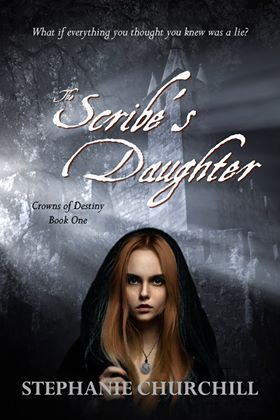
“My name is Kassia, and I am reckless. Or at least my sister, Irisa, would have you think so. Maybe she’s right, but my recklessness helped us survive as orphans on the dusty streets of the Imperial city of Corium.
Everything changed the day a stranger showed up at our market stall to hire me to complete a task beyond my abilities.
I probably should have asked more questions, because my decision set into motion a series of events that would change my life forever.”
Buy from Amazon UK Amazon US
Alison Morton is the author of Roma Nova thrillers – INCEPTIO, PERFIDITAS, SUCCESSIO, AURELIA, INSURRECTIO and RETALIO. CARINA, a novella, and ROMA NOVA EXTRA, a collection of short stories, are now available. Audiobooks are available for the first four of the series.
Get INCEPTIO, the series starter, FREE as a thank you gift when you sign up to Alison’s monthly email newsletter. You’ll also be first to know about Roma Nova news and book progress before everybody else, and take part in giveaways.
If you enjoyed this post, do share it with your friends!
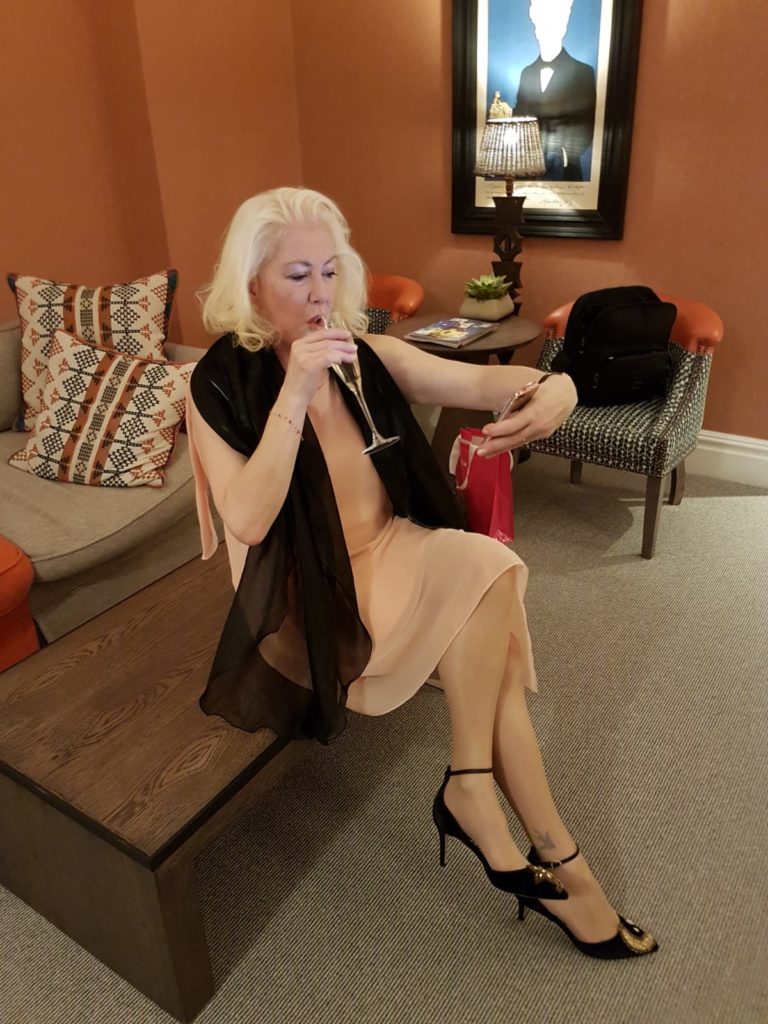 Jill in characteristic occupation As a child, Jill read so obsessively she got kicked out of the school library. But her passion for words continued. She graduated in English Literature and Theatre Studies from the University of Wales and set up a theatre company.
Since then, as an actor, director, teacher, writer and journalist, she’s worked in fifteen countries. Now, with her husband and three dogs, Jill lives in Switzerland, a country with four languages and mountains of new words.
Jill is a founder member of Triskele Books, European correspondent for Words with JAM magazine, co-edits Swiss literary hub The Woolf and writes European crime novels The Beatrice Stubbs Series. And she still reads.
Over to Jill…
“Three years of studying what?!”
You don’t need to go to university, love, you’re already a drama queen!”
“What’s the first thing a graduate says after getting an arts degree? You want fries with that?”
My choice of degree – Joint Honours in Drama and English – gave the locals at my parents’ pub hours of amusement. Even more so after my first term when I proudly came home and demonstrated my new skill: fire-eating.
But after three years of studying theatre and English literature, I can honestly say I used what I learnt in every job I’ve had. Obviously, as an actor and director, certainly as a teacher and trainer, undoubtedly as a journalist. But never more so than as a crime writer.
I know what you’re thinking. Character and dialogue come easily to someone with a background in theatre. To a point, yes. But for me, the real benefit is constructing a story.
Most writers are familiar with the three-act structure (terms and amount of story they take up may vary). Here’s my loose rule of thumb:
 Photo by Alessia Cocconi on Unsplash Inciting Incident (II): Act One (20%)
Here is where we build storyworld, introduce character and set the scene. The status quo is established and rapidly changed. Give our MC (main character) two things: Drive and Danger.
Progressive Complications (PC): Act Two (60%)
MC chases Drive, often thwarted by Danger. Build character, settings and relationships to environment, while keeping the hand on the Drive.
Climax and Conclusion (CC): Act Three (20%)
Crunch time. MC faces Nemesis, wins or loses. Or maybe just learns. After winding tension to snapping point, a moment to observe the change. Curtain call.
All in all, a very well-made play. How can we deepen that and add layers so the rhythm of tension, relief, curiosity, concern and plain old drama never feels repetitive or stale?
There are as many answers to that question as there are authors. My method? Multiply by three.
When sketching out a Beatrice Stubbs novel, I have three key plots. Plot A is usually the main crime story involving villain(s) and detectives. Plot B is the counterpoint, perhaps a secondary investigation which comes to bear on Plot A, or a character journey which influences emotions. The third plot is nearly always a clash of personalities, sometimes key players, sometimes secondary characters. Each has its Inciting Incident, Progressive Complications, and Climax & Conclusion.
But not at the same time
These three storylines con be conducted as instruments in an orchestra. One story begins alone and is soon joined by another. Their rhythms work in counterpoint, so when one storyline is downbeat, the other flies upwards. Adding to the harmony is the third narrative. This carries a tension and development of its own, lifting any lulls and offering the reader a rest and maybe even a smile.
Each thread starts and ends at a different point, so plots B and C fade out before the end, allowing the soloist centre stage. Here’s an example from the second in the series, Raw Material.
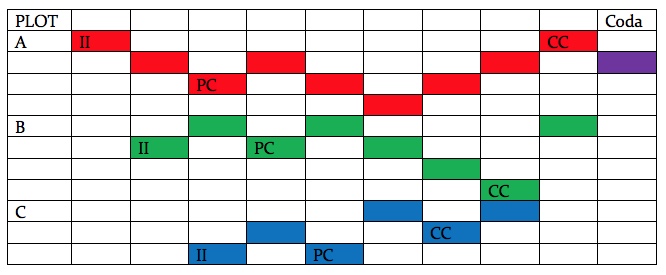
In this diagram, you can see the main plot dominates, its Inciting Incident at the beginning and its dénouement at the end. The other two stories weave in and out but are completed before Plot A ends. The final scene, or coda, may include elements of Plots B and/or C so that all unanswered questions are satisfied.
 Photo by Michael D Beckwith on Unsplash Storytelling structure is an instinctive part of all of us and readers have inbuilt expectations. Sure, authors have every right to defy those, bend the rules and create something entirely unexpected. How else will fiction grow and develop to fit our times?
After eight books, I’m still learning the rules. Only when I’ve mastered the techniques of powerful storytelling can I dismiss them.
Exits stage right.
Great performance, Jill! Take a well-deserved bow.
––––––
Find out more about Jill
Website: www.beatrice-stubbs.com Twitter: @JJMarsh1 Facebook: Beatrice Stubbs Page
––––––
Read Jill’s latest featuring Beatrice Stubbs…
SNOW ANGEL
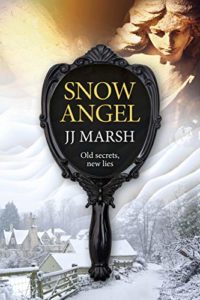 Love is a driving passion. So is hate. Love is a driving passion. So is hate.
December in a small Devonshire village is the perfect time for a Yuletide festival, a Narnian wedding or a murder.
Now retired, Beatrice is working on a book, planning a wedding and pretending she doesn’t miss the cut and thrust of Scotland Yard.
When a local celebrity dies in suspicious circumstances, Matthew encourages Beatrice to do some private investigating. Her enquiries reveal more than predicted and she discovers even her nearest and dearest are capable of deceit.
A snowstorm hits the village and Beatrice chases a lead, throwing everyone’s plans into disarray and threatening lives. The ancient forest conceals a primeval web of complex loyalties and lethal bonds.
Angels protect their friends. But destroy their enemies.
Buy at Amazon UK Amazon US
Your host, Alison Morton, is the author of Roma Nova thrillers INCEPTIO, PERFIDITAS, SUCCESSIO, AURELIA, INSURRECTIO and RETALIO. CARINA, a novella, and ROMA NOVA EXTRA, a collection of short stories, are now available. Audiobooks are available for the first four of the series.
Find out more about Roma Nova, its origins, stories and heroines… Get INCEPTIO, the series starter, FREE as a thank you gift when you sign up to Alison’s monthly email newsletter
If you enjoyed this post, do share it with your friends!
 On 4 March 2010, I wrote my first ever blogpost. It wasn’t startling, nor was it particularly erudite. I followed it up with thirteen more posts that month. Unfortunately, any ‘Likes’ and comments were obliterated when we suffered a major backup disaster in 2016. I wept, but some followers were kind enough to go back and ‘Like’ and new followers have discovered some of the older posts. Thank you! On 4 March 2010, I wrote my first ever blogpost. It wasn’t startling, nor was it particularly erudite. I followed it up with thirteen more posts that month. Unfortunately, any ‘Likes’ and comments were obliterated when we suffered a major backup disaster in 2016. I wept, but some followers were kind enough to go back and ‘Like’ and new followers have discovered some of the older posts. Thank you!
But something else has been happening… My site statistics for this and the Roma Nova blog have remained reasonably healthy, growing steadily with the odd huge peak here and there. So far so good. My burblings must be of interest or even amusement. But comments are few.
I am not alone. Other author blogs, product blogs, even revered institutional blogs are receiving fewer comments or even ‘Likes’.
 Now I don’t want you to get the violins out. In these time-strapped days, we have to be selective. However, there’s a very unfortunate trend developing and becoming increasingly prevalent – blog-snubbing (my word for it). Now I don’t want you to get the violins out. In these time-strapped days, we have to be selective. However, there’s a very unfortunate trend developing and becoming increasingly prevalent – blog-snubbing (my word for it).
When I publish my piece here or on the Roma Nova blog, it’s posted automatically to Twitter and Linked In. I post it to Facebook manually as I like to add a few words of introduction/temptation to accompany the link. I also post in other relevant Facebook groups depending on the content. Facebook very kindly notifies me if somebody has commented. “Great.” I think. “Time for some conversation!”
But… (You know me well!)
If somebody has commented on Facebook or Twitter saying “Thank you” or its equivalent, I’m very happy that they’ve enjoyed the post. It’s very gratifying they’ve noticed it and found something of interest in it.
But when the commenter on Facebook/Twitter has only replied to my introduction/temptation and in a superior tone or (more often) in an uninformed way, merely repeating what I said in my blogpost, I despair.
 Because I’m well-brought up, I resist the urge to be sarcastic and agree in a ‘hearts-and-flowers’ tone that that’s precisely what I was getting at. Because I’m well-brought up, I resist the urge to be sarcastic and agree in a ‘hearts-and-flowers’ tone that that’s precisely what I was getting at.
Then I ask them a supplementary which they would only be able to answer if they’d actually read the blog post, e.g. “And what did you think about my idea of how XYZ developed from there?” Either it’s ignored or they say “Oh, I didn’t read the post – I haven’t got time for that.”
Then why the —— did you comment in such a silly way?
Don’t get me wrong; I don’t ask people to read my blog or study it. It’s entirely up to them. I don’t have that big an ego. However, I’m delighted if they do as I try to write sensible and informative content without being over-long or boring. I always reply to comments below the blogpost as readers have made a positive effort to join in the conversation.
And commenting on a blog will bring a little glow to the author’s soul and inspire them to go on and write more.
Comments welcome!
If you did click through from social media to this post, I will send you a free ebook of any of my Roma Nova novels as a thank you if you leave a comment, however short. Include in your comment which book you would like. It’s just to see who actually does this when I post on Facebook/Twitter. 😉
You can, if you like, sign up to receive blogposts from this blog by completing the box in the right-hand column.
Alison Morton is the author of Roma Nova thrillers – INCEPTIO, PERFIDITAS, SUCCESSIO, AURELIA, INSURRECTIO and RETALIO. CARINA, a novella, and ROMA NOVA EXTRA, a collection of short stories, are now available. Audiobooks are available for four of the series. NEXUS, an Aurelia Mitela novella, will be out on 12 September 2019.
Find out more about Roma Nova, its origins, stories and heroines… Download ‘Welcome to Roma Nova’, a FREE eBook, as a thank you gift when you sign up to Alison’s monthly email newsletter. You’ll also be first to know about Roma Nova news and book progress before everybody else, and take part in giveaways.
If you enjoyed this post, do share it with your friends!
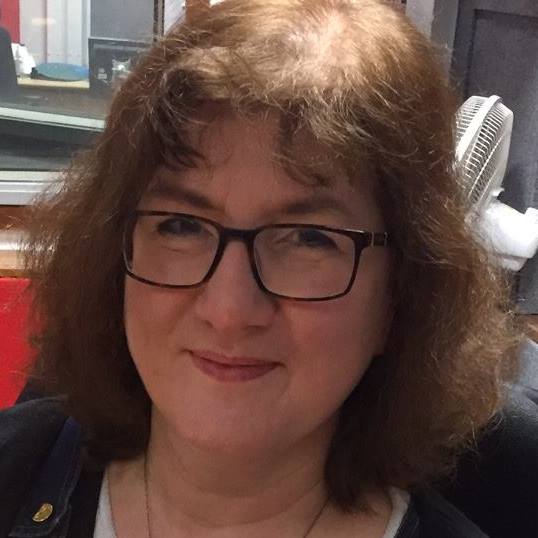 Photo: Dominic Cotter 2017 Today, my blog guest is Debbie Young writer of warm, witty, feel-good contemporary fiction inspired by life in the English village where she’s lived for nearly thirty years. Her Sophie Sayers Village Mystery’series begins with ‘Best Murder in Show’ and, when complete, will run the course of a calendar year in the life of a classic English Cotswold village. The fifth in the planned series of seven novels, ‘Springtime for Murder’, will launch on 15 November 2018.
She’s also writing the first in a new trilogy of novels, ‘Flat Chance’, first in the Staffroom at St Bride’s trilogy, set in the staffroom of an English girls’ boarding school. Will there be any dead bodies lurking in the dorms? You’ll have to wait to find out!
In her less frivolous moments, Debbie is the commissioning editor for the Alliance of Independent Authors’ blog.
Over to Debbie!
“The funniest opening line of a novel, period,” says crime writer Wendy H Jones of Murder in the Manger, the third in my Sophie Sayers Village Mystery series.
It’s not only in the opening chapter of my books that you’ll find such humour. One reviewer described them as “a chuckle on every page”, another as “Bridget Jones meets Miss Marple”.
“But hang on, aren’t you a crime writer?” I hear you cry.
Yes, but I write cozy crime (as our US friends like to spell it), rather than more straight-faced novels such as police procedurals. In my books, humour is a foil to the darker side of the story, and a seam of warm amusement at the world runs through all my books.
I don’t know about you, but for me, cozy crime feels more realistic to me than, say, Nordic Noir or a psychological thriller. I don’t think I’ve ever gone through a day without a laugh and a smile – though thankfully murders have so far passed me by.
Perhaps this is because, in my normal daily life, humour is such a valuable tool to get me through the day. Humour helps me process and deal with grim news and challenging events.
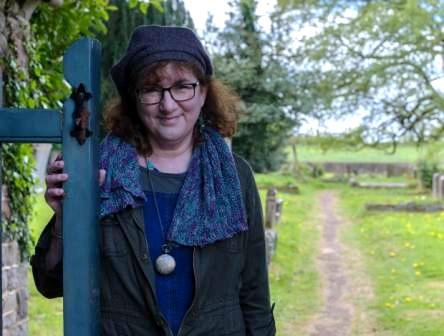 Debbie Young in the graveyard Photo: Angela Fitch I think I’m in good company. Think of the black humour deployed by medics, funeral directors and others who deal daily with grim diagnoses and death. Back when hanging was still a legal punishment, we also had gallows humour.
Not to mention Shakespeare. Macbeth, for example, is a grim play of ruthless and bloody murder. Though we are horrified by the murder of Duncan, we laugh out loud – and are glad to and need to – at the porter’s comic antics.
To take a more modern example, I find it interesting that the cast hugely successful recent televisation of Sherlock Holmes is full of comedy greats – Benedict Cumberbatch (Cabin Pressure), Martin Freeman (The Office) and Una Stubbs (Till Death Us Do Part). Each actor’s lines are sprinkled with witty asides and one-liners. This humour humanises them all, making it easier for us to relate even to the strangely unemotional Holmes, and to deal with the atrocities at the heart of each plot. Yet it doesn’t detract from the seriousness of the crimes at the heart of the stories, nor diminish our longing for justice.
Shakespeare and Sherlock get the balance right, creating a symbiotic relationship between serious and comic scenes, and I aim to do the same in my Sophie Sayers Village Mysteries.
- In Murder in the Manger, which runs from November 6ththrough to Christmas Eve, the cheery opening quickly gives way to the story’s central mystery: a stranger accuses the congregation of abducting her baby. This heart-breaking crime is all the more poignant when set in the parish church, a traditional sanctuary, in the season of goodwill, and during a comical performance of the nativity play by innocent children.
- Elsewhere in the novel, comedy moments run counterpoint to a respectful and serious scene set at the village school’s Remembrance Day service, echoing central themes of love, loss and reconciliation.
- In the previous book, Trick or Murder?, running from Halloween to Guy Fawkes’ Night, a reflective scene at the village church at the All Souls’ Day service is all the more powerful for being surrounded by comic encounters between the villagers and the sinister new vicar.
Used wisely, humour in crime adds warmth and depth to help us relate to, absorb and ultimately learn from the story.
Not that I’m suggesting that all crime writing should feature comedy, nor that there’s anything lacking in mysteries that don’t set out to raise a smile. But for optimistic extraverts like me, humorous crime writing is my comfort zone as both writer and reader (and law-abiding citizen). And that’s why it makes my day whenever a reviewer, like Wendy H Jones, really gets my jokes.
So, are you wondering what that opening line is that Wendy liked so much?
It was when the stable animals developed the power of speech that I realised the cast were departing from my nativity play script.
“Do you think your baby Jesus would like a cuddle, Mrs Virgin?” asked a small sheep politely.
“Hoi, first go for shepherds!” said an older boy with a tea-towel on his head, elbowing the sheep aside.
The small sheep scowled. “I asked first.”
A larger sheep pointed accusingly at Mary. “She’s the virgin around here. I think she should make you take turns nicely.”
The small sheep and the shepherd made a dash across the stable floor, both arriving at the manger at the same time and grabbing the Baby Jesus. The plastic doll fell in pieces to the flagstone floor, leaving the shepherd holding its left leg and the sheep its head. The congregation gasped in horror.
The larger sheep put his hands on his hips. “Now look what you’ve done. You’ve broken Baby Jesus.”
And if you’d like to find out what happens next, Murder in the Manger is now available from Amazon as a Kindle ebook and paperback from Amazon or any other online retailer or through your favourite bookshop (quote ISBN 9781911223221).
—————————–
 When Sophie Sayers’ plans for a cosy English country Christmas are interrupted by the arrival of her ex-boyfriend, her troubles are only just beginning. Before long, the whole village stands accused of murder. When Sophie Sayers’ plans for a cosy English country Christmas are interrupted by the arrival of her ex-boyfriend, her troubles are only just beginning. Before long, the whole village stands accused of murder.
Damian says he’s come to direct the village nativity play, but Sophie thinks he’s up to no good.
What are those noises coming from his van?
Who is the stranger lurking in the shadows?
And whose baby, abandoned in the manger, disappears in plain sight?
Enjoy the fun of a traditional Cotswold festive season, with echoes of Dickens’ A Christmas Carol, as Sophie seeks a happy ending for her latest village mystery – and for her new romance with charming local bookseller Hector Munro.Twitter:
Ebook: Amazon Kindle Paperback: Online – Amazon or other stores, or through your favourite local bookshop, quote ISBN 9781911223221
Connect with Debbie:
Website: www.authordebbieyoung.com
Twitter: www.twitter.com/DebbieYoungBN (@DebbieYoungBN)
Facebook: www.facebook.com/AuthorDebbieYoung
If you’d like to know when Debbie is about to publish a new book, you can join her Readers’ Club via her author website.
Alison Morton is the author of Roma Nova thrillers INCEPTIO, PERFIDITAS, SUCCESSIO, AURELIA, INSURRECTIO and RETALIO.CARINA, a novella, and ROMA NOVA EXTRA, a collection of short stories, are now available. Audiobooks are available for the first four of the series.
Find out more about Roma Nova, its origins, stories and heroines… Get INCEPTIO, the series starter, FREE as a thank you gift when you sign up to Alison’s monthly email newsletter
If you enjoyed this post, do share it with your friends!
|
Subscribe to Blog via Email
Join 368 other subscribers.
Categories
Archive
|
 1883: The slave trade flourishes in the Indian Ocean, a profitable trail of death and misery that leads from ravaged African villages to the insatiable markets of Arabia. Britain has been long committed to the trade’s suppression but now a firebrand British preacher is pressing for yet more decisive action. Seen by many as a living saint, but deliberately courting martyrdom, he is forcing the British government’s hand by establishing a mission in the path of the slavers’ raiding columns. His supporters in Britain cannot be ignored and are demanding armed intervention to protect him.