
I’m delighted to welcome Elizabeth St John back to the writing blog on the occasion of the launch of her new book, The Queen’s Tears. Her acclaimed historical fiction brings to life her ancestors – remarkable women linked to England’s royalty – and offers unique insights into Medieval, Tudor and Stuart times. Her novels unfold not just as traditional series, but as an interlocking web of lives: The Lydiard Chronicles – including the celebrated The Lady of the Tower – The Godmother’s Secret, and The King’s Intelligencer explore everything from the English Civil War to the mystery of the Princes in the Tower. Her newest novel, The Queen’s Tears, a dual timeline pursuing a stolen crown jewel, reunites favourite characters from the seventeenth-century with a present-day bookstore owner heroine.
At the heart of her writing is the transformation of real ancestral histories into narratives of historical continuity. She follows threads of legacy through generations, guided as much by wills, letters, portraits, country churches, ruined castles, manor houses, and lost gardens as by imagination. Locations become constant companions through time, while characters whisper across centuries—their decisions resonating in the lives of their descendants to reveal how choices shape legacies. Grounded in historic sites like Lydiard Park and the Tower of London, her work creates a living archival flow that continues to flourish as the past yields its secrets.
Elizabeth divides her time between California, England, and the past, surrounded by books, gardens, and animals, with a slightly bewildered, ever-supportive husband beside her.
When I received an advance copy of The Queen’s Tears, I was delighted with the dual timeline element. As you know, I love a bit of time twisting! When invited to host Elizabeth during her Coffee Pot Book Club tour, I had to ask her why she decided to write two timelines – a departure from her usual historical fiction!
Here she tells us why a jewel hunt and an enigmatic Van Dyck portrait evolved into a book with a theme of time.
I didn’t set out to write a book about time, but perhaps since this is my first dual timeline novel, it was inevitable it would become a preoccupation. In The Queen’s Tears, I set out to write about a mis-labelled Van Dyck portrait and a stolen crown jewel. But not long after I started, I realised that time was taking over and threading its way through the story as a recurring theme.
Although I wrote it after the historical, I had an outline for the modern story in my mind and that already laid the groundwork for the story. Julia and Oliver had parted in sorrow and neither of them are thrilled to find themselves thrown back together after thirty years. The only thing that has brought them back into the same room is the hunt for the Queen’s Tears, a remarkable lost royal jewel. They get on with it reluctantly, and the French proverb that sums up how they cope is Donner du temps au temps. Give time to time. Which is very good advice, but extremely hard to follow when you’re standing next to the last person in the world you want to see again.
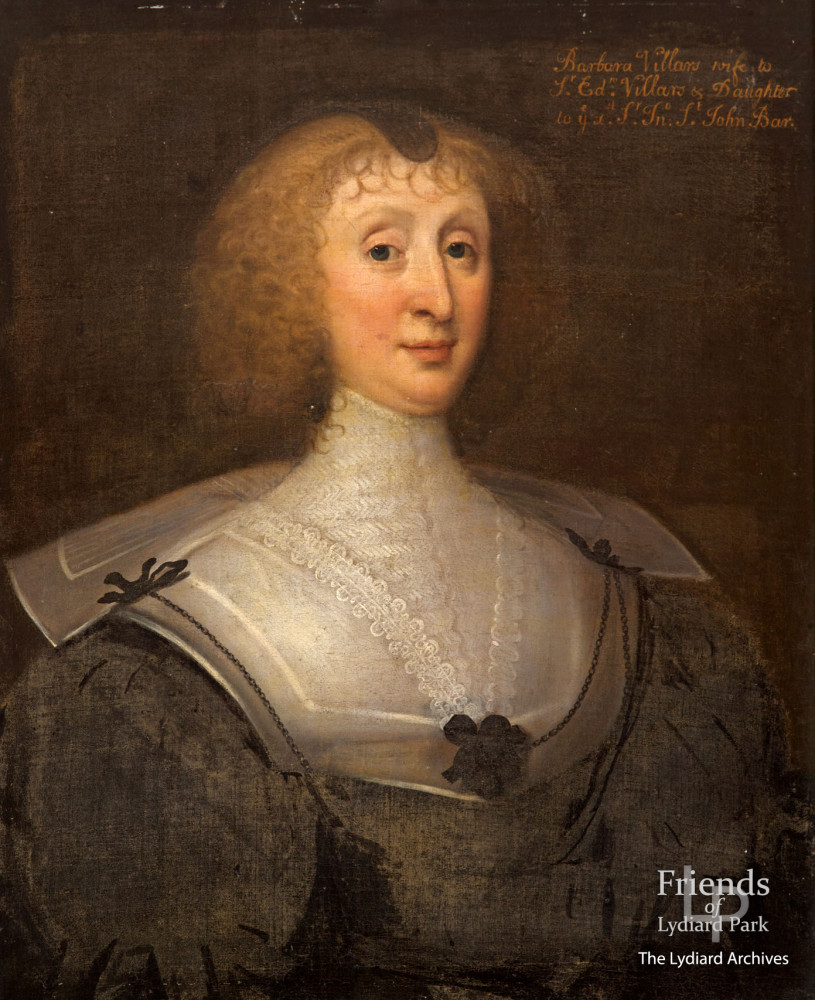
Barbara St John Villiers (Courtesy of the Lydiard Archives)
In 1619, Barbara Villiers would have had no patience with the phrase. Time was her enemy. We forget that in the 1600s nobody checked their wristwatch. (Actually, they don’t again now, either!) Clocks were rare and expensive, so church bells and daylight and the seasons gave you a sense of time. A letter carrying terrible news moved at the gait of an exhausted horse. A queen could die in a locked bedchamber over a night, a day and another night, with no sense of when it would be over. And a week’s journey to a foreign land with stolen property could drag like a lifetime.
Barbara spends much of the book feeling betrayed by time. When she most wants to hurry, it dawdles like a disobedient child. When she’s waiting and not knowing, each day rolls the same, and she’s suddenly lost whole months while she’s busy getting through them. She wishes she could control time. Or at least she’d settle for not feeling so helpless about it.
The other challenge in writing this dual timeline was when I looked at the structure. The modern story takes place over months. The historical one runs for decades. I needed to weave both together, without confusing the reader, and keep the echoes and mirrors and reflective themes to knit the story together. Most critically, decisions made in the past cast a shadow over discoveries in the present. I spent a good while embroidering the threads between the stores, occasionally unpicking and restitching if time betrayed the characters or the story.
I started using the word liminal, and although my wonderful editor flagged a couple of occasions where I may have used it too often, it still for me described the sense I wanted to convey. A liminal space is neither here nor there, a threshold, a blurred horizon, when you’re neither in one place nor the other. I used it when the mechanical measuring of time fades and emotions take over: a deathbed flickering under a lightning storm, a discovery in a quiet archive in a foreign library, a portrait that reveals secrets after four hundred years of anonymity. In those scenes, the clock literally stops. Time is measured by what people felt and what it cost them, which if you think about it, it’s how we mostly look at time anyway. Think of your worst ever year. It went on forever. Think of your happiest. It was over in a flash.
In The Queen’s Tears, both women encounter time twisting, four centuries apart. Neither can control it. But they are aware of its pull on their lives. And what they can do is decide what to do with it and whether they get that right is, I hope, why you’ll keep turning the pages.
Thank you, Elizabeth. Time governs us all, but your description of the varied way we perceive it, resonates very well with me and I’m sure with the readers.
Connect with Elizabeth
Website: https://www.elizabethjstjohn.com/
Twitter / X: https://x.com/ElizStJohn
Facebook: https://www.facebook.com/ElizabethJStJohn/
Instagram: https://www.instagram.com/elizabethjstjohn/
Bluesky: https://bsky.app/profile/elizabethstjohn.bsky.social
Book Bub: https://www.bookbub.com/profile/elizabeth-st-john
Threads: https://www.threads.com/@elizabethjstjohn
Amazon Author Page: https://geni.us/AmazonElizabethStJohn
Goodreads: https://geni.us/GoodreadsElizStJohn
Linked In: https://www.linkedin.com/in/elizabethjstjohn/
————–
What’s The Queen’s Tears about?
 A stolen crown jewel and an enigmatic portrait force two women to confront the devastating choices they made for love – and summon the courage to live with the truth.
1619: Barbara, Lady Villiers, at the bidding of her brother-in-law, the Duke of Buckingham, has stolen the dying Queen Anna’s jewels – and kept the greatest prize for herself. The Queen’s Tears, a brooch of extraordinary value, torments her: too dangerous to sell, too priceless to discard, and possibly her only means of securing her children’s future.
When the family fortunes are shattered, Barbara faces an impossible choice: remain loyal to Buckingham—or betray him by confessing the theft to King Charles.
Present Day: Julia Darke opens her Cotswolds bookshop to start life over peacefully. Instead, a Van Dyck portrait of Barbara’s daughter, with tantalising signs of the missing Queen’s Tears hidden in plain sight, brings her face-to-face with Oliver Villiers, the Oxford art conservator she once loved and walked away from.
Reluctantly drawn together to uncover Barbara’s secret, Julia and Oliver follow the trail of the Queen’s Tears—and the closer Julia comes to Barbara’s truth, the harder it becomes to hide from her own.
Inspired by the true stories of Queen Anna of Denmark’s stolen jewels and a missing Van Dyck painting, The Queen’s Tears weaves history, fiction, and family research across the centuries. Readers of The Lydiard Chronicles will find old favourites—and a new heroine following in their footsteps.
Buy The Queen’s Tears here: https://geni.us/TheQueensTears
You can also read it on #KindleUnlimited.
My thoughts
I confess I’m a fussy reader, but I know that I am safe in Elizabeth St John’s hands. In a departure from her pure historical fiction she has taken a gamble in writing a dual timeline story. My goodness, she has suceeded brilliantly!
Every single character is vivid, whether as the determined and ambitious 17th century Barbara, the emotionally fragile Julia or the sensitive but shielding Oliver. Even her side characters such as Oliver’s son, Alexander, or the spiteful rival Vivienne, are beautifully drawn.
As in any St John novel, the rich period detail is obviously well-researched, but so deftly woven into the story that you are immersed effortlessly in the atmosphere of a royal reception room, Oliver’s art gallery or home, or in Julia’s bookshop.
But one of the most intriguing aspects of this story is that just when you think you have solved the mystery, another challenge appears, another twist in the search. If you think it’s going to glide along an easy predictable path, think again. And that’s one of the aspects that keeps you gripped to the end. Highly recommended!
Alison Morton is the author of Roma Nova thrillers – INCEPTIO, CARINA (novella), PERFIDITAS, SUCCESSIO, AURELIA, NEXUS (novella), INSURRECTIO and RETALIO, and ROMA NOVA EXTRA, a collection of short stories. JULIA PRIMA and EXSILIUM, set in the late 4th century, tell the story of Roma Nova’s foundation. Audiobooks are available for four of the series. Double Identity, Double Pursuit and Double Stakes form a new contemporary thriller series. A new collection of Roma Nova short stories, HEROICA, is now out.
Find out more about Roma Nova, its origins, stories and heroines and taste world the latest contemporary thriller Double Identity… Download ‘Welcome to Alison Morton’s Thriller Worlds’, a FREE eBook, as a thank you gift when you sign up to Alison’s monthly email update. As a result, you’ll be among the first to know about news and book progress before everybody else, and take part in giveaways.








Thanks for the lovely post, Alison. Your question on “time twisting” really got me thinking about the differences – and similarities – in how time impacts our lives, both in the past and the present. (And wonderful memories of asking for a Tardis for Christmas when I was little!).
And I so appreciate the fabulous review. I’m so glad you enjoyed all the “twists” and turns my characters endured!
I thoroughly enjoyed reading it, so it was a complete pleasure. Yes, time is a very peculiar idea and our attempt to capture it fairly futile. 😉