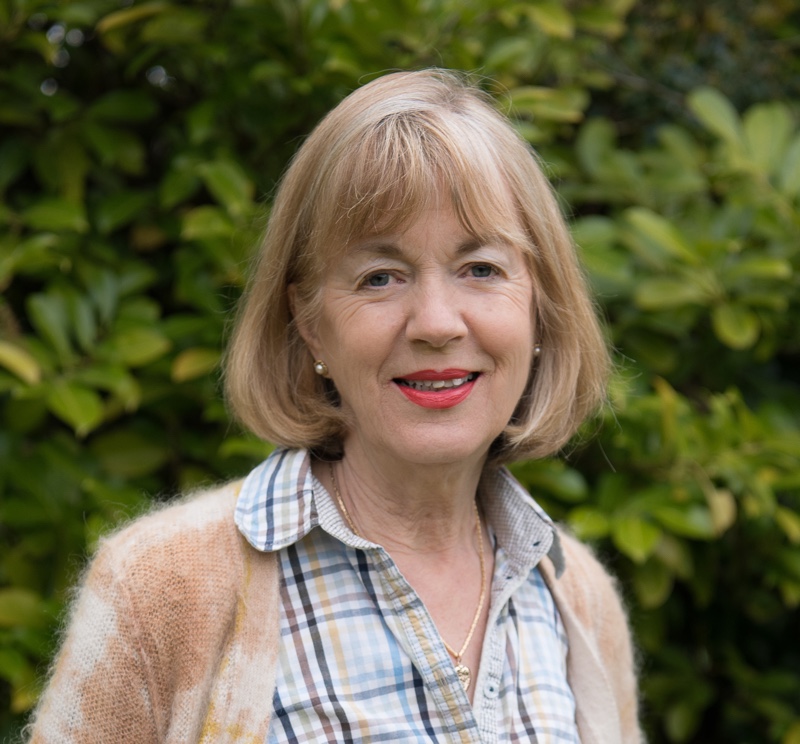
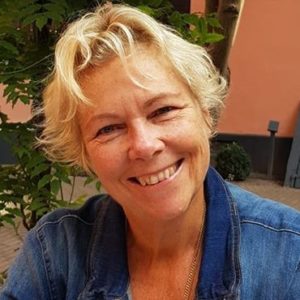
 Delighted to welcome long-standing writing friend Anna Belfrage back to the blog! Delighted to welcome long-standing writing friend Anna Belfrage back to the blog!
Had Anna been allowed to choose, she’d have become a time-traveller. As this was impossible, she became a financial professional with two absorbing interests: history and writing. Anna has authored the acclaimed time travelling series The Graham Saga, set in 17thcentury Scotland and Maryland, as well as the equally acclaimed medieval series The King’s Greatest Enemy which is set in 14thcentury England. She has recently released Smoke in Her Eyes, the second in a new series, The Wanderer, a fast-paced contemporary romantic suspense with paranormal and time-slip ingredients.
Over to Anna!
Most writers depend on inspiration.
A snippet of conversation we’ve overheard, an article about sheep, two people engaged in deep conversation while drinking Turkish tea out of ridiculously small cups—it doesn’t take more than that for me, and suddenly my brain is in overdrive, throwing one image after the other at me.
I am a visual writer. I “see” images as I write. Taking my few examples above as a starting point, the two gents drinking tea never ended up in a book – but because of them, Turkey (more specifically Istanbul) plays a major, major part in my contemporary series, The Wanderer.
The drawback with visual inspiration is that we see things all the time.
Over the course of a day, my brain presents me with thousands of images, potential sparks of inspiration. As I sit here tapping away at my laptop, I have but to lift my head to gaze out the window. Two lemon coloured butterflies dance in the sunlight, and I file that little scene away for future usage. Not that I see any need for butterflies in what I am presently writing, but one never knows, right?
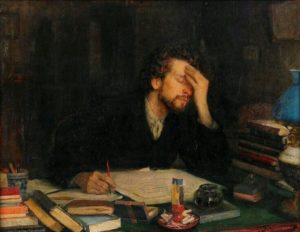 Writing, Leonid Pasternak, 1862 – 1945 Thing is, too much inspiration becomes a distraction. Historical fiction writers experience that frequently when doing research. From considering just what flowers a lady of the manor might use to decorate her solar, our intrepid researcher might suddenly drown in fascinating depictions of medieval salads and the best recipe for a good pottage. Or said writer becomes so engrossed in how colonial people made soap that he/she just has to include a long, long description in her WIP, no matter that it has no bearing on the story.
Even worse, if as an author you like working on multiple WIPs simultaneously, inspirational flashes can overburden your poor brain. I am one such author: I have FIVE different stories under gestation. Five. Time-wise, they span everything from the 13thcentury to the 21st. One is set in medieval Spain. The other in England and France a century or so later than the Spanish story. A third plays out in the last decade of the 17thcentury. The fourth is very firmly set in the here and now. The fifth is a time-slip, taking the early 18thcentury as its starting point. I guess I do not need to point out just how easy it can be to confuse things here, right? (And now I am wondering whether lemon coloured butterflies fluttered in medieval Spain as well as in present-day Sweden. Or do they have them in 17thcentury Maryland? Hmm. Note to self: look up endemic butterflies)
So how do I cope with all this inspiration?
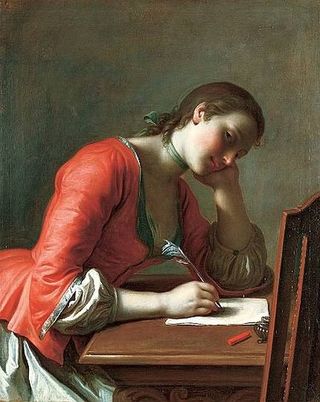
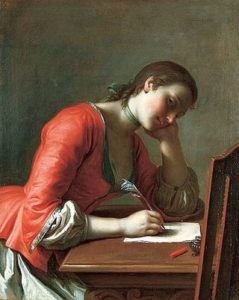 Girl Writing a Love Letter, Pietro Antonio Rotari, 1707 – 1762 When I first started writing seriously, I handled this by keeping a note-book by the bed in which I jotted down Ms Inspiration’s every whisper (She tends to visit a lot at night). Most of it I culled, because what sounded so fab at three a.m. was more of a “meh” experience come the bleak light of dawn. However, at the time, I was obsessing over ONE story line, not five, so the note book thing worked. It doesn’t work when one has five different threads vying for attention.
What I have had to do is move from being a “pantser” to being a “plotter”. The “pantser” generally creates solely based on what he/she is inspired by. The “plotter” makes a plan, draws up an outline, has a notion of where things are going with the various stories. The “plotter” approaches writing as a profession, not a passion—which, I must hasten to add, does not preclude having intensely passionate moments while submerged in writing.
What this means is that depending on where I am at in my outline, I will react or noton the sudden surges of inspiration. In the case of my story set in medieval Spain, I have a clear idea of where it is going, who the protagonists are, what historical events I will portray. I am therefore restrictive when it comes to jotting down new ideas—I assume that once I start writing the story properly, inspiration will kick in anyway. I do, however, add notes along the lines of “R captured by Moorish pirates. N to the rescue. Pomegranate crucial.” Greek to you, dear readers, but not to me.
When it comes to my new time-slip, however, I am much more generous re Ms Inspiration’s contributions. Here, the story is not set in stone and I am still putting the building blocks in place, so I have to listen carefully to that inner voice of mine.
None of my notes end up in notebooks
I still have a notebook by the bed, just in case, but these days I quickly transfer my ideas to my laptop. Each WIP has a huge, messy outline, with some things in caps, some notes in red. It contains everything from characters to general plotline to settings, things I need to research. One contains an instruction to dig into the history of brocade. Another has a list of books to read related to the first Jacobite rebellion. Together, these outlines form a navigational chart, an overview of my ongoing creative process that allows me to listen to Ms Inspiration when she pops by but not always take her seriously.
Except, of course, I never tell her that: Ms Inspiration is a somewhat touchy lady!
———
Connect with Anna:
website www.annabelfrage.com
Amazon page, http://Author.to/ABG
FB: https://www.facebook.com/annabelfrageauthor/
Twitter: https://twitter.com/abelfrageauthor @abelfrageauthor
———
Read Anna’s latest book
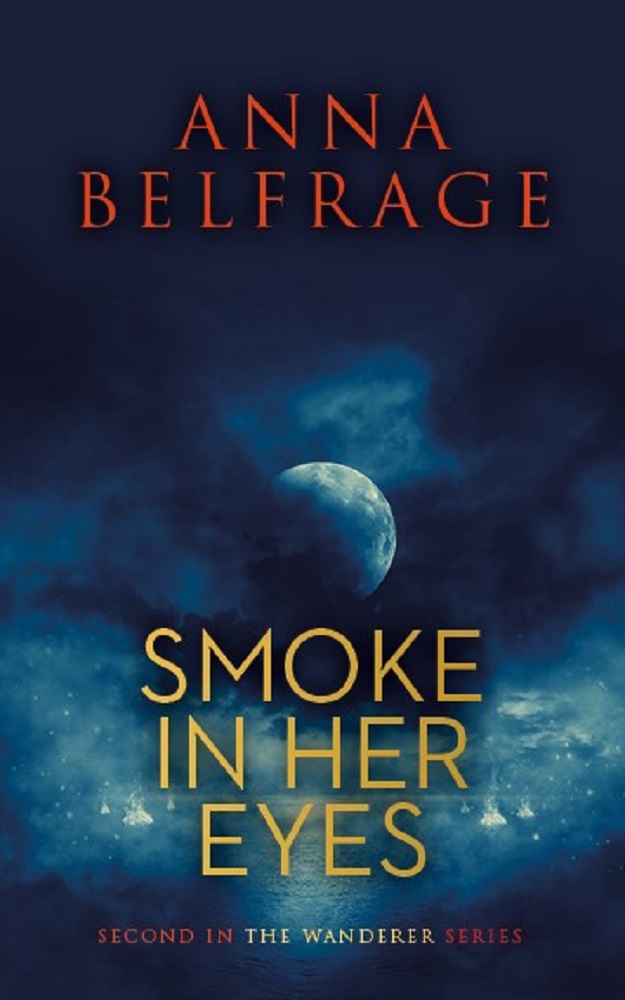 Six months ago, Helle Madsen would have described herself as normal. Now she no longer knows if that terms applies, not after her entire life has been turned upside down by the reappearance of not one, but two, men from her very, very distant past. Six months ago, Helle Madsen would have described herself as normal. Now she no longer knows if that terms applies, not after her entire life has been turned upside down by the reappearance of not one, but two, men from her very, very distant past.
Helle Madsen never believed in mumbo-jumbo stuff like reincarnation—until she came face to face with Jason Morris, a man who purportedly had spent fifty lives looking for her. Coping with being reunited with the lover from her ancient past was one thing. Having Sam Woolf, her vindictive nemesis from that same ancient past join the party was a bit too much. Suddenly, Helle finds herself the reluctant heroine of a far-flung, time-transcending epic story, one in which pain and loss seem to play a very big part.
This time round, Jason and Helle are determined to make it to the happily ever after. Unfortunately, Sam Woolf will stop at nothing to crush them. That ride into the golden sunset seems awfully far away at times…
Second in The Wanderer series
Available from: http://myBook.to/SmIHE
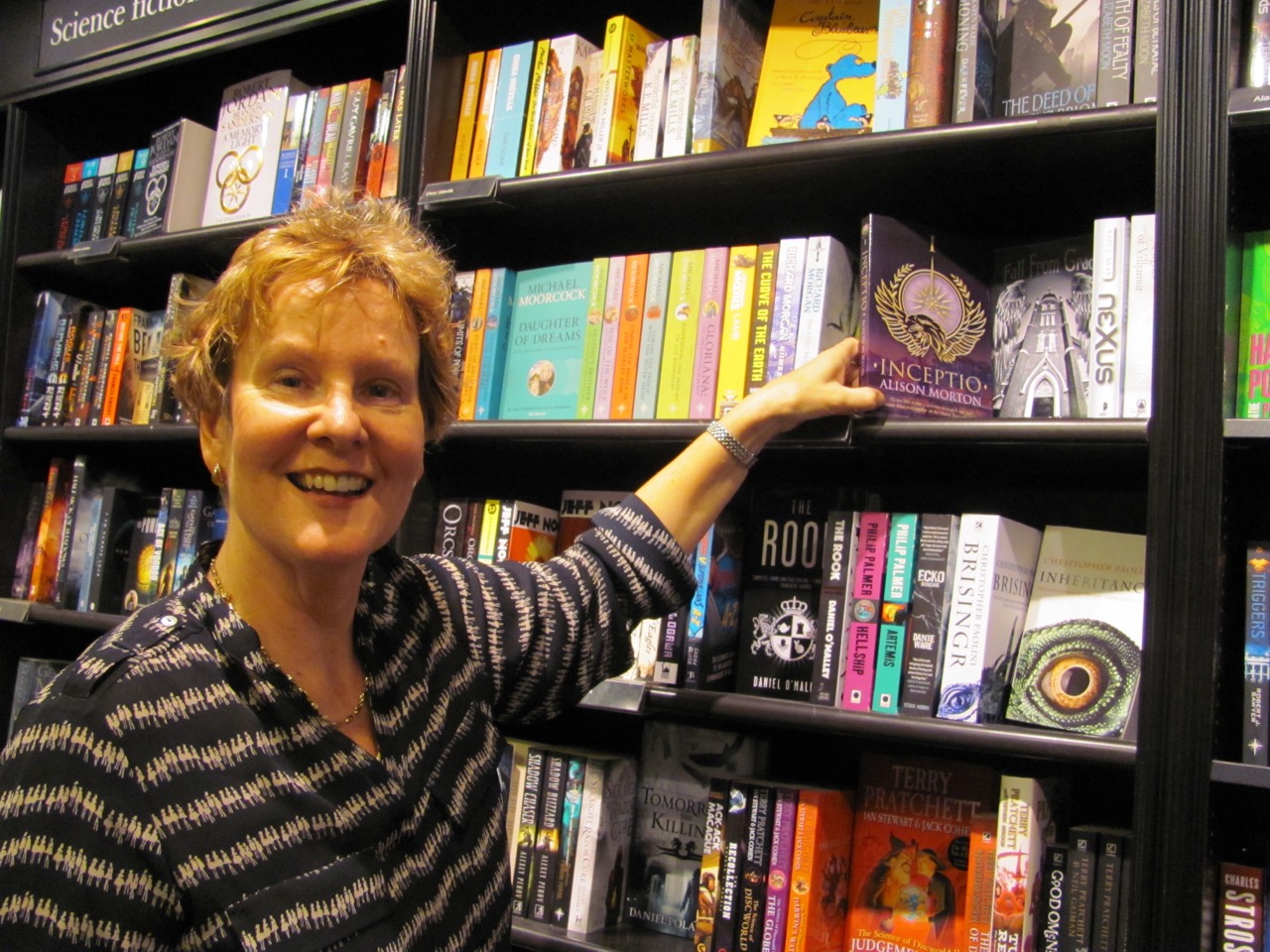
Alison Morton is the author of Roma Nova thrillers – INCEPTIO, PERFIDITAS, SUCCESSIO, AURELIA, INSURRECTIO and RETALIO. CARINA, a novella, and ROMA NOVA EXTRA, a collection of short stories, are now available. Audiobooks are available for four of the series. NEXUS, an Aurelia Mitela novella, will be out on 12 September 2019.
Find out more about Roma Nova, its origins, stories and heroines… Download ‘Welcome to Roma Nova’, a FREE eBook, as a thank you gift when you sign up to Alison’s monthly email newsletter. You’ll also be first to know about Roma Nova news and book progress before everybody else, and take part in giveaways.
If you enjoyed this post, do share it with your friends!
 This week’s guest is multiple-named, multiple published author Denise Barnes. She’s sold lipstick in Denver, modelled in Atlanta, worked as secretary to the UN Narcotics Director in Geneva, chauffeured a Swiss multi-millionaire in Zurich, assisted a famous film producer in the UK, and cooked in a sanatorium in Bavaria. This week’s guest is multiple-named, multiple published author Denise Barnes. She’s sold lipstick in Denver, modelled in Atlanta, worked as secretary to the UN Narcotics Director in Geneva, chauffeured a Swiss multi-millionaire in Zurich, assisted a famous film producer in the UK, and cooked in a sanatorium in Bavaria.
Although she set up and ran her own chain of estate agents successfully for 17 years she unfortunately sold it to two conmen. Seller Beware: How Not To Sell Your Business emerged as a warning on how easily one can be conned (Biteback Publishing 2013).
After self-publishing The Voyagers trilogy – a saga stretching from 1913-2012 – under the pseudonym Fenella Forster, she is currently writing her fifth novel for Avon HarperCollins, all set in the Second World War, under the pseudonym Molly Green.
Over to Denise!
Thank you, Alison, for inviting me on to your very popular blog as a guest. You and I have both written trilogies/series and we’ve often discussed the pros and cons of such a slippery project, and come to many of the same conclusions.
Not all trilogies and series start off as such. When I wrote my first novel. it was never intended to be a trilogy. In my mind were two heroines. I wanted to tell the story of Annie, a young woman in 1913, and her granddaughter, Juliet, in modern day. In other words, a dual timeline – the kind of novel I love reading.
However, it became a hefty manuscript of over 150,000 words, and no agent or publisher would touch it, particularly as I was an unknown author. Many professionals told me it was like two different books jammed together, and I remember being very upset because I’d already begun a sequel about Kitty, the daughter of Annie, so this time set in the Second World War.
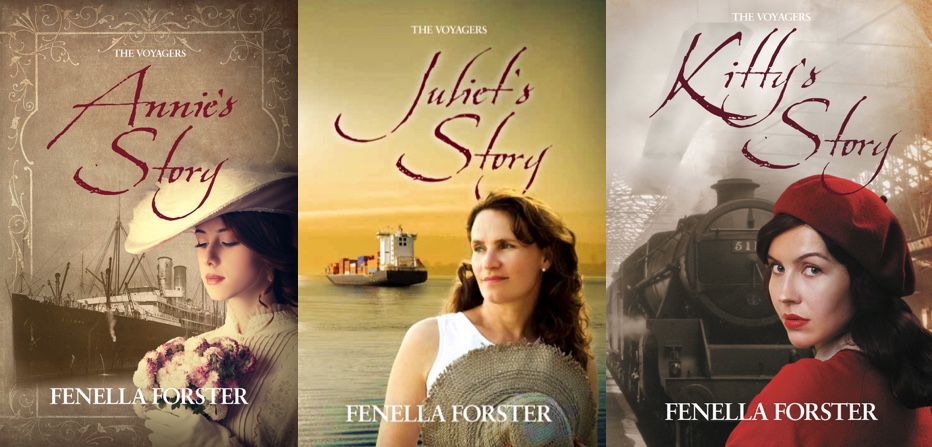
Depressed, I Skyped my CWP (critique writing partner) who happens to be Alison. She said, ‘Just pull the damned stories apart (she might have used a stronger adjective) and Kitty then becomes the third of a trilogy.’ As soon as she said the word “trilogy” I was excited. But it was extremely challenging and I wish I’d known all the following tips before I started.
Make all of them standalones
People don’t always buy books in the order you write them. It depends how the readers come across your books. So at least if they are a complete story you won’t leave the reader dissatisfied. You may think you should leave the ending open, so readers are tempted to buy the next one. Don’t do it! You will get some grumpy readers who spot that particular selling ploy, and they may not bother to read your next one.
Tie up the loose ends.
This is really important to give the reader a satisfactory reading experience. But there is an exception to this non-written rule if you’re writing a series. If you leave what appears to be a minor question pertaining to one of the secondary characters unanswered in the first book, you can choose not to refer to it again, or more interestingly, you can make it significant in the next book, and it will provide a nice link between the two novels.
Trilogies or series must link up
You should form connections in more than one way or you might as well write completely unrelated stories. If it’s a saga series, you might well be writing about different members of the same family. Or it may have the same setting. And even some of the same characters. But you would normally have a different heroine and hero, although again, there’s no set rule. You may think you’ve created a writer’s gift in that several familiar characteristics in the first novel are already in place that you can repeat in Book 2.
But be careful. You will have to describe the same settings and same characters in a fresh light so as not to bore your readers who’ve already come across these descriptions in the first book. But you can’t skip over them either by being too eager to get on with the story, or your new reader to the series will be confused when you make allusions they can’t relate to.
Keep meticulous files on characters who will reappear in forthcoming novels, so they don’t end up with different eye colours, and worse, different personalities and goals.
The timeline is vital
Your characters should age correctly as the years move forward, and it will remind you of their birthdays, which might make a pivotal scene.
Examples of more links
A piece of jewellery, a diary, a bundle of letters, or a photograph might thread its way into two or more of the series. Or introduce a family secret such as a hidden identity, For something spine tingling, try an unknown name on a birth certificate, as I did in Kitty’s Story.
Trilogies or series don’t all have to be set in different period
My second and third series are chronological (set in the Second World War) but they all have many of the same characters. My ‘Orphan’ series has the same setting and many of the same children in a Dr Barnardo’s orphanage in Liverpool, thereby creating a strong link throughout.
In my latest ‘Linfoot Sisters’ series (first one: Flight Girl, due out this November), the overriding link is the three sisters, each one being the heroine of her own story. All three girls choose completely different ways of ‘doing their bit’ for the war effort, but they regularly meet in the three novels to keep the themes and links alive.
I’m sure you’ll think of many more reasons why it’s both frightening and exhilarating to write a trilogy or a series. As Alison will confirm, you really can have a lot of fun. I wish you the very best of luck.
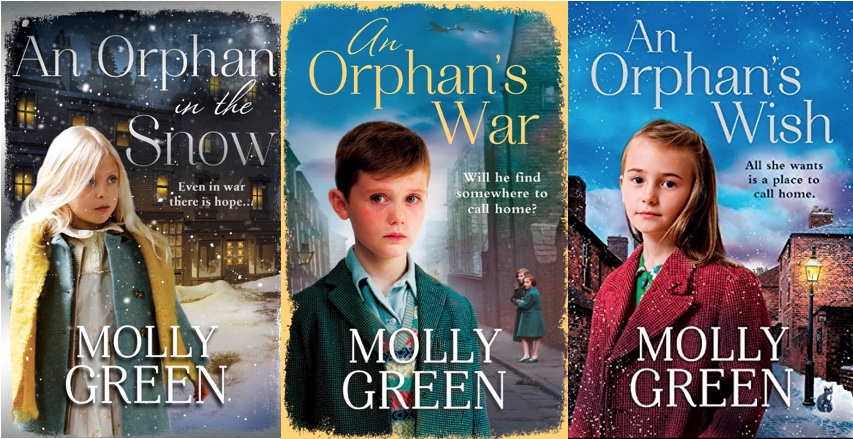
The Orphan series
More about Denise/Fenella/Molly on her website: https://denisebarneswriter.com
Follow her on Twitter: @denisebarnesuk https://twitter.com/denisebarnesuk
Alison Morton is the author of Roma Nova thrillers INCEPTIO, PERFIDITAS, SUCCESSIO, AURELIA, INSURRECTIO and RETALIO. CARINA, a novella, and ROMA NOVA EXTRA, a collection of short stories, are now available. Audiobooks are available for four of the series.
Find out more about Roma Nova, its origins, stories and heroines… Download INCEPTIO, the series starter, FREE as a thank you gift when you sign up to Alison’s monthly email newsletter.
If you enjoyed this post, do share it with your friends!
 My guest today is Richard Dee who writes science fiction and steampunk adventures, as well as chronicling the exploits of Andorra Pett, reluctant amateur detective. When he’s not writing, reviewing or blogging, he bakes bread and biscuits, cross-stitches and walks the Devon coast. My guest today is Richard Dee who writes science fiction and steampunk adventures, as well as chronicling the exploits of Andorra Pett, reluctant amateur detective. When he’s not writing, reviewing or blogging, he bakes bread and biscuits, cross-stitches and walks the Devon coast.
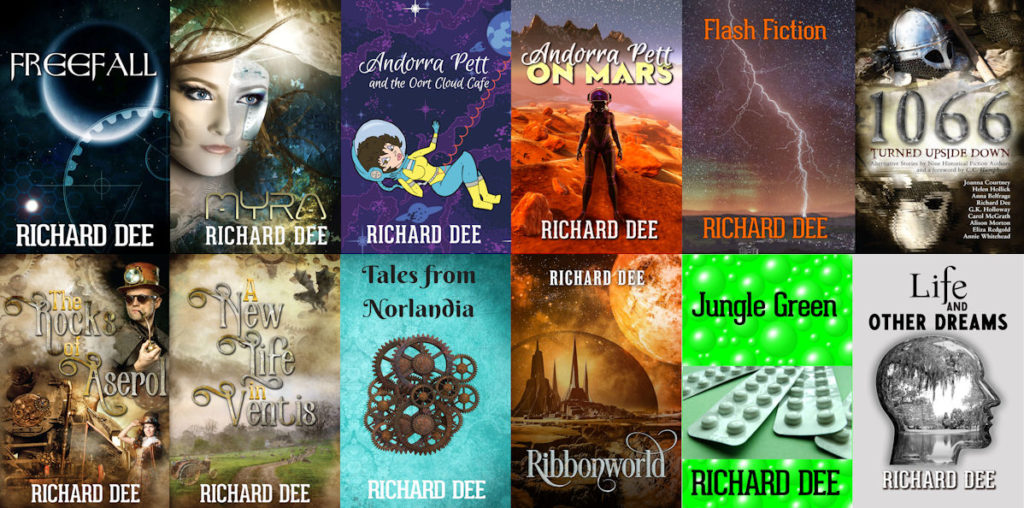
His first novel, Freefall, was published in 2013, followed by Ribbonworld in 2015. September 2016 saw the publication of The Rocks of Aserol, a steampunk adventure, and Flash Fiction, a collection of short stories. Myra, the prequel to Freefallwas published in 2017, along with Andorra Pett and the Oort Cloud Café, a murder mystery set in space.
He also contributed to 1066 Turned Upside Down collection of alternative history stories (where I ‘met’ Richard). Currently, he’s working on prequels, sequels, and a few new projects.
Over to Richard!
“Thank you, Alison, for the chance to post on your blog.
Write what you know, they said. They didn’t say how you were supposed to do that when all you wanted to write about was the future, about places that, as far as we know, don’t exist (yet).
Now you could be forgiven for thinking that writing about places that don’t exist is easy, after all,you don’t need to do any research, you can just make it all up as you go. Right?
Wrong. That was the first thing I found out, if you want to write about tomorrow, you have to have a pretty good idea about today. Not only that; you need to know about yesterday as well.
You see, there’s a little thing called realism. It’s a pesky nuisance but there you are. In the words of Isaac Asimov. Nothing has to be true, but everything has to sound true.
What that means, at least as far as I’m concerned, is that everything I create must be based on a fact. My story can head off into the future, on Earth or any place that I care to imagine, but it all needs to start with something that the reader can understand and relate too.
It can be a familiar thing, take my novel Ribbonworld, for example. It opens in a hotel room; they will have them in the future and you can bet that they’ll be roughly the same as they are now, only their location will have changed. Immediately, I’ve introduced you to something you can relate to. Now I can get you involved in what’s going on in the room, and then; wham! I pull open the curtains on a scene that no-one has ever witnessed before and takeyou into the action.
Or I could start with a piece of science, how about the fact that pressure drops when flow increases. Even if they don’t understand it, everyone uses it (it’s one of the principles that can help you get to that hotel room). With a bit of a twist, you can warp the science and use it to justify travelling faster than light.
Or, how about a problem that you need to solve in your future world; for instance, what do people on a space station eat? The obvious answer is that they survive by growing their own food. Of course, that brings its own difficulties; it’s up to you to justify it in a logical and realistic way that makes it feel like a natural part of your setting.
I guess what I’m trying to say is that whoever gave the advice was right. Writing about the future has to start withwriting what you know and showing that you know it thoroughly. Once you have the audience convinced, you can tweak it and expand it to fit your vision. You just have to blur the point where the reality ends and the fiction starts.
However, there is one thing about the future that I do know; whatever happens and wherever we go, we will take all our vices, emotions and behaviour with us. In the worlds of the future, there will be good guys (pardon my gender-type) and bad ones, the selfish and the selfless. All human nature will be our companion. Our adventures will play out on a wider stage.
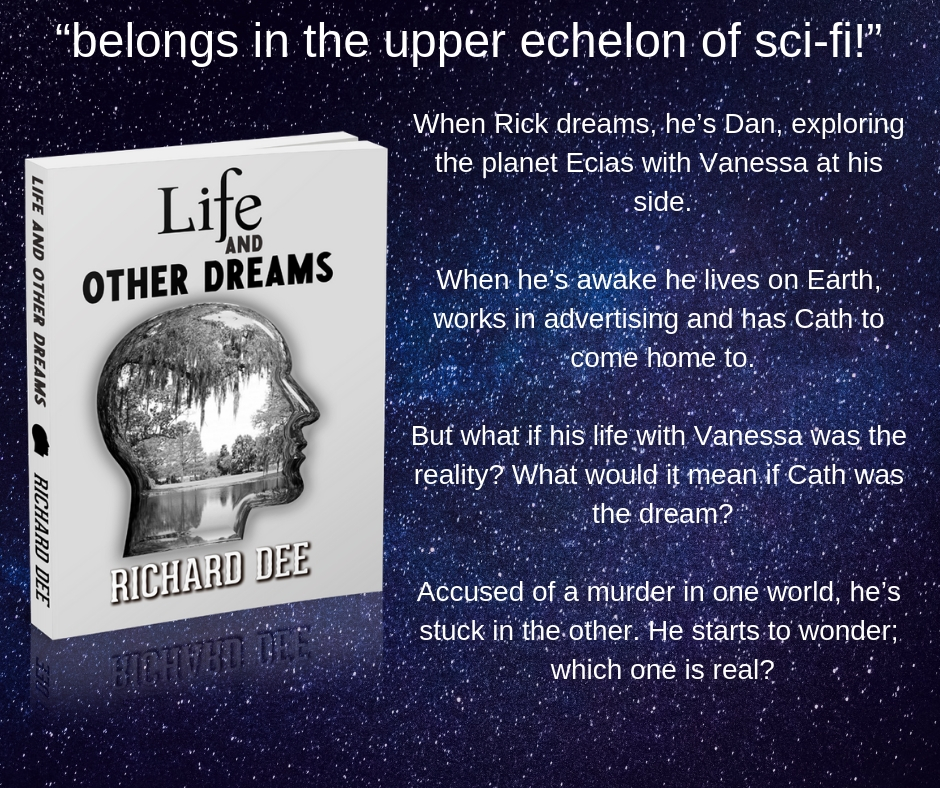
My latest novel explores one man’s life, he appears to exist in two places; which one is real?”
Thank you, Richard. As a science fiction reader who writes alternative history fiction, I completely endorse your advice!
Connect with Richard
Head over to richarddeescifi.co.uk to see what he gets up to, plus free short stories, regular features on writing, book reviews and guest appearances from other authors.
Facebook: RichardDeeAuthor Twitter: @RichardDocket1
Life and Other Dreams is available now.
Alison Morton is the author of Roma Nova thrillers INCEPTIO, PERFIDITAS, SUCCESSIO, AURELIA, INSURRECTIO and RETALIO. CARINA, a novella, and ROMA NOVA EXTRA, a collection of short stories, are now available. Audiobooks are available for four of the series.
Find out more about Roma Nova, its origins, stories and heroines… Download INCEPTIO, the series starter, FREE as a thank you gift when you sign up to Alison’s monthly email newsletter.
If you enjoyed this post, do share it with your friends!

| Kylara Vatta from Trading in Danger, Elizabeth Moon |
Eowyn, Lord of the Rings, JRR Tolkien |
Carina Mitela, PERFIDITAS, Alison Morton |
When I started pounding on my keyboard, I just wanted to tell a story. There’d be adventures and Romans, a heroine, a love interest, good guys and bad guys, a ton of action and romance, friendship and enmity, comradeship and purpose. And, eight books later, that’s what happened.
But there was a problem…
The publishing/book trade rather likes distinct genres; they suggest that the fiction book-buying public likes to know what it’s getting – a thriller or a romance or a historical or a science fiction. I had to decide in 2012 what slot or genre my first book, INCEPTIO, fitted into if it was going to be marketed successfully. Which shelf would it be on in the bookshop?
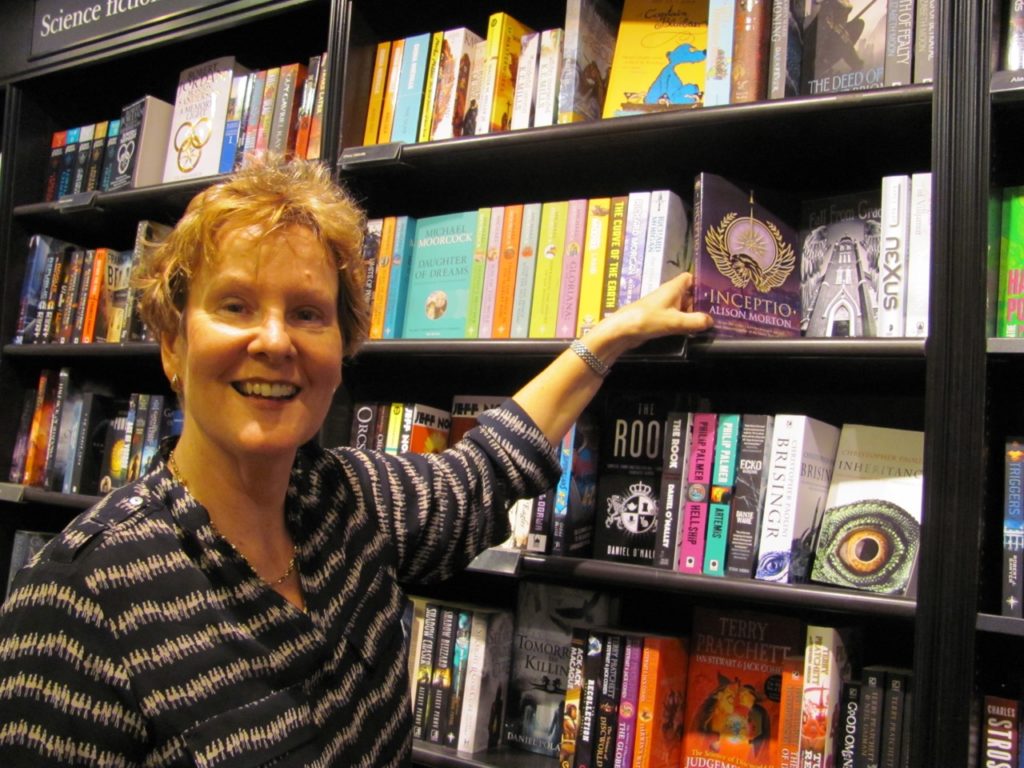
The first choice was romance or thriller. But the speculative Roman elements gave it a strong historical bent, so was it historical fiction or alternative history? Could it be adventure fiction or perhaps coming-of-age? And as it involved modern Praetorian Guards, would it slip into the military fiction mould? Whatever it was, it was going to run all over a number of categories…
What is cross-genre?
Essentially, fiction that blends themes and elements from two or more different genres. In contrast to single genre, it offers opportunities for opening up debates and stimulating discussion in ways that single genre books wouldn’t. ‘Genre-busting’ is a more dramatic term used occasionally in reviews, blurbs, marketing and on retailer product pages. And one that’s becoming more popular in the publishing world.
Some examples of cross-genres
Adventure thriller
Action comedy
Comedy-drama
Comedy-horror
Comedy thriller
Comic fantasy
Comic science fiction
Crime fantasy
Dark fantasy
Historical crime
Historical romance
Military science fiction
Paranormal romance
Romantic comedy
Romantic fantasy
Romantic suspense
Science fantasy
Science fiction Western
Urban fantasy
Combine (mash up) any two, three or four as you like!
Why cross the genres as a writer?
Creative people don’t always feel comfortable working within the confines of an established category. Some of their best stories fall between the cracks. Many an author has written a terrific, well-crafted story with emotional punch; their agent loves it, their publisher loves it but they don’t know how to package and market it. But quality cross-genre fiction has the huge advantage of potentially reaching more readers by appealing to multiple audiences.
Today, thanks to the rise of online booksellers and the easy access to digital publishing and driven self-publishing, there’s plenty of room on the infinite virtual shelf for books that defy conventional categorisation. Readers, not publishing conglomerates, are the gatekeepers and can feast on new and exciting story concepts which have few boundaries. I’ll often get a review that starts, “This isn’t my usual reading, but…” or “I wouldn’t normally read out of my usual genre, but…”
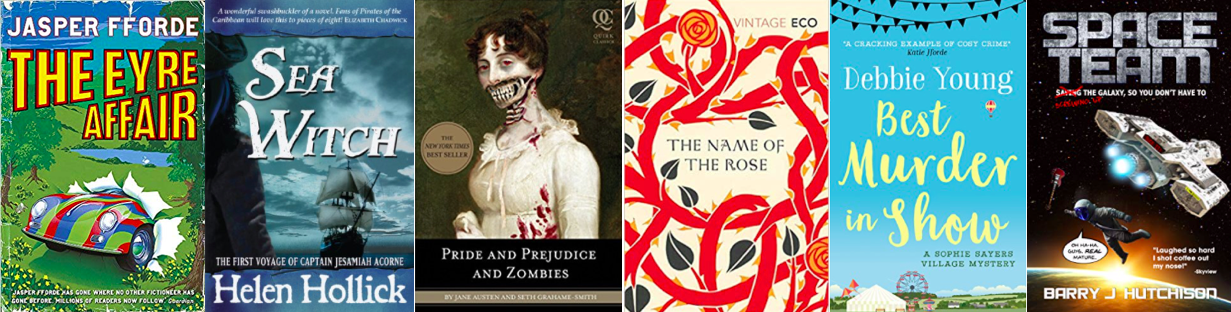
| Althist/crime |
Historic/fantasy |
Literature/horror |
Historic/crime |
Romcom/crime |
Scifi/comedy |
The essentials of successful cross-genre fiction writing
Choose one genre as head girl/head boy. Using a primary genre and following its traditional conventions gives the story a main framework and will make marketing easier. It also helps you focus as you develop the plot, especially if you are a pantser rather than a plotter. When you bring in other genres, keep an eye out for their conventions or you’ll annoy readers who know those genres well.
Use your essential writing skills and your previous writing experience. Just because you are spreading your story across different conventions doesn’t mean you can skimp on good writing, editing and research. But if you’ve successfully written in another genre, e.g. science fiction, and decide to write historical romance, you already have well-developed world-building awareness and skills which are essential in any historical fiction. And you are aware that conventions/rules apply to every genre.
Ensure your characters are strong, deep and flexible enough not to be tethered to any one genre. Characters should be able to stand on their own two (or four) feet. Of course, they will need to follow some genre conventions, but ask yourself this: if you were to pluck your character out of the novel and set her/him down in an entirely different place/time/circumstances, would the reader still care what happens to her/him?

What happens in practice?
Well, I plumped for ‘thriller’ as the main category for my books, adding ‘set in an alternative historical timeline and with a dash of romance’ where I could. So I market the Roma Nova series as thriller, alternate(iv)e history, historical fiction, romance, adventure, espionage and anything else I can think of.
- Thriller – action, tension, huge problems, a quest, fights, fast-pace
- Alternative history – ‘what if’, speculation, other worlds, imaginative settings and politics, strong conventions (Downside is that a vast number of ‘althist’ stories feature Nazis/Second World War or the American Civil War.)
- Historical fiction – Romans, historical foundation to the social and political setting, Latin names
- Romance – (of course) there’s an epic love story with plenty of bumps along the way but the characters are more realistic with emotional relationships and the high stakes that go with it.
- Adventure – each book has a slight gung-ho, ‘into the unknown’ element and who knows what might happen to the heroine?
- Espionage – the characters are mostly involved in intelligence, undercover and special forces operations
- Anything else – swapping gender roles, which is fun!
Crossing and mixing genres gives you not only creative freedom, but a marketing edge. You can write a vast range of posts on your own blog, appear on different genre groups as a guest, gather knowledge and expertise in many fields, widen your writing skills and offer something extraordinary to your readers.
What’s your experience?
Updated 2024: Alison Morton is the author of Roma Nova thrillers – INCEPTIO, CARINA (novella), PERFIDITAS, SUCCESSIO, AURELIA, NEXUS (novella), INSURRECTIO and RETALIO, and ROMA NOVA EXTRA, a collection of short stories. Audiobooks are available for four of the series. Double Identity, a contemporary conspiracy, starts a new series of thrillers. JULIA PRIMA, Roma Nova story set in the late 4th century, starts the Foundation stories. The sequel, EXSILIUM, is now out.
Find out more about Roma Nova, its origins, stories and heroines and taste world the latest contemporary thriller Double Identity… Download ‘Welcome to Alison Morton’s Thriller Worlds’, a FREE eBook, as a thank you gift when you sign up to Alison’s monthly email update. You’ll also be among the first to know about news and book progress before everybody else, and take part in giveaways.
If you enjoyed this post, do share it with your friends!
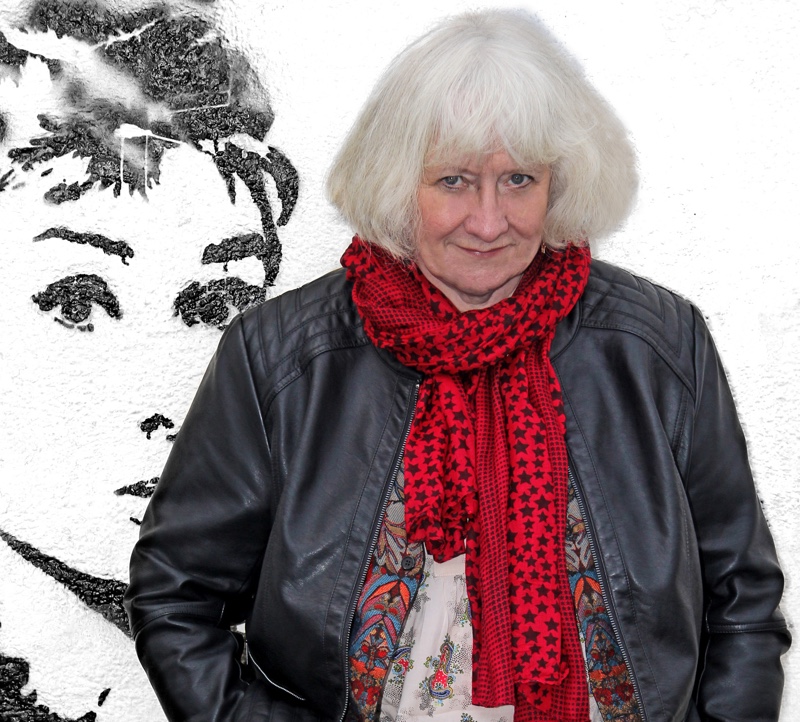
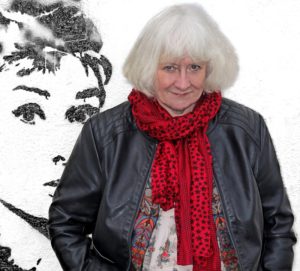 Today’s guest, Jan Edwards, is an award winning author with titles that include Winter Downs (Arnold Bennett Book Prize) and Sussex Tales (Winchester Slim Volume award).She also has a BFA Karl Edward Wagner award. A Sussex native, Jan now lives in Norths Staffs. Today’s guest, Jan Edwards, is an award winning author with titles that include Winter Downs (Arnold Bennett Book Prize) and Sussex Tales (Winchester Slim Volume award).She also has a BFA Karl Edward Wagner award. A Sussex native, Jan now lives in Norths Staffs.
Her short fiction can be found in crime, horror and fantasy anthologies across the UK and USA. She was a script writer for the Dr Who DVD and book Daemons of Devil’s End. Jan is also an anthologist with the award winning Alchemy Press, co-owned with her husband Peter Coleborn. Their latest anthology is The Alchemy Press Book of Horror.
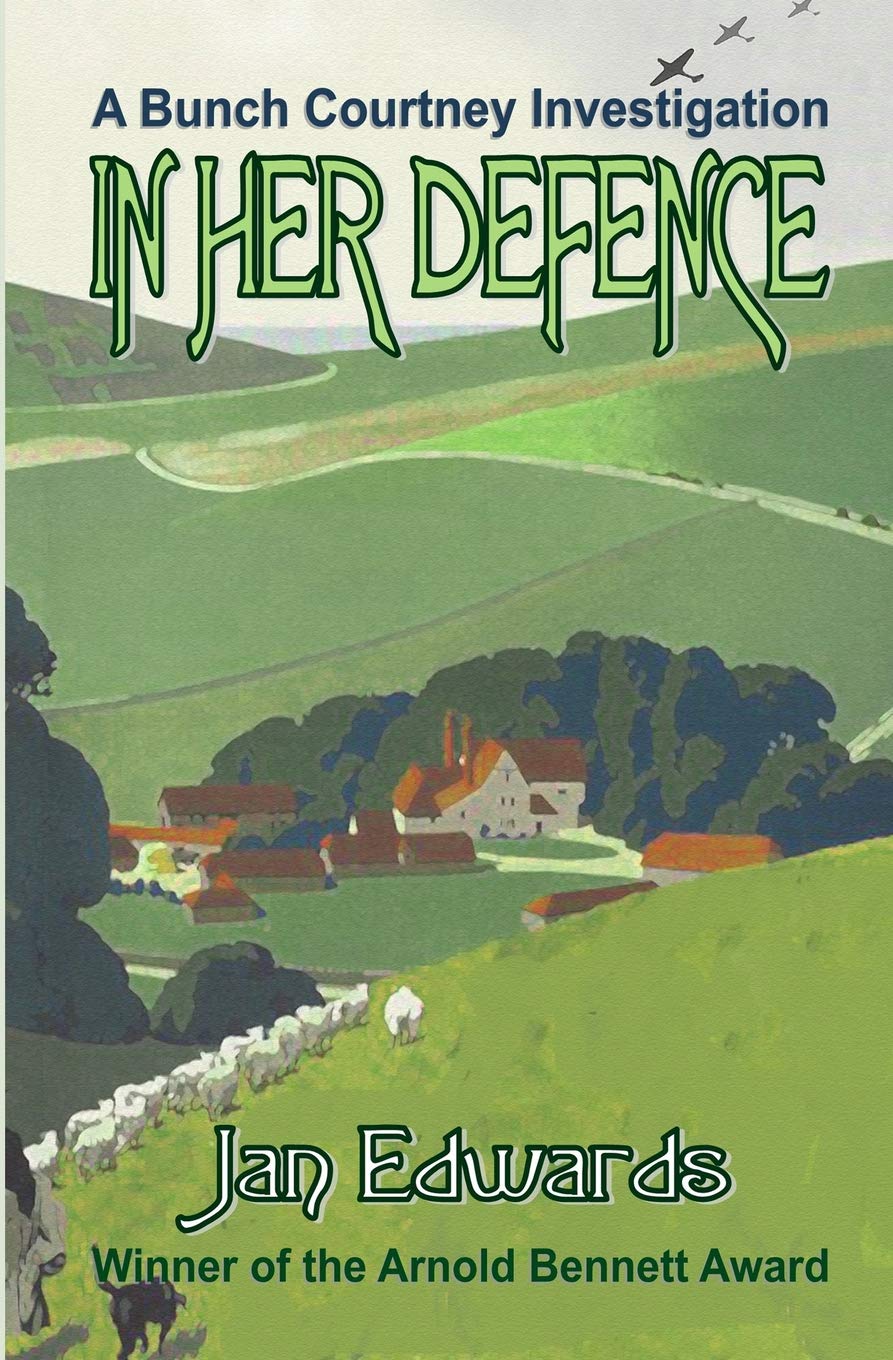
Jan tells us about writing In Her Defence, how she came to write the Bunch Courtney Investigations, and why Golden Age crime?
Over to Jan!
“Vintage Golden Age crime has always been a favourite read, so it’s not surprising that my Bunch Courtney Investigations ended up in that vein. The first in the series, Winter Downs, established Bunch Courtney and DCI Wright as the ‘phoney war’ ended and 1939 became 1940. The latest case, In Her Defence, has moved on to May 1940.
Though In Her Defence echoes something of our modern dilemma, it was not intentional. Because the main news items for May of that year 1940 were Churchill becoming PM, Dunkirk and the internment of enemy aliens, they came naturally to the fore. Murder remains the key issue along with a running theme for Bunch of the testing of old friendships and of course her abiding obsession with all things equine. It’s also a fascinating period for social change as Bunch watches her cloistered, pre-war, life rapidly dissolving. She knows that it will never return.
I am often asked how much research I carry out into the war years, and the answer is quite a lot. I’m a bit of a research geek and do get a huge kick out of tracking down minutiae so it is never a chore. I can spend happy days seeking details that have been largely forgotten and my internet search history can be colourful.
For In Her Defence it included the names of popular brands of rat poison; SOE training manuals; 1940s auction prices paid for stock; the various colours used in ration coupons; guns and their ammunition; common makes and models for a butcher’s van; agricultural machinery; or ‘Donkey stoning’ a doorstep.
Knowing what it is I need to add in is usually a matter of seeing some small snippet and following it to the next shiny thing. Very little of the information unearthed ever finds its way onto the page but it’s always an eclectic list. I throw nothing out because it could still prove useful. I suspect the goal is the same for any historical writer; to have their characters convey the reality of their workaday world but without leaving tedious info dumps for readers to trip over.
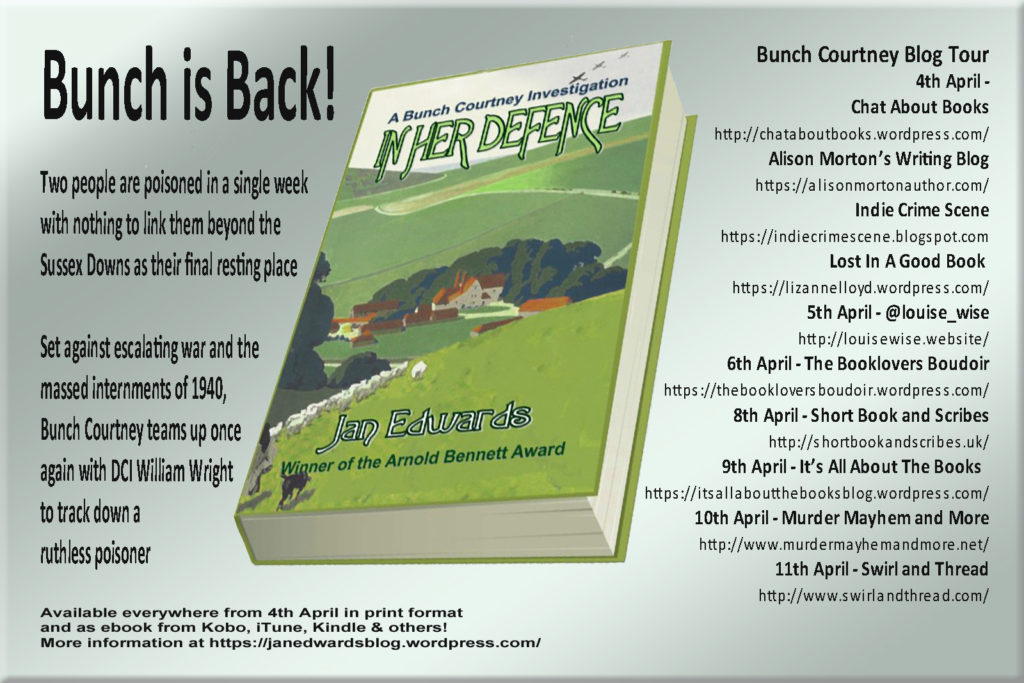
Another question I am asked a great deal is the precise location of the Courtneys’ country house. I have written a number of Sherlock Holmes stories so I took a leaf from Conan Doyle’s book and have been vague on the exact location. Storrington and Brighton exist of course, but though I drew on places known to me in my Sussex childhood the village of Wyncombe does not exist. Why? Because when for argument’s sake, you set a pharmacist in a chemist shop in any large town few people will question it. Being raised in a tiny Sussex village I realised people would tell me with great certainty that in Loxwood or Kirdford or some other hamlet it was never so – possibly because they are the son or daughter of that very chemist! Hence Wyncombe came to be out of sheer cowardice on my part.
So what next? I love writing about Bunch Courtney, and she has many more cases to investigate alongside Chief Inspector William Wright. Books 3 and 4, which are already well under way, will be taking Bunch and Wright into 1941. There is also a short DCI Wright story linked to Book 3 that may emerge as a giveaway, so watch my blog for news on that.”
Thank you, Jan! I share your fascination for research and for getting that research right.
In Her Defence is out on 4 April 2019 and will be available to order in paper and digital formats from all major suppliers, including Amazon US /UK/ AU, Indie Bound; Book Depository; Wordery; Waterstones. Also on Apple, Barnes & Noble Nook, Kobo and others.
Connect with Jan on her website: https://janedwardsblog.wordpress.com
Twitter: https://twitter.com/Jancoledwards @Jancoleedwards
What’s In her Defence about?
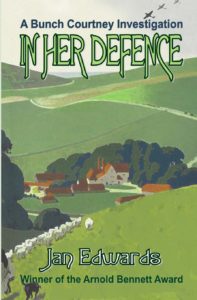 Bunch Courtney’s hopes for a quiet market-day lunch with her sister are shattered when a Dutch refugee dies a horribly painful death before their eyes. Bunch Courtney’s hopes for a quiet market-day lunch with her sister are shattered when a Dutch refugee dies a horribly painful death before their eyes.
A few days later Bunch receives a letter from her old friend Cecile saying that her father, Professor Benoir, has been murdered in an eerily similar fashion. Two deaths by poisoning in a single week. Co-incidence?
Bunch does not believe that any more than Chief Inspector William Wright.
Set against a backdrop of escalating war and the massed internments of 1940, the pair are drawn together in a race to prevent the murderer from striking again.
Alison Morton is the author of Roma Nova thrillers INCEPTIO, PERFIDITAS, SUCCESSIO, AURELIA, INSURRECTIO and RETALIO. CARINA, a novella, and ROMA NOVA EXTRA, a collection of short stories, are now available. Audiobooks are available for the first four of the series.
Find out more about Roma Nova, its origins, stories and heroines… Get INCEPTIO, the series starter, FREE as a thank you gift when you sign up to Alison’s monthly email newsletter.
If you enjoyed this post, do share it with your friends!
|
Subscribe to Blog via Email
Join 368 other subscribers.
Categories
Archive
|
 Delighted to welcome long-standing writing friend Anna Belfrage back to the blog!