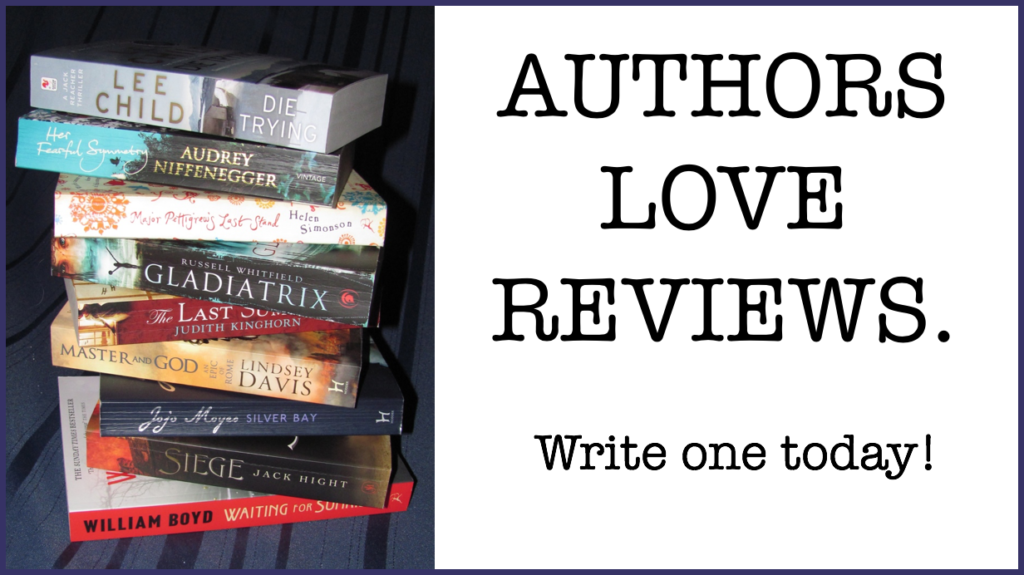
 Authors love reviews – this is not a secret! Authors love reviews – this is not a secret!
But after you’ve closed a book, why should you bother to write one? How do you do it? And who can write a review? What’s considered a ‘good’ review?
Whoa! Let’s take a step back…
Why write a book review?
Analysing and expressing your thoughts about a book you’ve read can help you understand it better and thus enrich your reading experience. Additionally, and more practically, book reviews are crucial in helping other readers understand what a particular book is about and whether they should invest time in reading it. An honest and well-written book review can also help your favourite authors. Reviews not only provide valuable feedback for the author – or at the very least, some much-needed praise and/or positive critique – they also boost visibility of books on sites like Amazon, helping more people find (and purchase) the books that you love and want to recommend to others.
Some tips…
- Before writing, consider who the review is for: online retailer e.g. Amazon, magazine/newspaper article (what readership?), book site e.g. Goodreads, your own blog, serious review journal, e.g. London Review of Books, genre review site/magazine e.g. Discovering Diamonds Reviews, HNS Historical Reviews or Mystery People magazine.
- Consider the style, tone and length of review appropriate for the publication while not sacrificing your own.
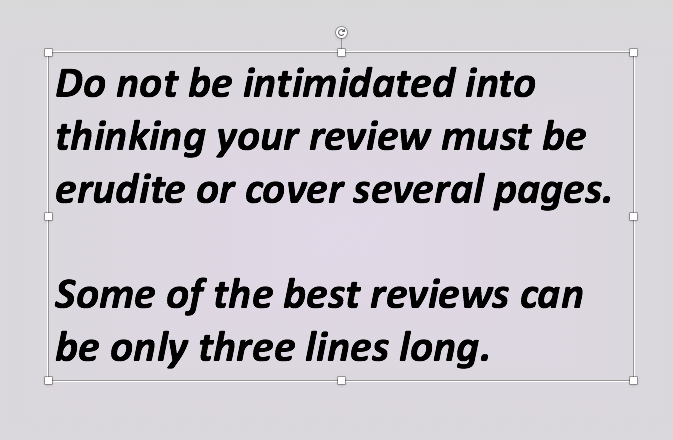
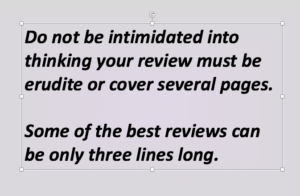
- Do not be intimidated into thinking your review must be erudite or cover several pages. Some of the best reviews can be only three lines long.
- Key guideline: it’s about the book, and not you.
A few general guidelines
 Make notes. By the time you have finished the book, you’re bound to have forgotten things you wanted to include in the review. The physical action of writing helps commit those points to memory. Make notes. By the time you have finished the book, you’re bound to have forgotten things you wanted to include in the review. The physical action of writing helps commit those points to memory.- Read the whole book unless it is so dire you can’t bear it. But be prepared to say why if asked.
- Any review that you write should be constructive, whether it’s positive or critical.
- Engage your readers immediately in your review – use the first sentence to state your overall opinion.
- Strive to be kind in your brutal honesty. Avoid being hurtful in your constructive criticism – authors are people too!
Nitty gritty
- Mention the main theme, genre, whether it’s part of a series, or a debut.
- Does it fit into genre conventions or not? Does that make it a better’/more interesting or engaging book?
- Does the book give you a sense of the place it’s set?
- What is the author’s ‘voice’ like?
- Mention the plot, character development and the writing style
- Is the dialogue lively or dull, correct for the period/setting?
Your reactions
- Other readers don’t want to hear just the facts. They also want to know what you think about the book, and how it made you feel! Did you like the story? Hate it? Why? Explain your feelings towards the book as best you can. What particularly excited you? What made you want to throw the book away (If you did)?
- What do you think the author did well? What do you think the author could have done better?
- Be authentic. Your followers/readers want to hear what you think of the book, and in your own voice.
Extras
- Include comments on any artwork or graphics included, extra materials (like a reading guide, map, family chart, glossary, etc.), whether there are any incorrect facts. (Check very carefully before you do!)
- DO NOT include half the plot, or heaven forbid, the whole plot, or spoilers in your review (No one enjoys spoilers and it’s mean).
Watch your formatting
While most book review sites and retailer sites such as Amazon prefer you write in a simple format, you can make it readable and enjoyable by other readers with these guidelines:
- Avoid writing just one big block of text. Space out your paragraphs so your review is easily readable.
- Don’t use ALL CAPS ever in a review.
- Don’t use punctuation excessively, such as using multiple exclamation points or question marks.
- Proofread your review for grammar, spelling mistakes, typos, etc. before sending it in or publishing it. A simple typo or error in your book review might discredit your review in the eyes of readers.
These are just a few guidelines – you do not need to do all of this, but hopefully, they may help to encourage you to leave a review after you’ve finished reading that book on your bedside table.
Happy reviewing!
Alison Morton is the author of Roma Nova thrillers – INCEPTIO, PERFIDITAS, SUCCESSIO, AURELIA, INSURRECTIO and RETALIO. CARINA, a novella, and ROMA NOVA EXTRA, a collection of short stories, are now available. Audiobooks are available for four of the series. NEXUS, an Aurelia Mitela novella, is now out.
Find out more about Roma Nova, its origins, stories and heroines… Download ‘Welcome to Roma Nova’, a FREE eBook, as a thank you gift when you sign up to Alison’s monthly email newsletter. You’ll also be first to know about Roma Nova news and book progress before everybody else, and take part in giveaways.
If you enjoyed this post, do share it with your friends!
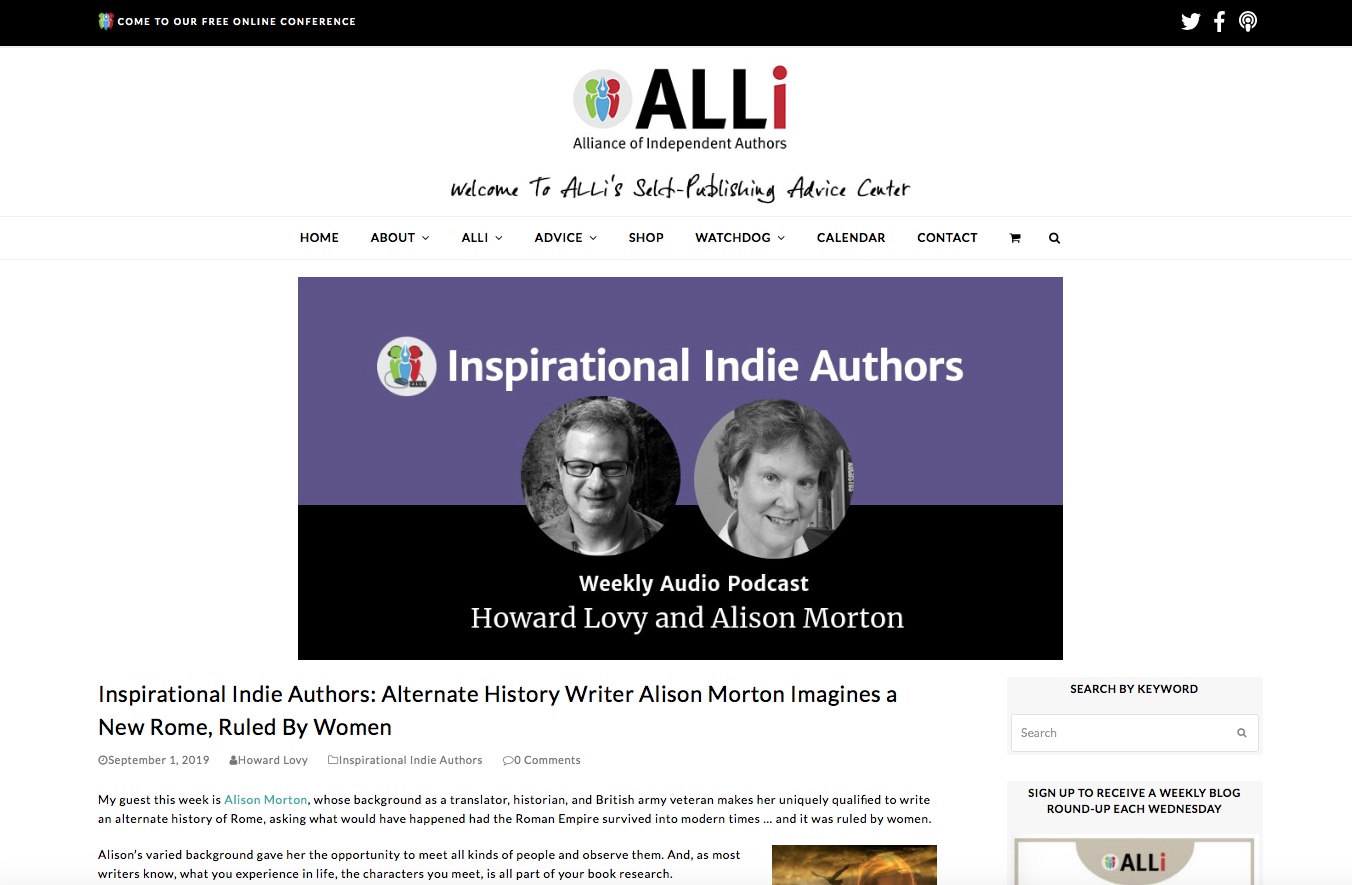
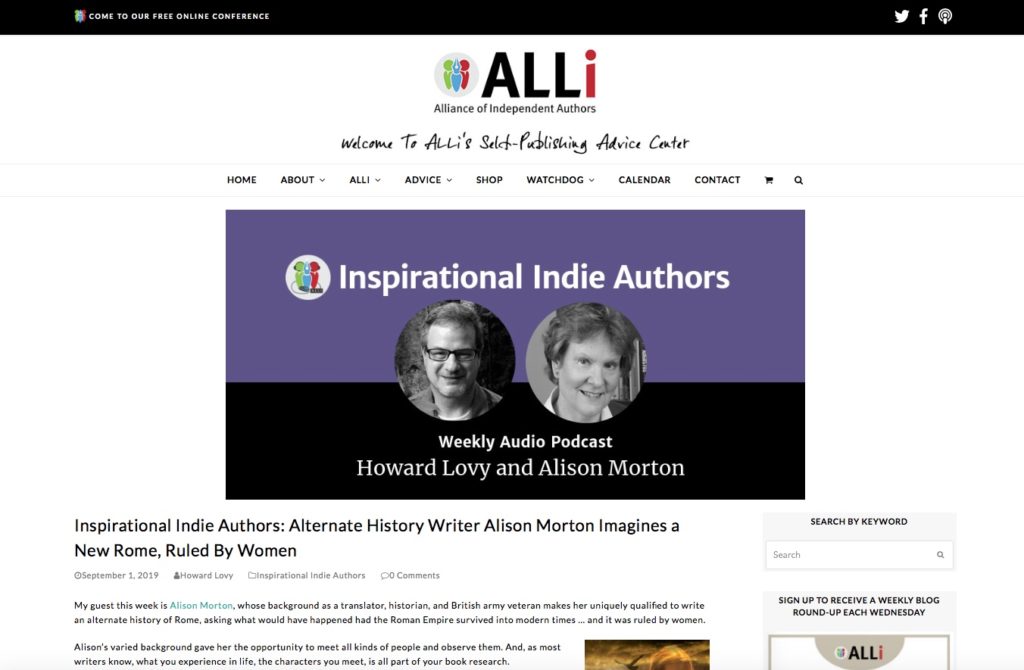 Absolutely thrilled to be invited on to the Alliance podcast, hosted by Howard Lovy. And even more so as it features ‘inspirational authors’ Not quite sure I’m inspirational, but that’s enough imposter syndrome. 😉 Absolutely thrilled to be invited on to the Alliance podcast, hosted by Howard Lovy. And even more so as it features ‘inspirational authors’ Not quite sure I’m inspirational, but that’s enough imposter syndrome. 😉
Like many people, I always take a (mental) deep breath before an audio interview as you can’t see who is going to be listening at the other end, both interviewer and the wider audience – they won’t be able to see your smile, whether nervous or confident. Audio only gives a stronger, less attenuated signal and is standard for interviews over the internet on systems such as Skype. I usually ask the host to switch on their video a few minutes to chat beforehand so I can visualise them as the interview progresses. Then we’re back to audio only.
Howard has created a very smooth yet snappy podcast from all my mumblings and highlighted a couple of quotes:
On Creating Alternate History
“Every book has its own world and you have to create that with detail, but not drop it in in great lumps. You’ve got to get your characters completely integrated into the world and drip drop information in. But you have to make it plausible, credible and consistent.”
On Bringing Roman Times Forward
“You can’t have kick-ass feisty women who are heroines doing stuff in the ancient Roman world. So it basically had to come forward to the modern world. And to get it forward, we had to have a Roman society that had survived.”
And here’s the podcast!
If you enjoyed it, do feel free to tweet!
 The Alliance of Independent Authors (ALLi, “ally with an i”) is a professional membership organization fostering ethics and excellence in self-publishing. The Alliance of Independent Authors (ALLi, “ally with an i”) is a professional membership organization fostering ethics and excellence in self-publishing.
ALLi is a diverse, supportive and friendly community of thousands of authors, collaborating with other author organizations and service partners.
In addition to an active, engaged, and growing membership, alongside with a healthy social media presence, ALLi has credibility and influence in the publishing and self-publishing industries with its founder-director, the award-winning novelist and poet Orna Ross, repeatedly named one of the “Top 100 people in publishing.” (The Bookseller)
As the only non-profit representing independent authors globally, with members on all seven continents, the association has become the most trusted voice in self-publishing. And its outreach education programs and campaigns ensure its impact is felt beyond its membership designations and borders, influencing the wider author community at every level.
Alison Morton is the author of Roma Nova thrillers – INCEPTIO, PERFIDITAS, SUCCESSIO, AURELIA, INSURRECTIO and RETALIO. CARINA, a novella, and ROMA NOVA EXTRA, a collection of short stories, are now available. Audiobooks are available for four of the series. NEXUS, an Aurelia Mitela novella, will be out on 12 September 2019.
Find out more about Roma Nova, its origins, stories and heroines… Download ‘Welcome to Roma Nova’, a FREE eBook, as a thank you gift when you sign up to Alison’s monthly email newsletter. You’ll also be first to know about Roma Nova news and book progress before everybody else, and take part in giveaways.
If you enjoyed this post, do share it with your friends!

Does your writing heart shrivel when you read on Facebook something along the lines of ‘Giving myself extra chocolate because I wrote 5,000 words today’? And it’s only 3pm… Praise piles on from others with the ‘Wow’ icon splattered everywhere. Then one or two brave souls, possibly including you, confess apologetically they’ve ‘only’ written 500.
Only? What’s wrong with that?
Of course, 500 words are a lot fewer than 5000 words, but why should anyone apologise for writing any amount on any specific day?
Undoubtedly, there are other people who won’t post at all in response because they feel truly embarrassed. Perhaps they weren’t able to get beyond a double-spaced page that day.
Don’t get me wrong. I admire such a high output but posting about it may seem a tad triumphalist and have the unintended consequence of agonising and demoralising people who are blocked, write slowly, or who don’t write every day. These could be writers just starting out, who’ve suffered multiple rejections of their work, were dropped by their publishers, or who for any number of reasons just don’t produce a lot, or write fast, possibly both. Or Real Life may be intervening…
Does a high word count mean high productivity, let alone high quality?
Writing fast may not be a guarantee of anything. Even taking into account it was probably for the first draft which is always a bit rough and ready, those 5,000 words may be complete rubbish. Writing that much and that quickly only proves the person can type fast.
It’s a pity some parts of the writing community are so obsessed with churning out words every single day, day after day – and tons of them. If you have a contract and you’re under deadline, I’d suggest the work schedule wasn’t too well planned in the first place. But measuring yourself as a writer by the number of words you write per day isn’t necessarily the best way.
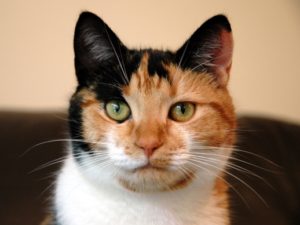 Serious face Non-writing as part of the book process
Experienced authors know how important revision and editing are to a finished work. At that stage, it’s not about how much you get done but about what you get done, how you re-shape your work A revised paragraph could involve few words but make a huge difference.
And let’s consider our old friend research; not the research you do before you type Chapter 1, but the checking facts and dates, products and weather that arise as you go along. I’ve spent half a day tracking down details of arable crops grown in Roman times and that changes significantly over all 1229 years!
Revision is also about introducing layers, honing dialogue, deepening character traits or motivations. You may only write fifty new words that day, but they could make a substantial impact on the overall narrative.
The positives of counting your words
When I’m deeply into my writing I do track my progress with word counts, but in a general way. My goal is 500-1,000 words a day. Some days I reach nearly 2,000, but usually it’s around 800-1,000. I have a back problem that prevents me sitting down for hours. I’m also a mental fidget. When writing that first draft, noting how many words you’ve written can be very encouraging. A little preen does nobody any harm, but obsessing can be bad for your mental health. It can also result in bad habits.
You won’t, I’m sure do any of these:
- Write over complicated and rambling sentences just because they entail more words.
- Use two words in description or scene setting when one will do.
- Pad dialogue with eight lines of speech when two would do.
- Introduce a scene that doesn’t take the story forward or develop the character
Would you?
Staying regular
 Writing every day should not feel like a compulsion. You are allowed to have a normal life, or at least a semblance of it. But if you dread sitting at the desk every morning and are scared to write the first word, you may not be in the right job. Yes, writing is a job as well as a creative art. Writing every day should not feel like a compulsion. You are allowed to have a normal life, or at least a semblance of it. But if you dread sitting at the desk every morning and are scared to write the first word, you may not be in the right job. Yes, writing is a job as well as a creative art.
Logging word count gives you something to look back on when you think you can’t get going; it reminds you that you have written something on a regular basis, even if it’s for three evenings a week only after the children’s bedtime.
Regular writing is like regular exercise, the more you do it the fitter you get and the less strenuous it becomes. I don’t use the word ‘easy’ as creative writing isn’t, although it’s extremely satisfying.
Regular writing will become habit-forming and your productivity will increase. I’ve noticed this every time I’ve finished marketing a book and I get back to serious writing. Noting words written can act as a springboard to get into the regular writing mode. As you see the total mounting up, you realise you might not be such a bad writer after all.
Don’t make it a tyranny, and don’t compare yourself to others; they may actually be telling fibs.
Alison Morton is the author of Roma Nova thrillers – INCEPTIO, PERFIDITAS, SUCCESSIO, AURELIA, INSURRECTIO and RETALIO. CARINA, a novella, and ROMA NOVA EXTRA, a collection of short stories, are now available. Audiobooks are available for four of the series. NEXUS, an Aurelia Mitela novella, will be out on 12 September 2019.
Find out more about Roma Nova, its origins, stories and heroines… Download ‘Welcome to Roma Nova’, a FREE eBook, as a thank you gift when you sign up to Alison’s monthly email newsletter. You’ll also be first to know about Roma Nova news and book progress before everybody else, and take part in giveaways.
If you enjoyed this post, do share it with your friends!
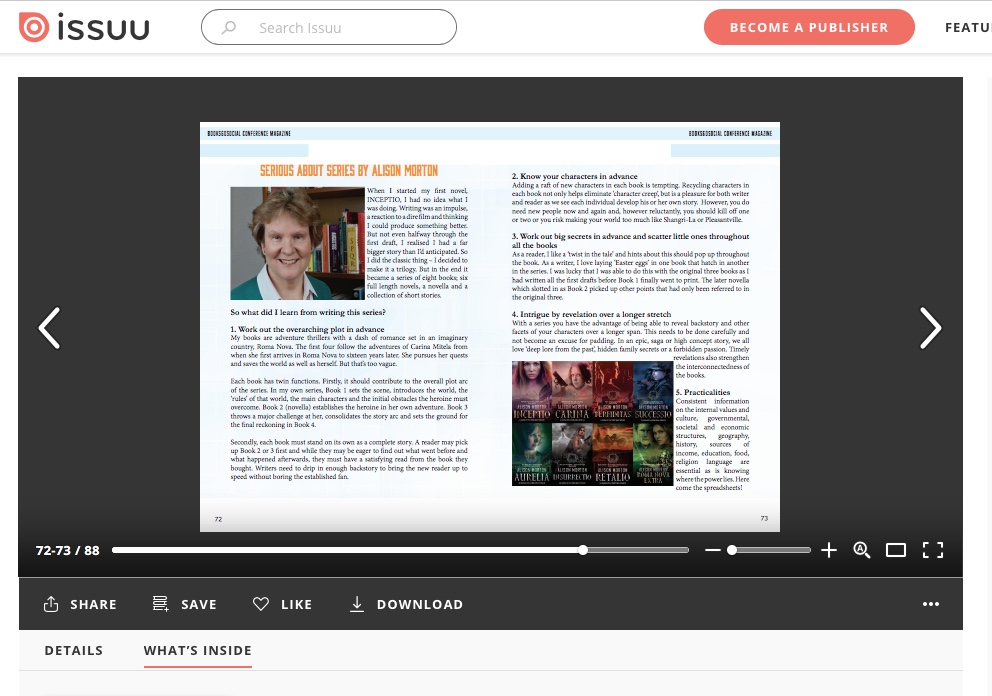
Although I’m not speaking at the conference this year. I’ve written a piece called ‘Serious about Series’ for the conference magazine. Delighted and honoured to be contributing virtually!

From the conference organisers…
‘Focused On Helping Authors & Aspiring Authors
Our expanded conference takes place at the Academy Plaza Hotel, just off O’Connell Street (map,) in the heart of Dublin’s city center. Our marketing sessions for writers will show you how you can find readers in a rapidly changing world. Our writing craft sessions will help you broaden your writing skills. Our pitch sessions could help you to sell your story to a publisher, to Hollywood or to readers.
Come for just the Saturday sessions or join us on each of the three days. Anyone who books to attend is also welcome to our opening session on Friday evening, where we will introduce the instructors and welcome you.’
Enjoy!
Alison Morton is the author of Roma Nova thrillers – INCEPTIO, PERFIDITAS, SUCCESSIO, AURELIA, INSURRECTIO and RETALIO. CARINA, a novella, and ROMA NOVA EXTRA, a collection of short stories, are now available. Audiobooks are available for four of the series. NEXUS, an Aurelia Mitela novella, is now out.
Find out more about Roma Nova, its origins, stories and heroines… Download ‘Welcome to Roma Nova’, a FREE eBook, as a thank you gift when you sign up to Alison’s monthly email newsletter. You’ll also be first to know about Roma Nova news and book progress before everybody else, and take part in giveaways.
If you enjoyed this post, do share it with your friends!
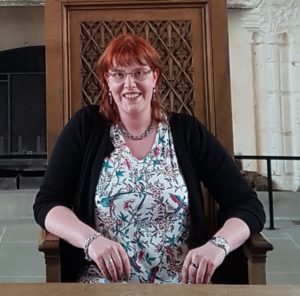 Jennifer in Stirling Castle This week’s guest is Jennifer C. Wilson, a marine biologist by training, who has developed an equal passion for history and historical fiction whilst stalking Mary, Queen of Scots on childhood holidays. (She has since moved on to Richard III.) Enrolling on an adult education workshop on her return to the north-east of England for work reignited her pastime of creative writing, and she has been filling notebooks ever since.
In 2014, Jennifer won the Story Tyne short story competition, and has been working on a number of projects since, including co-hosting the North Tyneside Writers’ Circle. Her Kindred Spirits novels are published by Crooked Cat Books and her timeslip novella, The Last Plantagenet?, by Ocelot Press.
She lives in North Tyneside, and is very proud of her approximately 2-inch view of the North Sea.
Over to Jennifer!
Have you ever been in the middle of a story, either reading or watching, when you’re suddenly jolted from your enjoyment, and find yourself thinking: “But you cannot get from there to there that way” or “That’s ridiculous, they’re miles from each other.”
We’ve all been there, usually when watching or reading about somewhere we know really well, either through living there or visiting, and although you might think it doesn’t matter to anyone other than those who know a particular place intimately, do you really want to shake your readers’ belief of your world?
Nobody is expecting you to necessarily be the academic expert in your particular field, but key facts still need to be correct, and one of the biggest areas for this is your setting. Even if you’re writing contemporary fiction, set in a ‘real’ location, e.g. the heart of London, world-building is vital to help readers lose themselves in your story, and this is doubled or tripled if you’re writing about far-flung places, either spatially or temporally.
In historical fiction, some of the ‘big hitters’ to get right include:
- Travel methods and timings;
- Location logistics; and
- Technology / food.
For this post, I’m thinking particularly about location logistics. This ranges from small-scale issues such as which parts of a building were physically present at the time you’re writing, to larger issues such as towns and their connection with the wider world.
Staying at a smaller scale, it’s important to think about what a place was really like in the period you’re writing about. One of the best ways to get a feel for a place is of course to visit it, but with historical fiction, we can never truly see a location in the way our characters would have done.
One example of this I struggle with is churches. We’re so used to seeing our churches fairly plain, simple, white, with very little adornment, and yet, you only have to look at contemporary churches on the Continent to see how British churches may have looked prior to the Reformation. Likewise, when we visit castles, even if we stand in the very room in which our action took place, we must really stretch our imaginations to see, for example, the roaring fire in the hearth, the thick tapestries on the walls, or to breathe in the heavy smoke, squint in the candlelight.
However, visiting your locations is still the best way to get a feel for that other element of setting: logistics. When I visited the Tower of London a second time, knowing by then that I wanted to write a story set there, I looked at it from a different angle, thinking about distances between buildings, what direction you would turn when leaving through a specific door etc. Yes, internal décor may have changed, but you still cannot have characters turning out of a door and into a brick wall (although, with mine being ghosts, I did have some leeway there!).
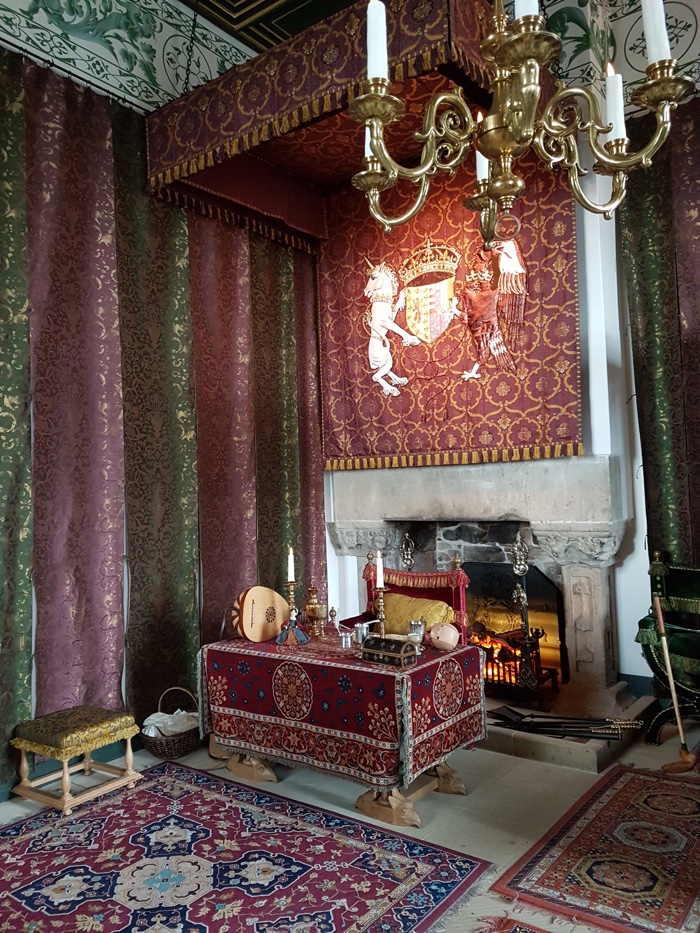 Stirling Castle royal apartments But what if visiting your location is out of the question? If it’s been destroyed over time, obliterated by modern developments? Getting to somewhere similar can be a useful stand-in. So many places recreate their original settings these days.
 Linlithgow, Mary Queen of Scots birth chamber Last year, I visited Stirling Castle, where Historic Scotland had recently redone the royal suite to represent the time of Mary, Queen of Scots’ parents, James V and Marie de Guise. The rooms are beautifully done, with tapestries, furnishings and accessories made in line with what’s known from inventories and descriptions. You can get a real sense of how it would have been to walk into them.
The next day, I went to Linlithgow, which was used by James and Marie during the same period, but hasn’t been kept up to the same standards of Stirling.
However, thanks to the work done at Stirling, the grey-walled, roofless rooms at Linlithgow could come to life in the same way. Likewise, and more extreme, we can look around Hampton Court Palace to get a sense of how the now-lost Nonsuch Palace might have been appointed, both having been used by the same monarch, Henry VIII.
This, combined with maps, descriptions and paintings can work to give a solid idea what your setting would have been like during the time you’re writing about. Reading extracts of diaries, letters and notes can also give great insight.
The physical setting is only half of the picture though. When we visit ruined castles, or battlefields, we dress ‘appropriately’ for the way things are now. Trainers and jeans are perfect attire for clambering up and down spiral staircases, or wandering on semi-muddied paths to see where a particular regiment might have been for a main advance. But, consider doing the same wearing the ‘right’ clothes.
I’m personally not into my battlefields, but I have found my mind wandering when I’m strolling through a great hall, thinking how wonderful it would have been to saunter through the same space in a stunning gown, the candlelight picking out the gemstones along the neckline, and golden thread glistening. But then you have to leave the hall, and navigate the narrow passageway to your bedchamber, or descend the tightly-wound staircase to leave the building. Not quite as glamorous, and also makes you pause when you have your heroine rushing anywhere!
I read a post on social media just this week, saying how certain actions make us feel like historical heroines, such as picking up the hem of a long dress when walking up steps. I had this in Malaga a fortnight ago, wandering through the palace within the Alcazaba, having to lift my hem to climb a set of stairs into the palace. Immediately I was transported back in time!
We cannot all have the opportunity to physically try on period dress, but seeing others wearing it can go a long way to understanding how people would have actually made their way about your setting.
At least, with almost all of these research techniques, it involves a nice day getting out and about, always good for adding inspiration into the ‘pot’!
Connect with Jennifer:
Website: https://jennifercwilsonwriter.wordpress.com/
Amazon: https://www.amazon.co.uk/Jennifer-Wilson/e/B018UBP1ZO/
Facebook: https://www.facebook.com/jennifercwilsonwriter/
Twitter: https://twitter.com/inkjunkie1984
Instagram: https://www.instagram.com/jennifercwilsonwriter/
Read Jennifer’s latest – kindred Spirits: York
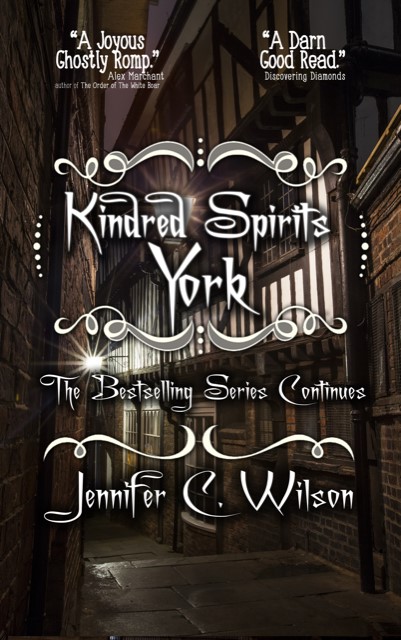
In the ancient city of York, something sinister is stirring…
What do a highwayman, an infamous traitor, and two hardened soldiers have in common? Centuries of friendship, a duty to the town, and a sense of mischief – until they realise that someone is trying to bring chaos to their home.
Joining forces with local Vikings, the four friends keep an eye on the situation, but then, disaster strikes.
Can peace be restored both inside and out of the city walls?
Alison Morton is the author of Roma Nova thrillers – INCEPTIO, PERFIDITAS, SUCCESSIO, AURELIA, INSURRECTIO and RETALIO. CARINA, a novella, and ROMA NOVA EXTRA, a collection of short stories, are now available. Audiobooks are available for four of the series. NEXUS, an Aurelia Mitela novella, will be out on 12 September 2019.
Find out more about Roma Nova, its origins, stories and heroines… Download ‘Welcome to Roma Nova’, a FREE eBook, as a thank you gift when you sign up to Alison’s monthly email newsletter. You’ll also be first to know about Roma Nova news and book progress before everybody else, and take part in giveaways.
If you enjoyed this post, do share it with your friends!
|
Subscribe to Blog via Email
Join 368 other subscribers.
Categories
Archive
|
 Authors love reviews – this is not a secret!