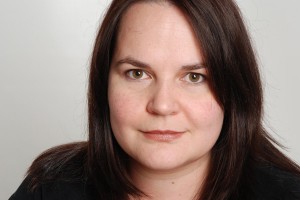
 My guest today is Liesel Schwarz, writer extraordinaire of steampunk adventures. Her heroine reminds me a great deal of Karen/Carina: young women who know their minds, courageous and who try to make sense of the different (to us) worlds they live in. A life-long fan of 19th Century Gothic literature, Liesel is a hopeless romantic and loves Victorians, steampunk, fairies, fantasy monsters, the Fin de Siècle, and the correct way to drink absinthe. My guest today is Liesel Schwarz, writer extraordinaire of steampunk adventures. Her heroine reminds me a great deal of Karen/Carina: young women who know their minds, courageous and who try to make sense of the different (to us) worlds they live in. A life-long fan of 19th Century Gothic literature, Liesel is a hopeless romantic and loves Victorians, steampunk, fairies, fantasy monsters, the Fin de Siècle, and the correct way to drink absinthe.
She also likes Medieval stuff, pirates, zombies, space operas and all subjects in between. She has been very busy with her doctorate in English and Creative Writing at Brunel University and her three books in The Chronicles of Light and Shadow series: A Conspiracy of Alchemists, A Clockwork Heart and, this June, Sky Pirates. She lives in London and is definitely a cat person.
Welcome, Liesel! You write in an alternative reality where technology based on steam prevails but social attitudes and values haven’t progressed much beyond in ‘real life’ Victorian society. How have you reconciled the ‘girl’s own adventure’ of your tough protagonist Elle with these values?
I think this was one of the most interesting and challenging parts of writing the series. I think it is impossible to create authenticity when writing within a certain historical context (whether it be alternative reality or not) without having your characters behave as they would have done in accordance with the attitudes and values of the time.
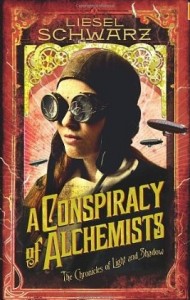 Historical fiction is, in a way, a form of time travel and I think most readers read historical fiction so they can escape to that specific space and time. In a way, the rigid and biased attitudes and values which prevailed in the early 20th century made setting up an adventure story really easy. There was also a precedent for this because there were a surprising number of women from that time who rebelled against the ideals of the time. These women engaged in all manner of professions such archaeology, botany, religious ministry, medicine, artists and many more. At the time, the first proto-feminists were growing the suffragette movement. Women were starting to challenge sexual stereotypes and we see the Bohemian movement and experimentation with all manner of things emerging. All of these ingredients gave me a lot of options that were credible within the historical context and playing with these ideas was great fun. Historical fiction is, in a way, a form of time travel and I think most readers read historical fiction so they can escape to that specific space and time. In a way, the rigid and biased attitudes and values which prevailed in the early 20th century made setting up an adventure story really easy. There was also a precedent for this because there were a surprising number of women from that time who rebelled against the ideals of the time. These women engaged in all manner of professions such archaeology, botany, religious ministry, medicine, artists and many more. At the time, the first proto-feminists were growing the suffragette movement. Women were starting to challenge sexual stereotypes and we see the Bohemian movement and experimentation with all manner of things emerging. All of these ingredients gave me a lot of options that were credible within the historical context and playing with these ideas was great fun.
What has been the most surprising thing – good or bad – on your journey to publication? And during your research?
I think I was just generally surprised by the whole journey to publication. I had hoped it would happen, but I never actually thought I would get published and to this day I still have to pinch myself to make sure it’s not just a figment of my imagination.
I was also quite surprised by the amount of work that goes into producing a book. Things like all the various rounds of edits, cover design and promotion. I don’t think many people actually realize how many hours go into the creation of a book.
I think the manner in which people respond to one’s work is truly surprising. Both good and bad. On the whole, I have been absolutely overwhelmed by positive responses to my work and that is one of the best things ever.
 As for my research, I often stumble on things that the Victorians and Edwardians invented. I look at these and think, ‘No way! No one is going to believe that was a real thing if I put it in a book.’ As for my research, I often stumble on things that the Victorians and Edwardians invented. I look at these and think, ‘No way! No one is going to believe that was a real thing if I put it in a book.’
I have to admit that I am quite a fan of Victorian “wellness” technology. Strange miracle tinctures, odd medical accouterments – all of which was invented in a time when things like electricity was still a mystery. I love looking at the old advertisements for those. One of my favourite inventions is an electric corset that apparently assisted with backache.
I’ll go for anything that saves backache!
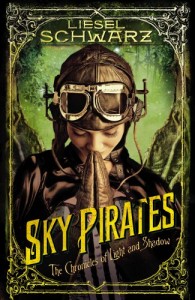 Liesel’s new book, Sky Pirates, the third in The Chronicles of Light and Shadow, is out in June. Here’s a taster… Liesel’s new book, Sky Pirates, the third in The Chronicles of Light and Shadow, is out in June. Here’s a taster…
For Eleanor ‘Elle’ Chance, the last year has been hard. Her husband is lost. Her duty as the Oracle is a blessing and a curse. If it wasn’t for her work, piloting the Water Lily and exploring the world, she would have nothing left to cling on to.
But as a routine cargo mission to the Sudan offers unforeseen opportunities, the council of Warlocks has fallen under the sway of the Shadow Master, and he has plans for the Oracle…
Liesel’s website: http://www.lieselschwarz.com
Alison Morton is the author of Roma Nova thrillers, INCEPTIO, and PERFIDITAS. Third in series, SUCCESSIO, is out early summer 2014.
If you enjoyed this post, do share it with your friends!
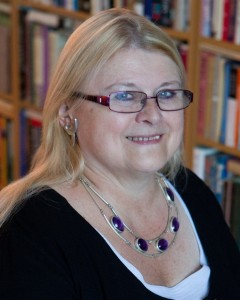 Photo: Jack Ladenburg I’m delighted to welcome my friend Carole Blake to my blog today to give an insight into one of the hottest questions in the publishing today. Carole has just celebrated 50 years in the publishing business, so she probably knows a thing or two. In 1977, after 14 years in publishing, Carole started her own literary agency which merged with Julian Friedmann’s agency to become Blake Friedmann in 1982. She is a past President of the Association of Authors’ Agents and author of From Pitch to Publication, a must-read for any writer wishing to understand the publishing industry. An updated version is due out in 2015.
Welcome, Carole. In the changing publishing world, one question I see debated everywhere, and with enthusiasm, is whether a writer needs an agent in today’s publishing environment.
Yes. And no. Many authors, especially self-published ones, manage everything for themselves now and many do it really well. Many authors are writing in areas that will not attract agents, so they have no choice.
But, of course, I think an agent is only a good thing for a writer: I’ve been an agent for 37 years and I know there are many things we do for our clients that would be difficult for them to accomplish alone.
Handling your own marketing, selling yourself, takes time and a certain kind of personality too. Having an agent represent you gives you a broader spread of influence, a bigger reach, access to many more contacts A good agent fights for you on many fronts and brings their experience to your career. I can’t imagine an author alone, negotiating their contract with a gigantic multi-national conglomerate publisher and getting the concessions that agencies do. An author without an agent simply wouldn’t have experience of enough contracts to know what was achievable. Even Amazon, with their ‘White Glove’ programme, offer agented authors who epublish via them, much higher royalty packages than unagented authors, and access to more promotions.
As publishers are sold, merge, go under, an agent represents stability in an unstable industry; continuity as publishing staff come and go. Agency staff change too, of course, but much less frequently than at publishing houses. Some of my clients have been with me for more than 30 years, yet they all find their editor, publicist or publisher (sometimes all three!) has changed. The market is a jungle. An author alone can’t expect to stay abreast of everything, especially if they are having to devote time to their marketing and are having to sell their own books.
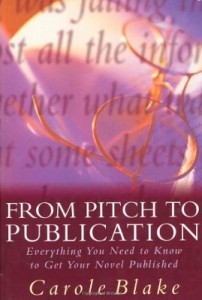 In addition to wide negotiating experience, agencies have staff to sell the rights they withhold from UK publishers: US, translation, film, television, stage, audio being the most common. Every extra strand of income we negotiate for our clients, every new language, every new right, brings more income and a greater visibility for the author. In addition to wide negotiating experience, agencies have staff to sell the rights they withhold from UK publishers: US, translation, film, television, stage, audio being the most common. Every extra strand of income we negotiate for our clients, every new language, every new right, brings more income and a greater visibility for the author.
Agents only get paid when they pay their clients (by law we must have separate client accounts, like lawyers). That certainly focuses the mind! We have a common purpose, and we share together in the successes. And we are there to encourage if things go wrong.
Many of my authors are published in more than 30 languages. That means that every time they deliver a manuscript I can anticipate selling it over and over again, without the writer having to do any more work. My agency has a network of overseas agencies that sell our list, and we have staff who deal with publishers around the world. Our preparation for international book fairs is military-like in its precision. My staff and I bring our decades of experience to bear on the work of the authors we represent, and take a huge satisfaction in presenting them with multiple deals over a range of formats and languages.
Thank you, Carole, for such a clear explanation for the readers. I’m looking forward to your update of From Pitch to Publication next year.
Alison Morton is the author of Roma Nova thrillers, INCEPTIO, and PERFIDITAS. Third in series, SUCCESSIO, is now out.
Find out about Roma Nova news, writing tips and info by signing up for my free monthly email newsletter.
If you enjoyed this post, do share it with your friends!
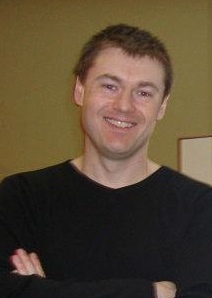 Today, I’m delighted to welcome Russell Whitfield (Just Another Freaking Roman Author or “JAFRA”). Russell was one of Roma Nova’s early supporters and endorsed INCEPTIO. Gladiatrix, Russ’s first novel, was published in 2008 by Myrmidon Books. The sequel, Roma Victrix, continues the adventures of Lysandra, the Spartan gladiatrix. A third book is planned for release in 2014. Today, I’m delighted to welcome Russell Whitfield (Just Another Freaking Roman Author or “JAFRA”). Russell was one of Roma Nova’s early supporters and endorsed INCEPTIO. Gladiatrix, Russ’s first novel, was published in 2008 by Myrmidon Books. The sequel, Roma Victrix, continues the adventures of Lysandra, the Spartan gladiatrix. A third book is planned for release in 2014.
I understand from fellow Roman author Ben Kane that you’re going on a “boys’ own adventure” walk from Capua to Rome. Tell us more about the what and why!
Well – last year, after a few too many lagers, Ben reckoned on that doing a team walk across Hadrian’s Wall – together – would be great. Tony Riches had done one before in full kit (the stuff that I ended up wearing in the end) and we foolishly agreed.
 It was really quite tough at times, especially if you’re a forty-something-fat-bloke and not a hard-as-nails-twenty-something legionary; physically taxing, but the trip was made much more bearable because we had real-life Indiana Jones Mike Bishop with us. Mike’s an eminent archaeologist and knows all there is to know about Hadrian’s Wall, so it was fascinating to learn about the sites as we walked along. It was really quite tough at times, especially if you’re a forty-something-fat-bloke and not a hard-as-nails-twenty-something legionary; physically taxing, but the trip was made much more bearable because we had real-life Indiana Jones Mike Bishop with us. Mike’s an eminent archaeologist and knows all there is to know about Hadrian’s Wall, so it was fascinating to learn about the sites as we walked along.
As to the why, well – we support two charities – Médicins Sans Frontières (or Doctors Without Borders) and Combat Stress. They really are worthy causes, but to be honest, one of the most touching thing that happened on the Hadrian’s Wall walk was that we ran into a bunch of Gurkhas who were on holiday. They were really amazed that we were mad enough to do this to help a cause that was clearly close to their hearts.
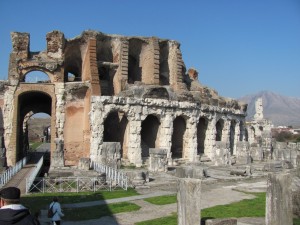 Amphitheatre at Capua Also, a few months after the walk, I was watching the telly and there was a huge disaster in the Philippines. At the time, I was certain that I would never do another walk again, but as I watched the telly, the first people on the scene were Médicins Sans Frontières and I sort of realised that I had, in a tiny way, helped those guys. So I had to do the walk again after that.
It’s going to hurt, though. 😉
You and I met at the Historical Novel Society 2012 Conference and you very kindly endorsed INCEPTIO for me. I loved your Gladiatrix and Roma Victrix about a female gladiator. What are you writing now?
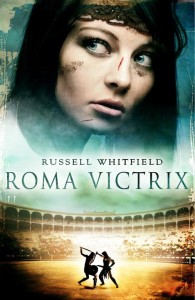 No problemo, loved the book and I’m thrilled that you liked Gladiatrix and Roma Victrix too! No problemo, loved the book and I’m thrilled that you liked Gladiatrix and Roma Victrix too!
I’ve written a few film scripts that we’re trying to get off the ground – they’re not historical, just some contemporary action stuff and couple of thrillers. It has been all consuming, though, and it kept me away from Lysandra and the arena for some time.
However, I’m now working on Gladiatrix III – Imperatrix. which should be done by October this year. It’s actually great to get back into proper writing. Script-writing is a totally different discipline… which I didn’t know when I first started trying it out.
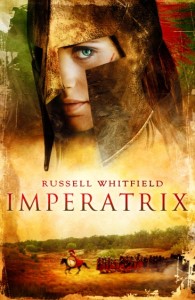 I’m happy to be back with Lysandra and her friends. I’m trying to keep things fresh in this new book but at the same time retain the stuff the people enjoyed in the first two, but it’s turning into a slightly different animal. I guess it’s because the focus isn’t so much on arena fighting and training and that sort of thing. There still will be fighting and training though! Just of a different kind. I’m happy to be back with Lysandra and her friends. I’m trying to keep things fresh in this new book but at the same time retain the stuff the people enjoyed in the first two, but it’s turning into a slightly different animal. I guess it’s because the focus isn’t so much on arena fighting and training and that sort of thing. There still will be fighting and training though! Just of a different kind.
Thank you, Russell, and the very best of luck with the walk. Now, the causes Russell mentioned are excellent ones and I’d encourage you to cough up a few pounds/dollars/euros at the official fundraising page.
A little more about Russell…
Russell Whitfield was born in Shepherds Bush in 1971. An only child, he was raised in Hounslow, West London, but has since escaped to Ham in Surrey.
Russell has had an (almost) lifelong fascination with ancient Greece and Rome, sparked by seeing the The Three Hundred Spartans on ITV in the seventies. Educated to A-Level, he did not complete college, preferring instead to seek fame and fortune in a heavy metal band. Sadly, fame and fortune were not forthcoming and a career in telesales beckoned. A series of jobs followed culminating in the heady heights of ‘content editor’ for a large multi-national.
Gladiatrix was Russ’s first novel, published in 2008 by Myrmidon Books. The sequel, Roma Victrix, continues the adventures Lysandra, the Spartan gladiatrix, and a third book is planned for release in 2014.
In an attempt to stave off an ever increasing beer-gut, Russ trains in the martial arts, but his training thus far has left little impression on said gut – or his class mates for that matter.
Heavy Metal is Russ’s music of choice, though he was also in a goth band and thus has the obligatory Sisters of Mercy and Mission CDs in his collection and photographs of Russ with dubious hairstyles have emerged on the internet.
He is a huge fan of the Swedish band Hysterica (www.hysterica.se) and has written a song for their album The Art of Metal.
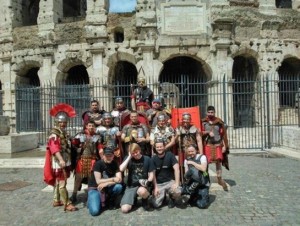 UPDATE: They reached Rome and here’s the picture to prove it! I spoke to Ben Kane on 12 June and he reported they’d raised over ££16,321, and counting.. UPDATE: They reached Rome and here’s the picture to prove it! I spoke to Ben Kane on 12 June and he reported they’d raised over ££16,321, and counting..
Macte!
Here’s the donation link again:
http://uk.virginmoneygiving.com/fundraiser-web/fundraiser/showFundraiserProfilePage.action?userUrl=RomaniWalk2014&isTeam=true
Alison Morton is the author of Roma Nova thrillers, INCEPTIO, and PERFIDITAS. Third in series, SUCCESSIO, is out early summer 2014.
If you enjoyed this post, do share it with your friends!
 Deadline 1 April 2014! Deadline 1 April 2014!
The Historical Novel Society seeks to support writers of new historical fiction by the HNS International Awards – a series of competitions for previously unpublished short stories and novels.
The 2014 Historical Novel Society International Award, with a prize of $2,000, will be for an outstanding historical short story. There will be an entry fee of $15 per story ($5 for members of the Historical Novel Society), and entries must be between 1,000 and 5,000 words. Submissions will be accepted from 1st December 2013, with a deadline for submissions of 1st April 2014.
For an idea of the quality of story we are looking for, please see the first HNS anthology, The Beggar at the Gate.
Your story in English can be in any genre of historical fiction but set at least fifty years ago. Entry is open to authors regardless of age or nationality and whether or not previously published. Full rules here.
Good luck!
Alison Morton is the author of Roma Nova thrillers, INCEPTIO, and PERFIDITAS. Third in series, SUCCESSIO, is out early summer 2014.
If you enjoyed this post, do share it with your friends!
 Today, I’m thrilled to welcome Jane Thynne to my blog. Jane has worked as a journalist for the BBC, The Sunday Times, The Daily Telegraph, and The Independent. She has been a panellist on the BBC Radio 4 literary panel game The Write Stuff on many occasions and was a member of the judging panel for the Oldie of the Year award in 2010 and a judge for the Best Online Only Audio Drama award of the first BBC Audio Drama Awards in 2012. Her first novel, Patrimony, was published in 199 followed by The Shell House in 1999, The Weighing of the Heart in 2010 and Black Roses in 2013. Today, I’m thrilled to welcome Jane Thynne to my blog. Jane has worked as a journalist for the BBC, The Sunday Times, The Daily Telegraph, and The Independent. She has been a panellist on the BBC Radio 4 literary panel game The Write Stuff on many occasions and was a member of the judging panel for the Oldie of the Year award in 2010 and a judge for the Best Online Only Audio Drama award of the first BBC Audio Drama Awards in 2012. Her first novel, Patrimony, was published in 199 followed by The Shell House in 1999, The Weighing of the Heart in 2010 and Black Roses in 2013.
Jane and I share a fascination not only for Berlin but for the lives of women during the Third Reich in Germany, mine non-fiction, hers spy thrillers in the world of the Nazi leaders’ wives, so it seemed natural to grill her about this…
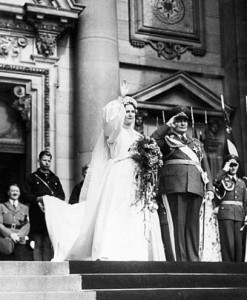 Goering marriage What attracted you to writing about women in Nazi Germany and having a woman protagonist in what has been depicted as a very male-dominated period?
The lives of German women under Hitler – like so much in the Third Reich – was rife with contradictions. It was an intensely misogynistic regime, and yet Hitler received more fan-mail than The Beatles and Mick Jagger put together. No one encapsulated these ironies more than the senior Nazi wives, who were expected to embody Nazi values but diverged from them in dramatic ways. We know a little of what it felt like because several of them, such as Emmy Goering, wrote memoirs about their lives. In many cases they were an important influence on their husbands – some of them, like the wives of von Ribbentrop and Heydrich – more Nazi than their men. Others, like Frau Goering, the wife of Baldur von Schirach, actively interceded with their husbands on an occasional basis to save friends.
But I was also interested in the lives of ordinary women, trying to live under an increasingly restricted, totalitarian regime. In my new novel, The Winter Garden, a murder takes place in a Bride School, one of those institutions established in 1935 by Himmler for women hoping to marry into the SS. Women actually had to gain a certificate in order to qualify for their wedding. Incredible!
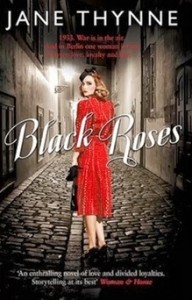 It seemed a good idea to make Clara Vine, my protagonist, an Anglo-German actress. Berlin was the centre of European film making – it really was the Hollywood of Europe. Actresses occupied an uneasy middle grown between ‘respectable’ women and celebrities and with acting also came many metaphors around playing a role and spying. It seemed a natural fit. It seemed a good idea to make Clara Vine, my protagonist, an Anglo-German actress. Berlin was the centre of European film making – it really was the Hollywood of Europe. Actresses occupied an uneasy middle grown between ‘respectable’ women and celebrities and with acting also came many metaphors around playing a role and spying. It seemed a natural fit.
Your period detail was rich and cleverly present throughout Black Roses. Do you have an affinity or special knowledge of Germany or was it a hard slog?
It’s impossible not to be intrigued by the country at the centre of the seismic event of the twentieth century. And if you’re interested in Germany, your eyes naturally turn to Berlin. I’ve walked the streets of Berlin over and over in reality and every day in my head for the past couple of years. It’s strange seeing your own imaginary Berlin like a palimpsest under the modern, rebuilt Berlin, but It helps that I have a working knowledge of German and I visit a couple of times a year.
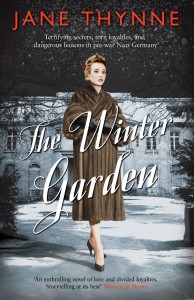 Thank you, Jane. I loved Black Roses which Jane talked about at the Harrogate History Festival last October and the sequel, The Winter Garden, is on my TBR pile. Thank you, Jane. I loved Black Roses which Jane talked about at the Harrogate History Festival last October and the sequel, The Winter Garden, is on my TBR pile.
Jane has kindly donated a copy for a giveaway and one lucky winner will win it in a draw. All you have to do is make a (sensible) comment by 22 March and your name will go in the hat!
Goering marriage photo from Bundesarchiv, Creative Commons Licence
Alison Morton is the author of Roma Nova thrillers, INCEPTIO, PERFIDITAS, SUCCESSIO and AURELIA. The fifth in the series, INSURRECTIO, was published in April 2016.
Find out Roma Nova news and book progress before everybody else, and take part in giveaways by signing up for her free monthly email newsletter.
If you enjoyed this post, do share it with your friends!
|
Subscribe to Blog via Email
Join 368 other subscribers.
Categories
Archive
|