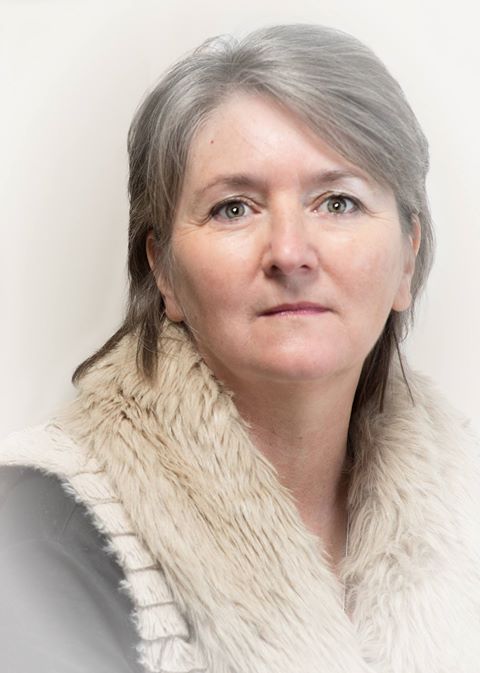
 I’m delighted to welcome back the award-winning Welsh author and photographer Jean Gill on the occasion of the publication of her new book, With Raven Wine.
Jean lives in Provence, in France, with the best scent-hound in the world, a Nikon D750 and a man. Best known for writing epic medieval adventures in The Troubadours and The Midwinter Dragon series, Jean has published 27 multi-genre books since 1988, including the dog bestseller Someone To Look Up To.
Although she’s hung up her beekeeping gloves, she still cares about her wild neighbours, which include boar, badgers, foxes and hares.
For many years, Jean taught English, and was the first woman to be a secondary headteacher in the Welsh county of Dyfed. She is mother or stepmother to five children so life was hectic. With Scottish parents, Welsh and French residence and an English birthplace, she can usually shout for the winning team in sporting events.
I’ve been looking forward to reading this new book, the fourth and (sadly) final in the Midwinter Dragon series, a re-imagining of the Orkneyinga Saga in the 1150s.
Over to Jean to give us a glimpse of an epic journey (in several meanings of the word epic).
Who is the ‘barbarian’?
Everyone knows that medieval Vikings sailed extraordinary distances as traders. Their sagas and poetry are very modern in extolling the benefits of travel in broadening the mind. But how were they received in the countries they visited? And were they as bemused by the uncivilised behaviour of their hosts as vice versa? Respect for other cultures – or lack of it – happens in both directions.
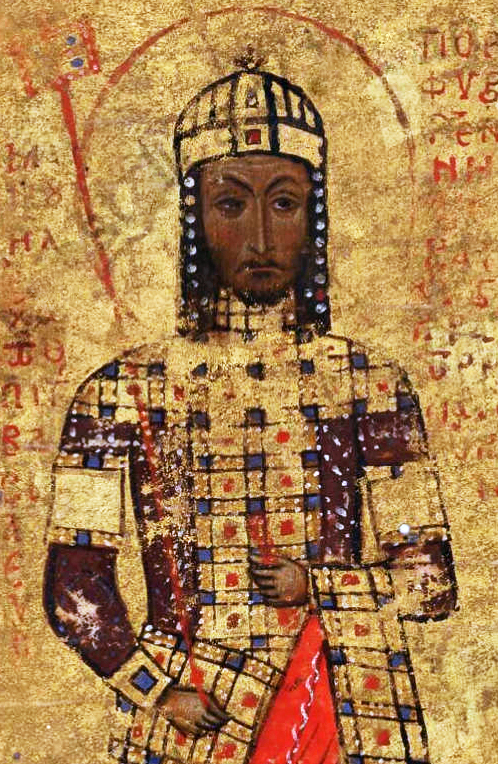
Manuel Comnenus, part of double portrait with Maria of Antioch, circa 1150 (Public domain, Vatican Library, Rome)
In With Raven Wine, Jarl Rognvald’s company of 12th century Orkney Viking pilgrims are guests at the court of Manuel Komnenos, the Emperor of the Eastern Roman Empire (also known as Byzantium, and now Greece), on their way home from Jerusalem. This is related in the Orkneyinga Saga as historically true.
One of Rognvald’s band is my fictional character, warrior-poet Skarfr, and we see the scene below through his eyes, as he attends the emperor. Manuel is head-hunting Skarfr to be one of his celebrated Varangian bodyguard, highly skilled Vikings who traditionally formed the closest level of military protection to the ruler.
My research turned up an amazing 11th century Greek book of court protocol entitled The Book of Ceremonies, which detailed what the emperor should wear, say and do on all important occasions. It also gave the rules for a thoroughly racist game. As the book was still dictating ceremonial behaviour in Manuel’s time on the throne, I wondered, ‘What if the emperor and his cousin Andronikos were drunk and bored, and remembered the game…’
Uh-oh!
Excerpt from With Raven Wine
Andronikos forced a laugh. ‘Do you remember the Goth Game?’ he asked Manuel. ‘From The Book of Ceremonies. I don’t think I ever saw it played, but my grandfather did. What if we revived the game?’
Manuel brightened at the prospect of distraction. ‘I do remember. According to the book it was to be played on the ninth day to Epiphany, so the Patriarch would approve of us keeping so religiously to tradition.’ When he slurred the word religiously Skarfr realised how drunk the emperor was. As the Patriarch was happily absent from the feasting, he could not offer his approval in person, and Skarfr had no doubts that the ‘game’ proposed was malicious in intent.
Manuel and Andronikos tried to remember the rules. ‘Two sides — the Greens on one side and the Blues on the other. Two men acting as Goths on each side—’
‘—With their furs inside out!’ said Manuel, which for some reason induced hilarity in both men.
‘Then the Goths make the grunts and growls that pass for language among such barbarians.’
‘And the Greens, or Blues, as the case may be, reply in a civilised manner with the set responses to wish the emperor long life. It is a lesson to barbarians on how to behave in the City!’ Manuel explained.
‘And it’s funny,’ Andronikos pointed out. ‘Who should play the Goths? That’s the funniest part, gabbling away with nobody understanding a word.’
‘What about Nico?’ suggested Manuel.
Nico, a serious old man with only one tuft of white hair left on his head, said, ‘If my Lord so wishes,’ with an air of resignation.
‘I know,’ said Andronikos, as if struck by a brilliant idea. ‘What about Skarfr? He would look the part and he could even speak that Varangian language they use, then he would sound the part too. He could recite some of that poetry he composes.’
‘That would be funny,’ agreed Manuel, almost giggling.
Skarfr was seeking the polite words with which to say he’d rather die than be so dishonoured when three men in red uniforms came from the back of the hall to approach the Emperor.
Read on in With Raven Wine to find out what happened next!
What’s With Raven Wine about?
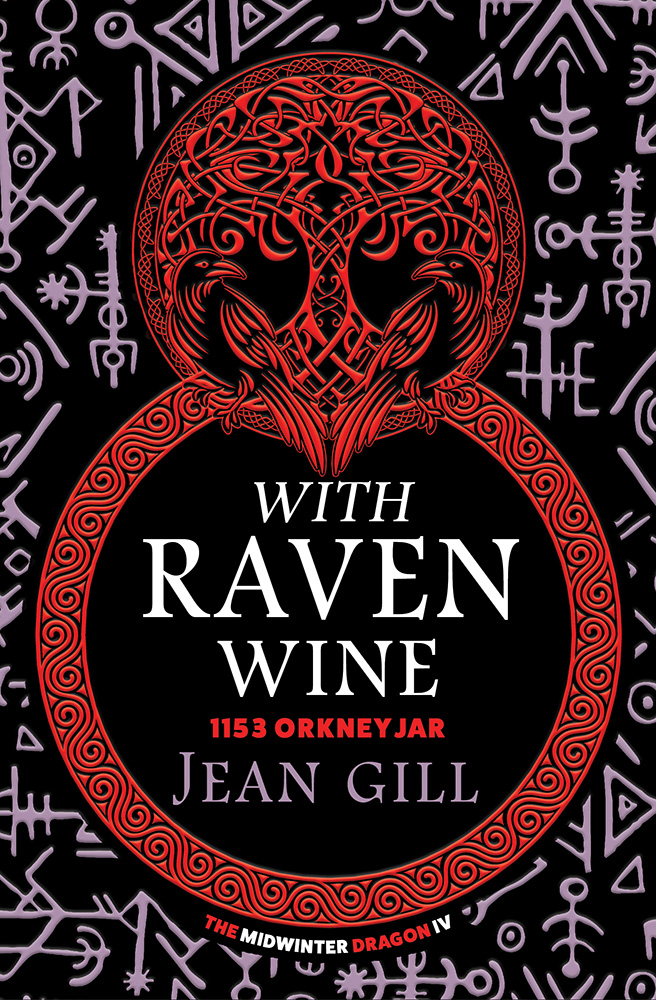 Gifts from the gods come with a price. Warrior-poet Skarfr Kristinsson has crossed the world, facing exile and battles. Forgiven at last by his lord Jarl Rognvald, he is restored to honour but destiny is not done with him yet.
From the holy waters of the River Jordan to the gilded intrigues of Constantinople, Skarfr and his formidable trader-wife Hlif are drawn into a web of ambition, betrayal and vengeance. Hlif’s dangerous gift of dream-walking allows her to cross into the shadow world where the old gods still rule and where fate can be glimpsed, but never escaped.
While the pilgrim fleet is far from home, Orkney descends into chaos. Old grudges ignite, loyalties fracture, and blood is spilled, the ‘raven wine’ of sagas.
Epic, brutal and lyrical, With Raven Wine is the powerful conclusion to Jean Gill’s award-winning Midwinter Dragon series, a re-imagining of the Orkneyinga Saga, perfect for readers who love Madeline Miller, Bernard Cornwell and Matthew Harffy.
——
The gripping conclusion to an award-winning series. Don’t just read Viking history – live it!
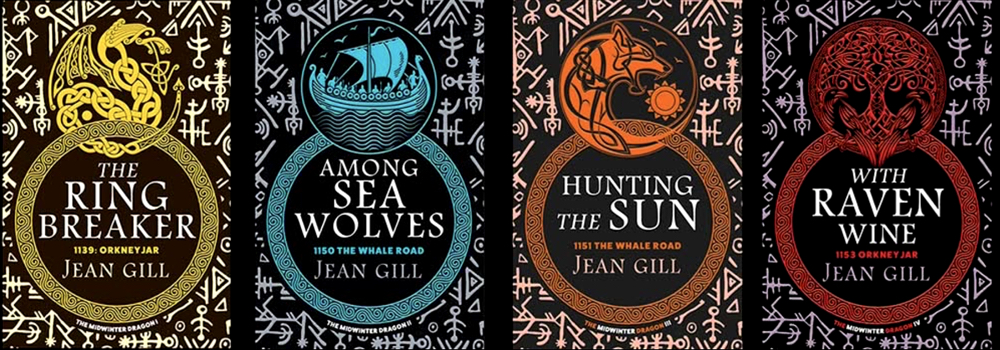
Praise for the series ⭐⭐⭐⭐⭐ “A yarn fit for a Norse saga. Full of action, poetry and heart; a thrilling voyage through the vibrant world of the twelfth century.” Matthew Harffy
Buy With Raven Wine here: https://www.books2read.com/RavenWine
My thoughts
Well, it had to come. The Midwinter Dragon series is coming to its end. I shall miss Skarfr and Hlif. I’ve watched their struggles from childhood and their evolution into mature, strong adults. Of course, it’s Jean Gill’s skill that binds us to them and their fate. But she reveals other characters – Rognvald, Inge, Brigid, Fergus, Thorbjorn Klerk and Harald – in their nobility, suffering, scheming, loyalty, weakness and resolve with such deftness that they seem like living, breathing people.
Pilgrimage, which is at the heart of the book, is a strange motivation to most 21st century people, but in the 12th century, it was an intense spiritual journey undertaken in arduous circumstances; the more arduous the better for the pilgrims’ immortal souls. The effect on, for instance Rognvald of bathing in the River Jordan, touches him deeply, but he still remains a hard-headed and effective leader in a violent age.The crucial intertwining of physical and spiritual worlds dimensions unknown to us, but so real to the characters, especially Hlif and Skarfr – an essential part of their existence.
Byzantine opulence is a far cry from Republican Rome’s military austerity, but the Eastern Roman Empire is as full of intrigue and political conspiracy as the Republic in the west in Julius Caesar’s time. The author draws us deftly in so that we feel the ripple of silk, smell the perfumed gardens and relax in the steaming hot baths so well that we almost don’t notice the traps and corruption that lie beneath.
This is such a well-written book that I dreaded it ending and even more so the whole series. I can’t wait to see what Ms Gill gives us next.
Alison Morton is the author of Roma Nova thrillers – INCEPTIO, CARINA (novella), PERFIDITAS, SUCCESSIO, AURELIA, NEXUS (novella), INSURRECTIO and RETALIO, and ROMA NOVA EXTRA, a collection of short stories. JULIA PRIMA and EXSILIUM, set in the late 4th century, tell the story of Roma Nova’s foundation. Audiobooks are available for four of the series. Double Identity, Double Pursuit and Double Stakes form a new contemporary thriller series. A new collection of Roma Nova short stories, HEROICA, is now out.
Find out more about Roma Nova, its origins, stories and heroines and taste world the latest contemporary thriller Double Identity… Download ‘Welcome to Alison Morton’s Thriller Worlds’, a FREE eBook, as a thank you gift when you sign up to Alison’s monthly email update. As a result, you’ll be among the first to know about news and book progress before everybody else, and take part in giveaways.







Thank you for inviting me onto your blog,Alison, and for taking the time to give your thoughts as you’re reading my novel. And what wonderful thoughts! You’ve made my day! What next is a BIG question and wide open at the moment. I’m waiting for readers’ reactions and hopes for what I write next – or for a ‘woo-woo moment’ as happened in 2018 when I saw Viking runes and a dragon, in Maeshowe burial chamber, Orkney, and ‘The Midwinter Dragon’ series was born.
A pleasure to host your wonderful book. Now, is that a teasing moment about possibly extending the series? Your fans wait…
🙂 I have no plans but MANY ideas. If readers like the idea, my short story in ‘Courage’ might turn into a novel… but it will have to fight with four stories all shouting ‘Write me next!’ in my head and I can’t write them all!
I know the feeling!
loved this book!
An immersive read!
Thank you both!