Oo-er! The SUCCESSIO paperback is starting to appear in online shops…


(It’s in euros because that’s my local currency 😉 )
Alison Morton is the author of Roma Nova thrillers, INCEPTIO, and PERFIDITAS. Third in series, SUCCESSIO, is out June 2014.
|
|
||
|
Oo-er! The SUCCESSIO paperback is starting to appear in online shops…
(It’s in euros because that’s my local currency 😉 )
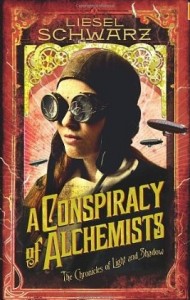
Alison Morton is the author of Roma Nova thrillers, INCEPTIO, and PERFIDITAS. Third in series, SUCCESSIO, is out June 2014. 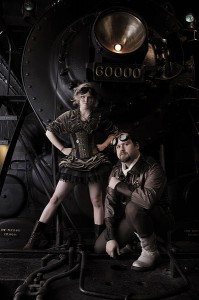 Steampunk themed photo: Kyle Cassidy When people ask me about my books, I say ‘Thrillers – alternative history thrillers.’ ‘Oh, steampunk, then?’ I gnash my teeth, but put on a pleasant smile. ‘No, actually, they’re adventure stories set in our world, but where history evolved alternatively.’ ‘Oh, steampunk, then?’ ’No, that’s more fantastical and based on Victorian technological ideas.
My alternative history world exists in the 21st century based on the difference caused by a small dissident Roman colony surviving from ancient times.’ ‘Oh, not steampunk, then?’ ‘No, steampunk is a separate sub-genre of science fiction with steam-powered machinery, inspired by industrialised society of the 19th century. Recently, it’s expanded from the Victorian period into American West or post-apocalyptic-themed, sometimes off-world.’ ’So it’s not alternative history?’ ‘In a way, because it’s one version of a possible historical development, but often with fantasy elements such as fairies and other planets which tip it more into fantasy or science-fiction proper.
‘God, it’s complicated!’
‘Okay, good tip.’ She picks up INCEPTIO and PERFIDITAS and hands over 22€. I smile and wish her happy reading. She turns and asks, ‘So when are you going to write a proper steampunk story?’ I collapse on to my chair and weep. Much more detail here on what alternate history is really about.
Alison Morton is the author of Roma Nova thrillers, INCEPTIO, and PERFIDITAS. Third in series, SUCCESSIO, is now out. Find out about Roma Nova book progress, news, writing tips and info by signing up for my free monthly email newsletter.
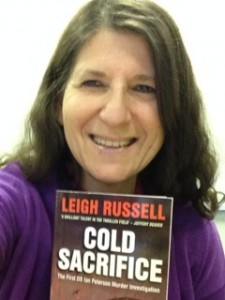
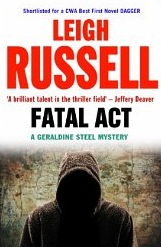
Now I only have two questions for you, Leigh, but you need to answer them fully. Anything you say…Well, you know the rest. Ever since Geraldine Steel burst on to the (crime) scene, she has had unparalleled success (CWA awards, #1 on Amazon, Eurocrime Top Read and hundreds of 5 star reviews); readers have taken her to their hearts. What makes her such an attractive heroine? Of course, there can be a number of motives driving such behaviour. It seems to me there is always an element of madness about it. Do you remember Anders Breivig who killed eight people in Norway and claimed to be sane? All I can say is, if that is sane behaviour, then I must be even more crazy than I thought, because I don’t believe that killing other people is ever a sane way to behave. I am opposed to physical violence of any kind. Aggression is never an answer to a problem. And yet… if someone was threatening the life of a member of my family, and I had a gun – and knew how to use it – would I pull the trigger? Of course I would. Does that mean I’m insane? When I started writing, it was the killer, and not my detective at all, who engaged my attention. I wrote pages and pages about him, “taking the reader into the darkest recesses of the human psyche”, as Barry Forshaw kindly said of my books. Having established the premise for my debut, Cut Short, and explored the lives of my killer and his victims, the next step was to introduce a detective to solve the crime. So Geraldine Steel was created. You might think – as I did – that a credible ‘normal’ detective would be far easier to create than a plausible killer. Paradoxically, Geraldine took longer to emerge than that first killer. Creating a detective inspector imposes certain restraints. She has to behave in a way that is believable. So I had to stay within certain unwritten parameters of ‘normality’ if my readers weren’t going to dismiss my story as too far-fetched. I have a following on the police force. They know what life is like for a detective inspector. So I wanted to get my detective right. With my killer I had absolute artistic and creative licence to make him do whatever I wanted. He didn’t need to be sane. His actions needed to make sense only within the world of his own mind. No reader could say to me, ‘I don’t believe a killer would do that,’ because how would the reader know what might go on in a killer’s mind? Writing my killer, I was free of all rules. It was incredibly liberating. Readers’ reactions to both Geraldine Steel and Ian Peterson has taken me completely by surprise. Some of my fans know more about my detectives than I do! I am really grateful to the many fans who contact me wanting to know about them. It has been genuinely surprising, and really thrilling. So if you are a fan of my work – thank you! What is the most frequent question that fans/readers ask you and how do you answer it? Here are the remaining UK publication dates for 2014. The sixth Geraldine Steel title, Fatal Act, is available in paperback this month. The seventh will be out as an ebook in December, as yet untitled. The second Ian Peterson title, Race to Death, is out as an ebook in June, with the paperback out in September. …And looking at that schedule, I think I’d better get back to writing! Thank you very much for inviting me onto your blog, Alison. I look forward to seeing you at the St Clementin Literary Festival in France in August! After chatting together at the London Book Fair in April, it will be great to meet up with you again in France, Leigh! More about Leigh on her website 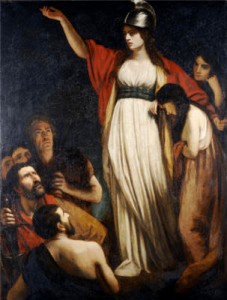 “Boadicea Haranguing the Britons” by John Opie (1761-1807) ‘Tough’, ‘feisty’, ‘kick-ass’ – clichés, ironic or signposts? And, provocative question, would you apply them to men? Perhaps the first one and possibly the third, but I can’t remember reading about a ‘feisty hero’. That aside, how do you recognise a tough heroine?  Violette Szabo GC Or perhaps Violette Szabo – a true story immortalised in Carve her Name with Pride – courageous, understated, self-sacrificing Some common themes here… So how do you write a tough heroine?
Beware of bunny rabbits and kittens…
Courage doesn’t come from ‘boldly going’, but from ‘boldly going’ when you are half scared to death and you’re not at all sure you’re going to get out of the situation without being killed. What do you think makes a strong heroine?
Alison Morton is the author of Roma Nova thrillers, INCEPTIO, PERFIDITAS, SUCCESSIO and AURELIA. The fifth in the series, INSURRECTIO, was published on 12 April 2016. Find out Roma Nova news and book progress before everybody else, and take part in giveaways by signing up for her free monthly email newsletter.
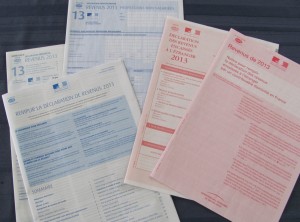
Globally, taxation under the Roman Empire was about 5 percent of gross product. Individuals typically paid from 2 to 5 percent. The tax code was complex; direct and indirect taxes, some paid in cash and some in kind (hopefully not weeks’ old fish). Taxes might be specific to a province (read local authority/state), or special types of property such as fisheries or salt evaporation ponds (rateable value). Tax revenue in Rome had one principal object – to maintain the military. Taxes in kind were accepted from less-monetized areas, especially if it was grain, animals or goods supplied to army camps. The primary source of direct tax revenue was individuals, who paid a poll tax (ha!) and a tax on their land (rates/council tax), construed as a tax on its produce or productive capacity (business tax). Supplemental forms could be filed by those eligible for certain exemptions; for example, Egyptian farmers could register fields as fallow (set aside) and tax-exempt depending on flood patterns of the Nile (tax credits). The amount of tax payable was determined by the census, which required each head of household to make a declaration to the censor’s official and provide a head count of his household, as well as an accounting of property he owned that was suitable for agriculture or habitation. Read Lindsey Davis’ Falco adventure “Two for the Lions” about the room for abuse and how tax collectors could make a not un-useful fee for this work. A major source of indirect-tax revenue was the portoria – customs and tolls on imports and exports – including among provinces. (Thanks to free trade within the EU, we no longer have this in Europe – hooray!) Special taxes were levied on the slave trade. Toward the end of his reign, Augustus instituted a 4 percent tax on the sale of slaves, which Nero shifted from the purchaser to the dealers, who responded by raising their prices. An owner who manumitted a slave paid a “freedom tax”, calculated at 5 percent of value. (No legal modern equivalent, TG, but it does have echoes of stamp duty on property transactions.) Inheritance tax of 5 percent was levied when Roman citizens above a certain net worth left property to anyone but members of their immediate family (inheritance tax). Revenues from the estate tax and from a 1 percent sales tax on auctions went toward the veterans’ pension fund (aerarium militare).(How sensible – MOD, please note.) Low taxes helped the Roman aristocracy increase their wealth, which equaled or exceeded the revenues of the central government. An emperor sometimes replenished his treasury by confiscating the estates of the “super-rich”, but in the later period, the resistance of the wealthy to paying taxes was one of the factors contributing to the collapse of the Empire. (Ouch! A chilling lesson for modern times.) So the principle and methodology of taxation were two more things the Romans did for us. If we’re not careful with the one in the last paragraph, it may do for us as well.
Alison Morton is the author of Roma Nova thrillers, INCEPTIO, and PERFIDITAS. Third in series, SUCCESSIO, is out early summer 2014. |
   
Buy AURELIA from Apple! UK US |
|
|
Copyright © 2026 Alison Morton Author - All Rights Reserved Posts Feed Log in Privacy policy |
||