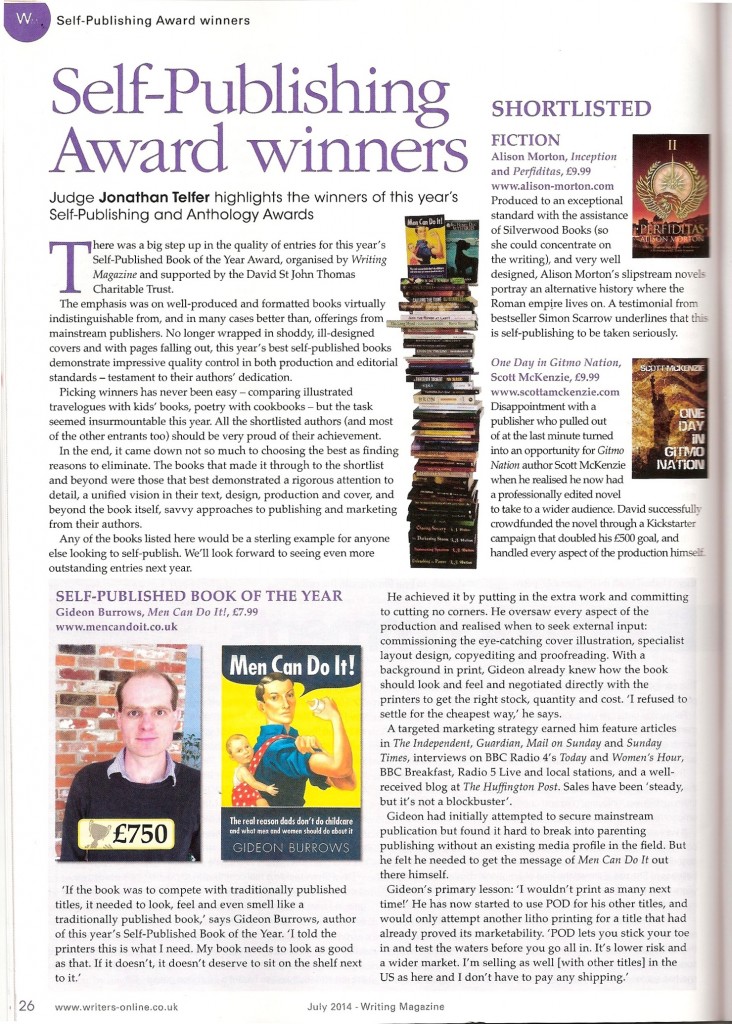
 Several months ago, I entered INCEPTIO and PERFIDITAS for the Writing Magazine self-published book award. With all the work finalising SUCCESSIO, I almost forgot about it. Imagine my pleasure when I came home after the SUCCESSIO launch trip, browsed the July issue of Writing Magazine and found that both books had been shortlisted for the award. Several months ago, I entered INCEPTIO and PERFIDITAS for the Writing Magazine self-published book award. With all the work finalising SUCCESSIO, I almost forgot about it. Imagine my pleasure when I came home after the SUCCESSIO launch trip, browsed the July issue of Writing Magazine and found that both books had been shortlisted for the award.
Of course, it would have been fantastic to have won, but having INCEPTIO and PERFIDITAS as two of the remaining four fiction shortlists was wonderful.
And this is what Writing Magazine said…
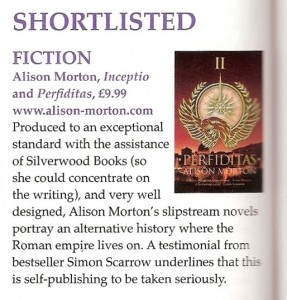 Extract courtesy of Writing Magazine, July 2014
Well, my ego’s been nicely massaged!
Find out about Roma Nova news, writing tips and info by signing up for my free monthly email newsletter.
Alison Morton is the author of Roma Nova thrillers, INCEPTIO, and PERFIDITAS. Third in series, SUCCESSIO, is out now.
If you enjoyed this post, do share it with your friends!Like this:Like Loading...
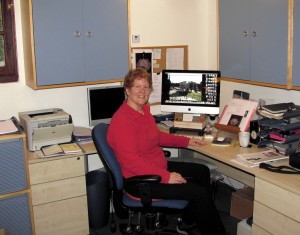 I’ve been tagged by historical fiction author Antoine Vanner in a game of Lucky Sevens. I’ve been tagged by historical fiction author Antoine Vanner in a game of Lucky Sevens.
It’s a bit of online fun for writers that pulls us out of our sheds where we sit scribbling away for hours on end and lets us reveal a little our our current work in progress.
Here is how it’s done:
Go to page 7 or 77 in your current manuscript
Go to line 7
Post on your blog the next 7 lines or sentences – as they are!!
Tag 7 other people to do the same
Now, a lot of people have already done this, so I’m not tagging, but I’m inviting any writers who read this to dare to do the same. 😉 Just let me know if you do and I’ll add your name to this post (free advert!)
So here are seven lines from AURELIA, based in Roma Nova and the Germanic Federation state of Prussia. It’s set in the 1960/70s.
‘Himmel! Is that what was transmitting? It’s tiny.’ He stretched his hand out, an acquisitive look in his eyes. ‘I’ll have to take it as evidence.’
‘No. It’s imperial state property. You have your recording.’
He bent his fingers, beckoning impatiently.
‘Sorry, no.’ I glanced up at him. ‘Anyway,’ I said, trying not to sound smug, ‘you don’t have the hardware to transcribe it.’
For all their famous technologic expertise, the Prussians weren’t a patch on us. We kept our secrets to ourselves. As a tiny country, we had to use every advantage and our technology was one of the most important. Even more than the silver.
I’m finding it quite hard to get into the 1960s/70s era. It’s part of my early life and I’ve forgotten most of it! So, back to research..
STOP PRESS: Two writers have stepped forward to take up the Lucky Sevens challenge – and what fascinating replies they are…
Linda Chamberlain http://nakedhorse.wordpress.com/2014/06/29/some-history-instead-of-horses/
Carol Cooper http://pillsandpillowtalk.com/2014/07/05/the-not-so-secret-game-of-sevens/
Alison Morton is the author of Roma Nova thrillers, INCEPTIO, and PERFIDITAS. Third in series, SUCCESSIO, is out now.
If you enjoyed this post, do share it with your friends!Like this:Like Loading...
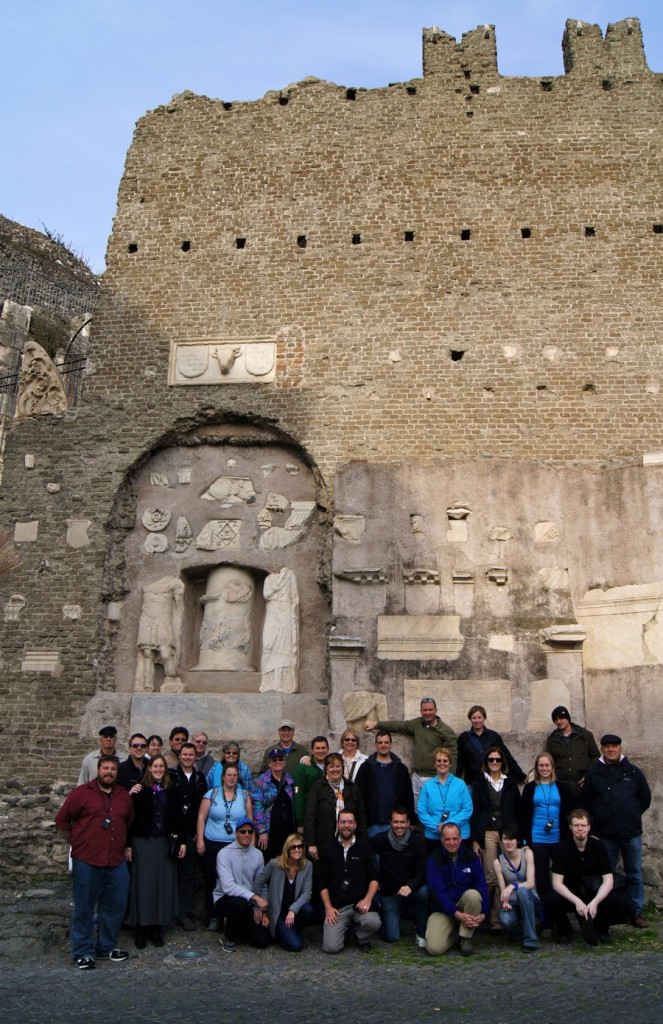 My Roman trip! A ‘holiday’ today means is a specific trip or journey, usually for the purpose of recreation or tourism. But the concept of taking a vacation is a recent invention, and has developed through the last two centuries. Historically, the idea of travel for recreation was a luxury only wealthy people could afford.
Ancient Romans travelled in their ordinary lives – a lot – as did their goods. Soldiers of all ranks were posted to frontiers of Empire; traders traded on sea, in desert cities, on rivers and across land; civil servants on the cursus honorum professional path to fame and riches (they hoped) went off to Baetica, Illyria, Britannia, Noricum or Antioch on government jobs; rich young men were sent to Athens to complete their education. Roman women often travelled with their husbands and fathers when the latter were posted abroad, which could be for years at a time, although many did stay in Rome.
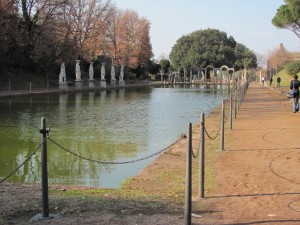 Hadrian’s villa garden. Canopus, designed to recall the Canopus canal, an arm of the Nile River between Alexandria and Abukir. In summer, the Roman elite would take to the hills e.g. Hadrian’s villa at Tivoli, or the Bay of Neapolis. Many went to their estate or farm in the countryside to escape the heat, smells and disease of Rome in the summer. The poor and slaves didn’t have the option unless their employer or master took them along.
But glimmerings of an early tourist trade appeared when Augustus had rid the Mediterranean of pirates, highways were relatively safe for travel, and inns and guides could be found throughout the ancient world’s wonders. Result? Exploration of Italy, Greece, Asia Minor and Egypt became possible for the first time.
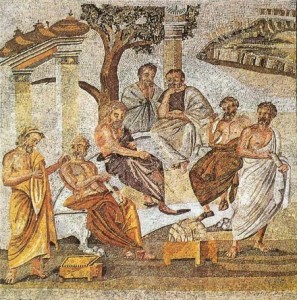 Plato’s Academy (Pompeii mosaic) Wealthier members of society who were educated and sophisticated could travel in groups to visit the great wonders of history and myths they’d read about all their lives. Greece was the favourite destination, particularly Athens where Socrates lived and Plato debated; the Parthenon on the Acropolis was compulsory! And who didn’t want to hear what the oracle at Delphi has to say about your future life?
Asia Minor (roughly modern Turkey) was one of the wealthiest provinces in the empire – all the great spas were there.
But the main attraction was a visit the ruins of Troy (Illium). Quite how genuine an experience it was is questionable. No doubt there were rip-off merchants selling Achilles’ shield, showing them Hector’s sword or pointing out the graves of the various heroes. (Yeah, right)
And no trip was complete without a visit to the pyramids in that exotic and louche country, Egypt, the bridge between Europe, Africa and Asia. And our travellers would bring back souvenirs: statues, fabrics, scrolls of poetry and the odd unmentionable disease. These ‘holidays’ could take up to two years, if you threw in a visit to Petra and Palmyra. A possible parallel is the Grand Tour undertaken by young aristocrats in the 18th and 19th centuries.
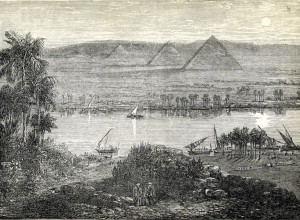 From ‘La terra del Cristo. Viaggio in Oriente’ 1881 But these trips weren’t the rather romantic individual experiences of seeing the wonders of the world in a dreamy and uplifting cloud as the later poets would have us believe. The Romans inhabited a busy, multi-layered and connected world. Going to the Olympic games in Greece was uncomfortable and crowded, and everyone collapsed from heat exhaustion, but they put up with it because it was an amazing spectacle.
And they were used to the noise, bustle and smell of feast/games days back home in Rome.
 Most people’s break from the routine centred on the many feast days celebrating one or other of the gods, the emperor’s birthday, a victory – any excuse, really. During the rule of Claudius, 159 days in the year were designated public holidays, on 93 of which spectacles and games were offered at public expense. Originally, games had religious significance, but under the republic more and more secular games were introduced, some of which lasted as long as a fortnight. Most people’s break from the routine centred on the many feast days celebrating one or other of the gods, the emperor’s birthday, a victory – any excuse, really. During the rule of Claudius, 159 days in the year were designated public holidays, on 93 of which spectacles and games were offered at public expense. Originally, games had religious significance, but under the republic more and more secular games were introduced, some of which lasted as long as a fortnight.
Pretty exhausting all in all. But which is better, going on a holiday overseas with all the excitement, wonder and whiff of danger or on-going days off throughout the year with free public entertainment at home?
Find out about Roma Nova news, writing tips and info by signing up for my free monthly email newsletter.
Alison Morton is the author of Roma Nova thrillers, INCEPTIO, and PERFIDITAS. Third in series, SUCCESSIO, is out now.
If you enjoyed this post, do share it with your friends!Like this:Like Loading...
SUCCESSIO is in the very capable hands of the Historic Fiction Virtual Book Tours (HFVBT) who are organising a mini book tour, called a book blast. It’s mainly to let readers know that the third Roma Nova book is now available.
Follow the Successio Book Blast
June 16: Flashlight Commentary & Princess of Eboli
June 17: Kincavel Korner, Mina’s Bookshelf, & Literary Chanteuse
June 18: Kinx’s Book Nook
June 19: So Many Books, So Little Time, The Lit Bitch, & West Metro Mommy
June 20: Historical Fiction Obsession
June 21: A Bookish Affair & Broken Teepee
June 22: Just One More Chapter
June 23: The Little Reader Library, The True Book Addict and Svetlana’s Reads and Views
June 24: A Bibliotaph’s Reviews & Historical Fiction Connection
June 25: Historical Tapestry & The Maiden’s Court
June 26: Book Nerd & Passages to the Past
June 27: CelticLady’s Reviews
plus there is a giveaway…
Where to buy a copy of SUCCESSIO
Alison Morton is the author of Roma Nova thrillers, INCEPTIO, and PERFIDITAS. Third in series, SUCCESSIO, is now out.
If you enjoyed this post, do share it with your friends!Like this:Like Loading...
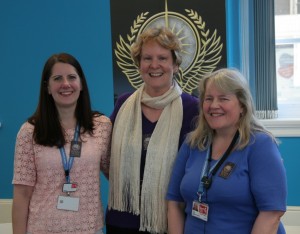 Librarians Emma (left) and Susan (right) After the success of the INCEPTIO evening in Pembury Library in 2013, Susan Rogers, the community librarian, had long wanted me to give a talk in the area central library in Tunbridge Wells, so we arranged it to coincide with the publication of SUCCESSIO, the third of the Roma Nova stories. Susan was delighted to count seventeen in the audience plus other staff, myself, my husband (photographer) and my critique partner, Denise Barnes.
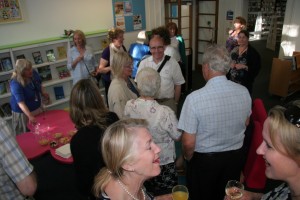 After a glass of wine (or juice), we settled down and instead of me giving the traditional talk, Denise fired some questions at me. After a glass of wine (or juice), we settled down and instead of me giving the traditional talk, Denise fired some questions at me.
As my critique partner (or more informally, writing buddy), Denise knew the Roma Nova stories inside out. That in itself was mildly terrifying – she would find any weakness with the usual razor sharpness she applied to my writing. I smiled at her, she smiled at me, then we began.
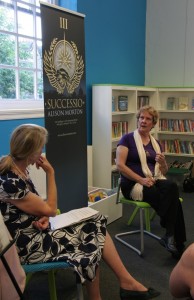
She asked me about Roma Nova, heroine Carina and her hero, Conrad, how I’d even thought up the who setting and why. She probed into my own military experience, asking how much influence that had had on Carina’s character. The ‘in conversation’ format worked extremely well and drew the audience of readers fans and fellow writers in.
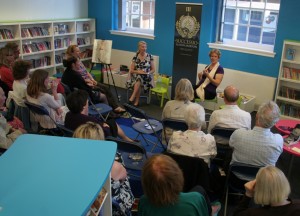 And didn’t they ask some good questions! One who was a historical writer herself asked how much I’d dug into myself to form the character of Carina. Inevitably, a writer draws on her own experience, certainly at first, but as the characters develop, they diverge from there and indeed take on their own life. Another reader asked how I’d got inside the head of a 24 year old. Well, I said, in my own head I’m 28. General laughter. I did check with some young students who were helping me with the American terminology and dialogue content for protagonist Carina who had been brought up (or raised) in America. I also watched a lot of films for that age group and visited a lot of forums! And didn’t they ask some good questions! One who was a historical writer herself asked how much I’d dug into myself to form the character of Carina. Inevitably, a writer draws on her own experience, certainly at first, but as the characters develop, they diverge from there and indeed take on their own life. Another reader asked how I’d got inside the head of a 24 year old. Well, I said, in my own head I’m 28. General laughter. I did check with some young students who were helping me with the American terminology and dialogue content for protagonist Carina who had been brought up (or raised) in America. I also watched a lot of films for that age group and visited a lot of forums!
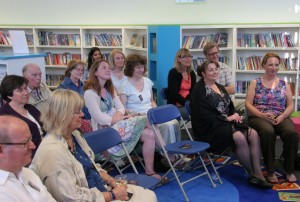 An intriguing one was about religion as the Roma Novans had stuck to the traditional Roman gods and forms of worship rejecting Christianisation. Carina, although she uses the gods’ names when swearing, is pretty neutral about religion in general as her parents had been. For her religion played a ritual and social role rather than anything else. An intriguing one was about religion as the Roma Novans had stuck to the traditional Roman gods and forms of worship rejecting Christianisation. Carina, although she uses the gods’ names when swearing, is pretty neutral about religion in general as her parents had been. For her religion played a ritual and social role rather than anything else.
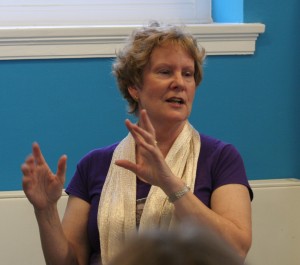 Research and writing craft questions followed, plus one about the Roman idea of ‘virtus’ the masculine ideal in Ancient Rome which carries connotations of military courage, manliness, excellence, character, and worth, perceived as masculine strengths. In Roma Nova, I replied, it had developed into a shared ethical ideal of duty and service to the state shared by both women and men. Research and writing craft questions followed, plus one about the Roman idea of ‘virtus’ the masculine ideal in Ancient Rome which carries connotations of military courage, manliness, excellence, character, and worth, perceived as masculine strengths. In Roma Nova, I replied, it had developed into a shared ethical ideal of duty and service to the state shared by both women and men.
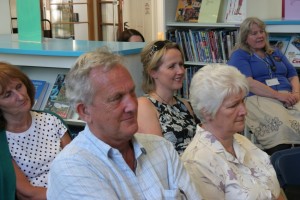 The last question was about whether I had a huge wall board with all the information about Roma Nova written on it. Now I know my critique partners, Denise, does with lines and arrows everywhere, but I’m not as organised as that. I smiled at the questioner and said. ‘No, I just live there in my head…’ The last question was about whether I had a huge wall board with all the information about Roma Nova written on it. Now I know my critique partners, Denise, does with lines and arrows everywhere, but I’m not as organised as that. I smiled at the questioner and said. ‘No, I just live there in my head…’
And then on to signing…
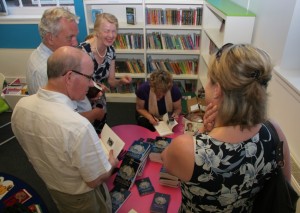 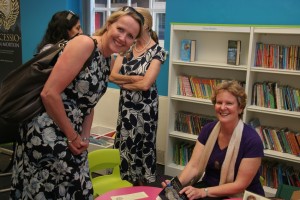
Susan, Emma and Jane, the Tunbridge Wells library team couldn’t have been more helpful; positive, knowledgeable and smiling, they were everything that is best in the public service. And this morning, I received a lovely email from Susan:
‘Just to say thanks again for a brilliant evening last night.
We had 17 people attending, which I thought was a great turnout, who all really enjoyed your talk.
Hope we can do this again!’
So do I.
Alison Morton is the author of Roma Nova thrillers, INCEPTIO, and PERFIDITAS. Third in series, SUCCESSIO, is now out.
Find out about Roma Nova news, writing tips and info by signing up for my free monthly email newsletter.
If you enjoyed this post, do share it with your friends!Like this:Like Loading...
|
Subscribe to Blog via Email
Join 368 other subscribers.
Categories
Archive
|