I ran a giveaway draw with my post about the Roman dusk – part of the Winter Solstice Blog Hop. Let me say, it was incredibly difficult to decide, so I put all the names in a hat and the name of the winning paper was …
(drum roll)
Nicole Evelina!
Read about her here…
A signed copy of PERFIDITAS will be on its way to Nicole.
Thank you to everybody who took part.
Alison Morton is the author of Roma Nova thrillers, INCEPTIO, and PERFIDITAS. Third in series, SUCCESSIO, is out early summer 2014.
If you enjoyed this post, do share it with your friends!Like this:Like Loading...
A hearty winter greeting from Rome – have a great holiday!
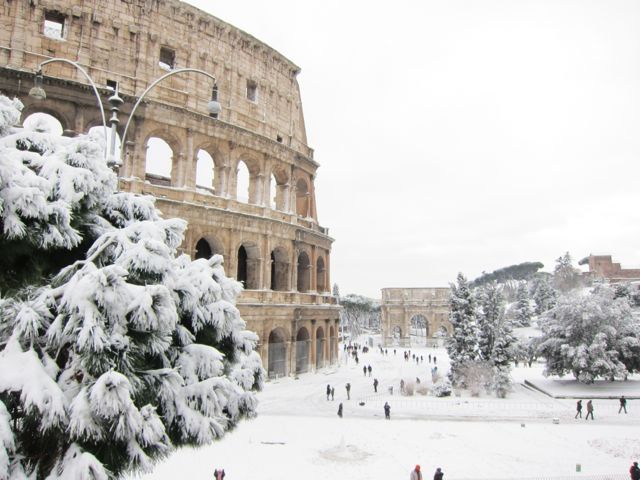 (Actually, it was taken in February 2012 at the time of the Great European Freeze a couple of weeks before my own study tour there, but doesn’t the Colosseum look good in snow?) (Actually, it was taken in February 2012 at the time of the Great European Freeze a couple of weeks before my own study tour there, but doesn’t the Colosseum look good in snow?)
Photo courtesy of Elizabeth Minchilli, http://www.elizabethminchilliinrome.com/2012/02/snow-day-rome.html
Read more about Saturnalia here.
Alison Morton is the author of Roma Nova thrillers, INCEPTIO, and PERFIDITAS. Third in series, SUCCESSIO, is out early summer 2014.
If you enjoyed this post, do share it with your friends!Like this:Like Loading...

A post about darkness and light to mark the longest night in the northern hemisphere…
“The Fall of the Roman Empire” was a 1964 epic film starring Sophia Loren, Stephen Boyd, Alec Guinness, James Mason and Christopher Plummer. Emperor Marcus Aurelius was dying and did not want his unpleasant son Commodus to succeed him. The final scene of the film shows Rome in total chaos.
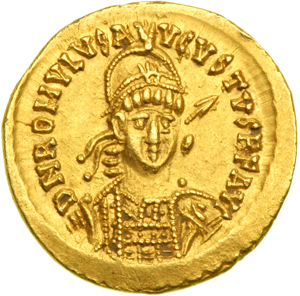 Romulus Augustulus (solidus) But the end of Rome wasn’t quite like that. Marcus Aurelius and Commodus reigned to AD 180 and AD 192 respectively and the Western Roman Empire didn’t end technically for nearly another three hundred years in AD 476 with the abdication of Emperor Romulus Augustulus, a boy of sixteen, and the assassination in AD 480 of Julius Nepos, another contender. The Eastern Roman Empire continued for several more hundred years but declined steadily from the twelfth century until the Fall of Constantinople (Byzantium) in 1453.
But let’s focus on the Western Empire… A scholar I chatted to last year on my Rome & Pompeii study tour joked how there were 257 reasons for the collapse of Rome. But how do we define such disintegration, in essence a “failed state”? We’re not looking at a temporary vacuum caused by regime change or a coup d’état, but total collapse:
- A loss of control of its territory, or of the legitimate use of physical force in it
- The erosion of legitimate authority to make collective decisions, i.e. a government without power
- An inability to provide public services
- Widespread corruption and criminality
- An inability to interact with other states as a full member of the international community
- A sharp decline in trading, monetary control and ability to feed its population
In AD 376 (pre-the Battle of Adrianople) large numbers of Goths crossed the Danube River. They sought admission to the territory of the Roman Empire, which despite having both new and longstanding systematic weaknesses, still wielded effective power across the area surrounding the Mediterranean and beyond. The Empire had large numbers of trained, supplied and disciplined soldiers, a comprehensive civil administration based in thriving cities with effective control over public finances and it maintained a high wealth economy, complex social structure and legal system.
 Fourth century hunting scene, found near Burgos, Spain Its wide-ranging trade networks allowed even modest households to possess goods manufactured the other side of the known world. Among its literate and political elite it enjoyed ideological legitimacy as the only worthwhile form of civilization and a comprehensive and sophisticated cultural base including the arts, literature and rhetoric.
Only a hundred years later, when Odoacer, a Roman general of Germanic, possibly Hunnic origin, deposed the Emperor Romulus, the Western Roman Empire wielded negligible military, political, or financial power and had no effective control over the scattered Western domains that still described themselves as Roman. Some provinces struggled on, e.g. the Domain of Soissons in northern France where in AD 486 Syriagus the then “King of the Romans” came up against the most dynamic and ruthless leader of the new Europe, the Frankish king Clovis, and lost one of the few remaining outlying Roman provinces at the Battle of Soissons.
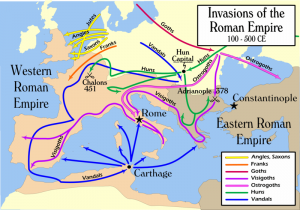 Trade, public services, communications and above all legitimacy had broken down and the remaining Romans were unable to hold on to their diminishing territories. Barbarian invasions, the settlement of non-Romans within the Empire and the growth and migration of vigorous warlike peoples in Europe (Franks, Goths, Alans, Burgundians, Alemans) piled the pressure onto brittle systems ready to snap. Trade, public services, communications and above all legitimacy had broken down and the remaining Romans were unable to hold on to their diminishing territories. Barbarian invasions, the settlement of non-Romans within the Empire and the growth and migration of vigorous warlike peoples in Europe (Franks, Goths, Alans, Burgundians, Alemans) piled the pressure onto brittle systems ready to snap.
The Western Roman Empire localised and eventually dissolved like chain mail fragmenting into separate links, giving way to rump states, local city states and petty kingdoms ruled sometimes by members of the established Romanized ruling elite, sometimes by the invaders. In the southern parts of France, Italy and Spain and the Iberian Mediterranean coast Roman culture lasted until the 6th or 7th centuries.
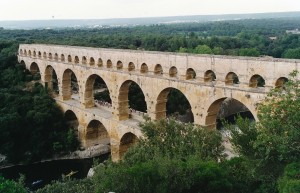 Pont du Gard, near Nimes, France So, what did the Romans do for us at their dusk? Many of their buildings, roads and monuments were used for centuries afterwards, especially in continental Europe. Some parts of the Nimes aqueduct, which includes the famous Pont du Gard, is said to have supplied local farmers into the 10th century.
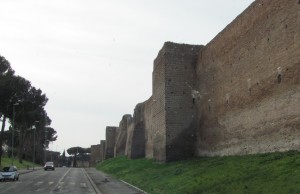 The Aurelian Walls in Rome served as significant military defence for the city until 1870. The Aurelian Walls in Rome served as significant military defence for the city until 1870.
But population decline of over 20% between AD 400 and AD 600, the loss of technological knowledge, systemised agriculture and manufacturing in Europe from late antiquity into the early middle ages (approximately AD 400-AD 750), the scarcity of artistic and cultural output including historical records, when compared with both earlier and later times, led Petrarch and others to call it the “Dark Ages”. Modern historians prefer to call it the “Early Middle Ages”, but it remains a period of disintegration, impoverishment and rupture, not helped by climate cooling around AD 450-500 and waves of plague and smallpox in the sixth century. A dark period indeed.
By the early AD 700s, agricultural, social and political conditions had started to improve and the climb out of retrenchment began. However, the greatest light in the darkness that persisted from the collapse of the Western Roman Empire, and into the centuries to come, was the gift of Latin as a lingua franca.
Lux in tenebris lucet
(Light shines in the darkness.)
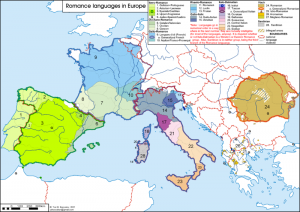 By the end of Empire, Latin had spread to many Mediterranean and some northern European regions. Dialects spoken in these areas, mixed to various degrees with the local languages, developed into modern Romance languages such as Italian, French, Spanish, Portuguese and Romanian. Many Latin words came back to Britain via Old French. By the end of Empire, Latin had spread to many Mediterranean and some northern European regions. Dialects spoken in these areas, mixed to various degrees with the local languages, developed into modern Romance languages such as Italian, French, Spanish, Portuguese and Romanian. Many Latin words came back to Britain via Old French.
Classical Latin itself slowly changed with the disintegration of the Western Empire as education, recording skills and wealth diminished. The consequent Medieval Latin, influenced by Germanic and proto-Romance languages until expurgated by Renaissance scholars, was used as the language of international communication, scholarship, and science until well into the 18th century, when it began to be supplanted by national languages. But apart from naming plants and animals and studying history and archaeology, there is still great interest in Latin as a door into the Roman world.
Omnia mutantur nos et mutamur in illis
(Everything changes, and we change with them.)
——–
And if a little piece of the Roman Empire had struggled through history into the 21st century but had changed its social structure in order to survive, could it have a heroine like Carina Mitela…?
Read about her latest adventure in PERFIDITAS, the sequel to INCEPTIO.
![2013-Light-Darkness[1]](http://alison-morton.com/wp-content/uploads/2013/11/2013-Light-Darkness1-300x231.jpg) And when you’ve done that, do visit some of these other sites: clever, informed authors, cracking posts. I don’t think you’ll be disappointed on this night of darkness when you find some shining light… And when you’ve done that, do visit some of these other sites: clever, informed authors, cracking posts. I don’t think you’ll be disappointed on this night of darkness when you find some shining light…
- Helen Hollick : A little light relief concerning those dark reviews! Plus a Giveaway Prize
- Prue Batten : Casting Light….
- Alison Morton Shedding light on the Roman dusk (that’s me!) – Plus a Giveaway Prize!
- Anna Belfrage : Let there be light!
- Beth Elliott : Steering by the Stars. Stratford Canning in Constantinople, 1810/12
- Melanie Spiller : Lux Aeterna, the chant of eternal light
- Janet Reedman The Winter Solstice Monuments
- Petrea Burchard : Darkness – how did people of the past cope with the dark? Plus a Giveaway Prize!
- Richard Denning : The Darkest Years of the Dark Ages: what do we really know? Plus a Giveaway Prize!
- Pauline Barclay : Shedding Light on a Traditional Pie
- David Ebsworth : Propaganda in the Spanish Civil War
- David Pilling : Greek Fire – Plus a Giveaway Prize!
- Debbie Young : Fear of the Dark
- Derek Birks : Lies, Damned Lies and … Chronicles
- Mark Patton : Casting Light on Saturnalia
- Tim Hodkinson : Soltice@Newgrange
- Wendy Percival : Ancestors in the Spotlight
- Judy Ridgley : Santa and his elves Plus a Giveaway Prize
- Suzanne McLeod : The Dark of the Moon
- Katherine Bone : Admiral Nelson, A Light in Dark Times
- Christina Courtenay : The Darkest Night of the Year
- Edward James : The secret life of Christopher Columbus; Which Way to Paradise?
- Janis Pegrum Smith : Into The Light – A Short Story
- Julian Stockwin : Ghost Ships – Plus a Giveaway Present
- Manda Scott : Dark into Light – Mithras, and the older gods
- Pat Bracewell Anglo-Saxon Art: Splendor in the Dark
- Lucienne Boyce : We will have a fire – 18th Century protests against enclosure
- Nicole Evelina What Lurks Beneath Glastonbury Abbey?
- Sky Purington : How the Celts Cast Light on Current American Christmas Traditions
- Stuart MacAllister (Sir Read A Lot) : The Darkness of Depression
Alison Morton is the author of Roma Nova thrillers, INCEPTIO, and PERFIDITAS. Third in series, SUCCESSIO, is out early summer 2014.
If you enjoyed this post, do share it with your friends!Like this:Like Loading...
The most frequent question readers have asked me since the launch of INCEPTIO in March has been: how did you work out the characters?
Karen/Carina has been buzzing around in my head for a while – about fifteen years. So in the end it was a choice between seeing a psychiatrist or becoming a writer!
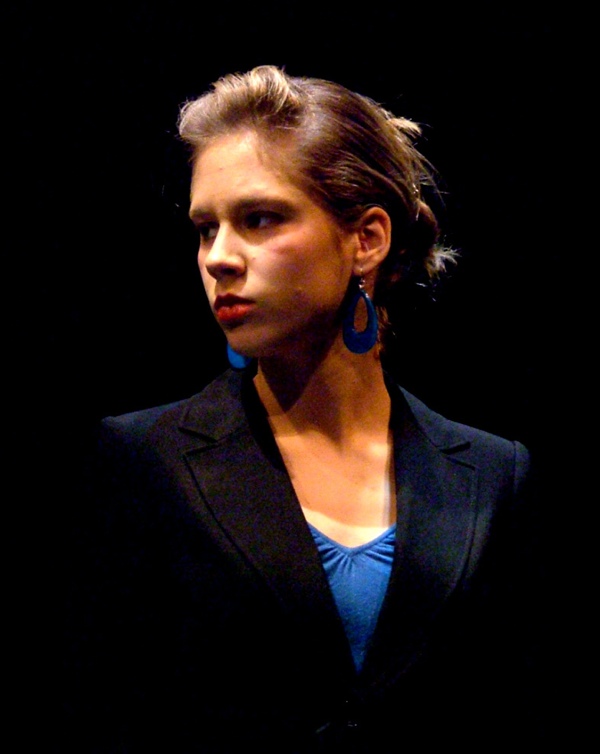
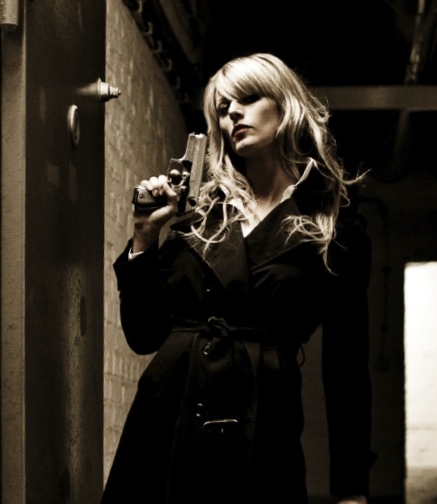
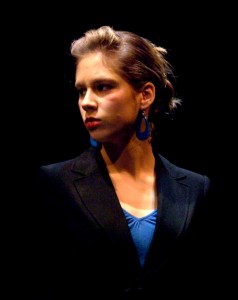 Could this be a version of Karen? Is it all about looks?
People have asked me what the characters look like. I think that’s for the reader to decide; reading is a two-way experience and my idea of what they look like could be miles away from somebody else’s.
Fiction writers often use a photo in a magazine, an actor, a painting or somebody on television to keep the character as a human being, and avoid developing a distorted cartoon or cardboard construct.
I give a few details of each person when they first appear on the pages, so that you know whether they are tall/short, young/old, what their hair and eye colour and build are. After that, you’re on your own! That’s the joy of reading a book – you can create your own world.
Knowing your character
I wrote a sketch of Karen as she was at the beginning of INCEPTIO: her basic life conditions, background, work, friends, hobbies, character traits and general attitude to life. I learned this technique at an Arvon Foundation course for commercial fiction writers and it’s stood me in good stead ever since. I added a few notes as I progressed with her story.
So, who is Karen?
 She works in a ‘run of the mill’ office job, she left education after high school and doesn’t earn quite enough money to cover her bills. She’s outdoorsy – she jogs and goes to the gym. She remembers her rural childhood in leafy New Hampshire with longing and lives for the weekends working as a volunteer in the park. We know she stands up for other people – the injured man in the park, her cousin in Nebraska. Like anybody else would be, she’s frightened when Renschman and his people threaten her. But then she gets angry. She works in a ‘run of the mill’ office job, she left education after high school and doesn’t earn quite enough money to cover her bills. She’s outdoorsy – she jogs and goes to the gym. She remembers her rural childhood in leafy New Hampshire with longing and lives for the weekends working as a volunteer in the park. We know she stands up for other people – the injured man in the park, her cousin in Nebraska. Like anybody else would be, she’s frightened when Renschman and his people threaten her. But then she gets angry.
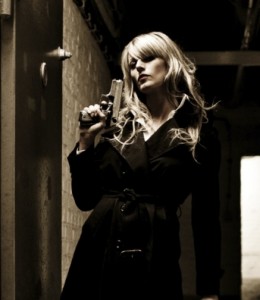 Or is this Karen? Her temper and defensiveness make her human. We see in INCEPTIO that although she gets on with other people – Amanda at work, Chip and the park staff – she senses she’s still on the outside in some indefinable way. She’s uncomfortable in the Washington legation because people defer to her, but she “gathers up her grit” as her father used to say and manages to face down the über-superior Favonius.
And, no, I don’t have a clue why I made her an American, rather than British. That’s how she came alive in my head. Perhaps it’s because of the Old World/New World clash, a vague idea that Americans have a more adventures in popular culture, perhaps her rose-tinted view of life in America versus the reality of a more structured life in Roma Nova.
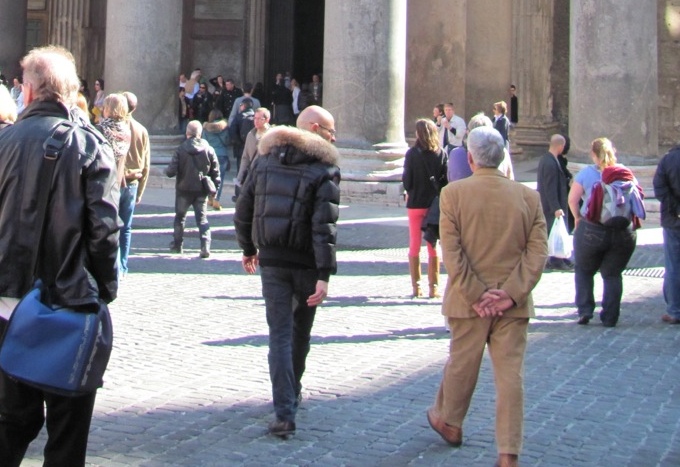
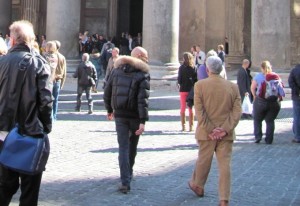 Moving and shaking Moving and shaking
Writers look at the way their characters move, if they stride, walk gracefully, lumber, glide almost silently, or march. In historical fiction, the different shaped clothes, stiff fabrics, shoes, boots, hats, swords and gloves often dictate different ways of moving, sometimes easier, sometimes more constraining.
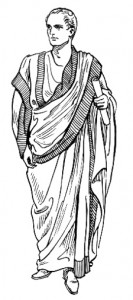 In Roman fiction, wearing a simple tunic is easier than a heavy toga! Position in life, occupation, age and gender also affect whether the character walks confidently, swaggers or trudges along with head bowed as well as what a character is thinking or feeling at the time. In Roman fiction, wearing a simple tunic is easier than a heavy toga! Position in life, occupation, age and gender also affect whether the character walks confidently, swaggers or trudges along with head bowed as well as what a character is thinking or feeling at the time.
Perhaps some characters use their hands a lot when talking? Or do they hold themselves in, crossing their arms. Do they have a distinct way of speaking as Apollodorus does in INCEPTIO with his old fashioned elaborate speech habits? Staccato, or nonchalant, taking everything in their stride? These habits leak out into their actions but also influence them and so we learn more about the characters.
But of course, more than their appearance, it’s the characters’ behaviour, motivation and actions that make them real people rather than stereotypes. This comes out in their interactions and dialogue, but that’s another whole post…
Alison Morton is the author of Roma Nova thrillers, INCEPTIO, and PERFIDITAS. Third in series, SUCCESSIO, is out early summer 2014.
If you enjoyed this post, do share it with your friends!Like this:Like Loading...
 What? A while ago, I applied for INCEPTIO to be listed on the Awesome Indies list, a prestigious indie book evaluation site. Determinedly and fearsomely focused on ensuring only the best self-published titles are included, they have an equally fearsome submissions process. What? A while ago, I applied for INCEPTIO to be listed on the Awesome Indies list, a prestigious indie book evaluation site. Determinedly and fearsomely focused on ensuring only the best self-published titles are included, they have an equally fearsome submissions process.
And this is A Good Thing.
With the huge growth of self-published, sometimes called indie published, books coming on to the market each year, there have to be quality marks to distinguish the ones good enough to rival mainstream published work.
Awesome Indies say, “We take the risk out of buying indie, save you from having to sort the gems from the slush pile. If you buy books listed here, you can rest assured that you are supporting the independent authors that deserve to succeed; those that maintain high standards in their written language.”
You can read the Alliance of Independent Authors (ALLi) interview with Tahlia Newland of AI earlier this year here.
Listing by Awesome Indies is free for authors; they run a basic author support programme free of charge, or members can opt for a modest $30 a year for enhanced subscription which has a basketful of additional marketing support services. But like any independent author group, it’s the engagement of its members that makes the group a success.
For readers, the AI site provides assurance that a book recommended there is going to be a good read. Win-win, I’d say.
You can see INCEPTIO here and Awesome Indies home here. Follow AI on Twitter.
Alison Morton is the author of Roma Nova thrillers, INCEPTIO, and PERFIDITAS. Third in series, SUCCESSIO, is out early summer 2014.
If you enjoyed this post, do share it with your friends!Like this:Like Loading...
|
Subscribe to Blog via Email
Join 368 other subscribers.
Categories
Archive
|