My Kindle reader has become indispensable. Not only can I download books wherever I am (I have the 3G version), but it’s so easy to use. Slim enough to slip into a handbag, light enough not to cause heart failure when my suitcase is weighed at check-in. My Kindle reader has become indispensable. Not only can I download books wherever I am (I have the 3G version), but it’s so easy to use. Slim enough to slip into a handbag, light enough not to cause heart failure when my suitcase is weighed at check-in.
But I’ve been worried about its susceptibility to damage, especially when travelling. I try to be careful with my gadgets, although the odd accident happens. (Let’s not refer more than once to the glass of red wine and my netbook keyboard…). On recent trips, I’ve wrapped the Kindle in a spare cloth bag, but that only protected it from dust and minor scratches. Now, I’m not intending to enter it for the Kindle-throwing championships or use it as something to prop up a wonky chair, but it needs some protection (Not in the Al Capone sense, you understand.).
I don’t necessarily want to hold it in my hand all the time I’m reading, so I looked for a combined cover and stand.
 The choice, material and price ranges are enormous. Usual story – buy what is appropriate for your needs and pocket. I got my Tuff-luv padded cover/stand through Amazon itself, but the vendor has its own site with on-line shop. I especially like the secure, rather clever system for the stand using Velcro tabs, the full width hinge and the padding which protects without compromising the stylishness. The choice, material and price ranges are enormous. Usual story – buy what is appropriate for your needs and pocket. I got my Tuff-luv padded cover/stand through Amazon itself, but the vendor has its own site with on-line shop. I especially like the secure, rather clever system for the stand using Velcro tabs, the full width hinge and the padding which protects without compromising the stylishness.
The red thing? Black is sophisticated, sure, but a little unconformity goes a long way…
If you enjoyed this post, do share it with your friends!
Not a big scene, but which framed a confrontation, added a little pzazz as well as demonstrating my heroine’s hot temper.
As we cruised along the peripheral at max speed limit, setting citizens a good example, a silver Mercedes flew past us, cutting us up. We weren’t traffic cops, but I was incensed. I looked at Sentius, he pulled out the blue light, activated the roof clamp and siren. I floored the accelerator. Tyres squealing, I spun the wheel hard to the left and pulled my Giulietta out into the outside lane. A dark SUV braked to get out of the way. I rocketed around the long curve before the river crossing, weaving between vehicles that didn’t get out the way of the blue light.
We were catching up fast. The curve straightened out and we barrelled towards the Pons Apulius. The huge cable-tied bridge rushed towards us as the speedometer showed 130 kph. We drew abreast of the Mercedes. I eased the Giulietta relentlessly to the right, the rotating blue beacon reinforcing the message the front wing of my car was conveying. The Mercedes slowed and pulled over to the kerb right in the centre of the bridge.
Sentius hopped out, ran back to place with the flashing blue road light behind the Mercedes. He took up position nearside kerb, nightstick ready. I peeled myself out of the Giulietta, my hand on my holster. I rapped on the driver’s tinted glass window with the Furies behind me.
‘Open this bloody window. Now.’
All those years of watching Top Gear have at last come in handy…
Comments always welcome 🙂
If you enjoyed this post, do share it with your friends!
 Lumb Bank What magic turns sixteen anxious wannabees with doubts a hundred feet high into confident, capable producers of good writing within a week?
In February this year, I booked the Arvon Foundation course ‘Popular Fiction’ 4-9 October at Lumb Bank, Yorkshire. It was to run from 4 to 9 October, with tutors Mavis Cheek and Paul Sussman. My writing buddy, Denise Barnes, had been on several Arvon courses and urged me to plunge in. So I booked my flight, organised the rest of my itinerary and put it out of my mind.
Months later, on 4 October, I rammed some warm jumpers into my suitcase (Please! This is Yorkshire in October…) and set off in plenty of time for Nantes airport. But this was on the day of the worst gridlock in the town for months. I arrived three minutes before the gate closed. Twenty-seven people missed the flight. The airport, security and Ryanair staff were calm and collected, unlike me who had run like a hell-hound into the terminal, torn across the concourse and dived into check-in. Perfect scenario for a thriller writer…
Arriving at Leeds Bradford International(!) Airport, the sky was as blue as in my home Poitou-Charentes. Huh? Where was the rain and cold? I’d been a student at Leeds. I knew how cold it got. But the sun was to hold for the rest of the week. Negotiating buses and trains, I arrived at Hebden Bridge railway station, redolent of The Railway Children. After a hairy drive up drystone-walled single track lanes, we arrived at Lumb Bank, once owned by Ted Hughes.
Sixteen nervous nellies from the UK, Nigeria, France and the USA, of different ages and backgrounds, whose experience of writing fiction ranged from none to authorship of two unpublished novels, awkwardly introduced themselves to each other as they drifted in. Eyeing each other up, we struggled to remember names. By the end of the week we were BFFs.
 My writing desk The centre staff, Rachel, Becky and Liz, explained the Arvon ethic; this was our home for the week, away from Internet, blogs, Twitter, radio and television. We lived together and worked together, taking turns to wash up and cook. My corner room was exactly as a writer’s room should be; fabulous, inspiring views, a large desk, quiet and comfort.
Each morning at ten, we assembled promptly for our workshops. Mavis and Paul put us at our ease and were tirelessly enthusiastic, but strong on timing and fairness for everybody. Their double act (Mavis clever, tough, full of wisdom and quotations; Paul jokey, supportive, cheeky and brooking absolutely no use of the word ‘sorry’) seduced us. We were engaged from the first hour.
So what did we do? First morning workshop was an exercise on ‘My childhood home’. We can all write something about that. Twenty minutes later when we read our efforts out, I realised with sinking heart how good they all were. But whilst inwardly panicking, I smiled as if unconcerned. Qui s’excuse, s’accuse and all that. Later that evening when the wine began to flow, we all confessed to the same. At that point the bonding started. The group melded and became a supportive entity of its own. A magic ingredient to the mix. Over the next few days, we did exercises on describing a room without the owner present, character, dialogue, turning point and using location. On Friday we worked from art postcards, drawing together the lessons from the week. Imagination was strongly encouraged as well as hard crafting which is why I turned the three Sitwells into vampires…
 The barn at Lumb Bank In the afternoons, I wrote. And wrote. I am applying the machete to my first novel thanks to excellent advice from Nicola Morgan of Pen2Publication. The barn at Lumb Bank has a long row of networked computers, plenty of deskspace and a peaceful atmospher. Comfy sofas, including an eight-seater, encourage lounging whilst reading and re-reading.
Half-hour tutorials with Mavis and Paul gave me valuable insights into genre, pace and characterisation on my current WIP. Both loved my idea, Paul venturing to call it ‘high concept’.
Lissa Evans visited on Thursday, reading from Their Finest Hour and a Half . Extremely knowledgeable about the 1940s and clearly loving the period, she talked about and answered questions with humour, patience and verve.
 Reading my stuff Friday night was the big night. Open mic night, when we read out pieces we had written, revised or polished up from our WIP. I’m pleased to say mine went down well (Tries hard not to be too pleased about rapturous reception). Much wine was drunk that night in the barn…
Saturday was inevitably an anticlimax as we prepared to tear ourselves away. Email adresses swapped and taxis ordered, we dispersed in small groups.
Since then, I’ve had some emails from the group:
‘It’s odd not to be sitting round the lunch table with you all right now and with complete strangers sitting across from me instead. They have no idea that I am irritated with them for not being any one of you.’
‘I’m in bed with laptop on knees, my lie-in having been scuppered by the need to write. I feel bags under my eyes from here on in may be all down to Arvon… The magic of the place has definitely come home with me.
I feel very priviledged to have shared such a beautiful place with all of you and have come away knowing I have 15 Fairy Godmothers and fathers.’
‘Thank you all so much for this past week, it’s been really helpful and so lovely meet such kind, friendly, nurturing, fabulous people (too many adjectives?) I intend to never self-edit immediately on a first draft, or to apologise for or explain anything ever again.’
Says it all, really, doesn’t it?
Alison Morton is the author of Roma Nova thrillers, INCEPTIO, and PERFIDITAS. Third in series, SUCCESSIO, is now out.
Find out about Roma Nova news, writing tips and info by signing up for my free monthly email newsletter.
If you enjoyed this post, do share it with your friends!
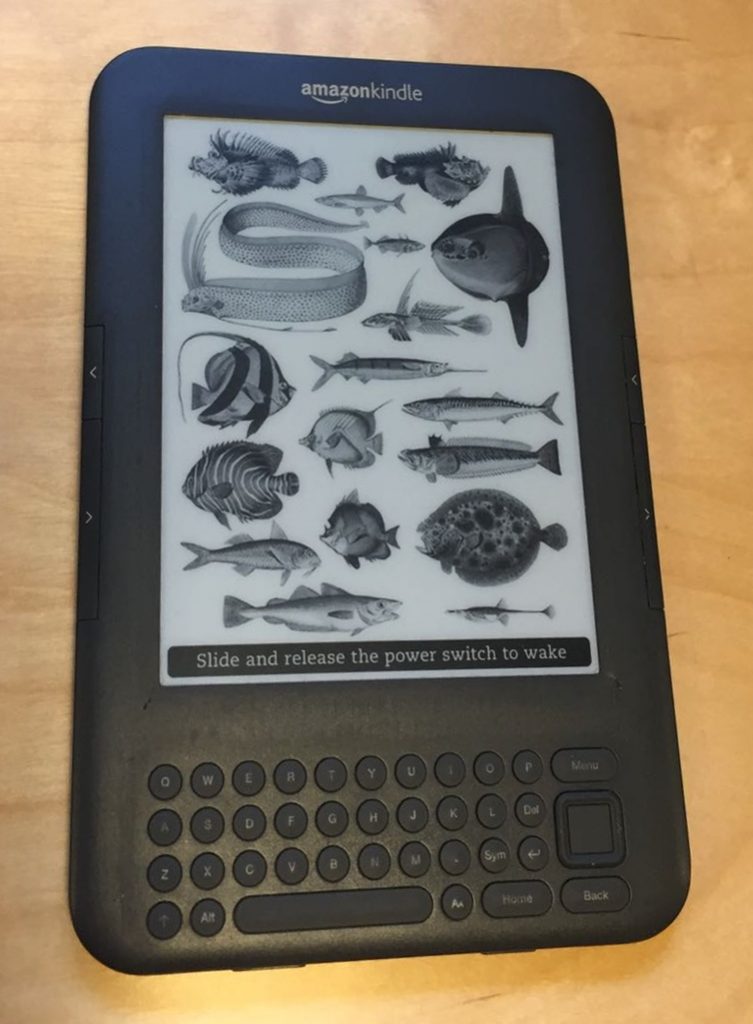 I’ve been given a fab birthday present – a 3G Amazon Kindle. Thank you, Steve xx I’ve been given a fab birthday present – a 3G Amazon Kindle. Thank you, Steve xx
As a writer, I read a huge number of books; our house is groaning with them. As a plane passenger, it’s agonising trying to sift out the books to take (or, worse, leave behind). As a Luddite, it’s been a big decision to think about flirting with the dark side of electronic books.
But I’m having a ball, a ‘St Paul on the road to Damascus’ revelation. Already my paperback favourites are starting to look a tad quaint.
The clear screen and sharp type work in sunlight, under subdued light, in any light. I’ve already downloaded books and am finding them very easy to read. I’ve found no sense of distortion between the paper page and epage experiences.
As resident outside the UK, my buying channel is via amazon.com. Not quite sure whether or not that’s going to make any difference as the books I want appear on both amazon.co.uk and amazon.com.
I’ve explored the connectivity a little, but not very much beyond setting up and downloading books. When I go back to the UK, the download on demand anywhere feature will be an enormous benefit.
For a comprehensive review, including techie things, have a look at Steve’s blog post
Well, Captain Kirk, those handy little pads you read Enterprise crew reports on seem to have made it into the early 21st century. 😉
Alison Morton is the author of Roma Nova thrillers, INCEPTIO, PERFIDITAS, SUCCESSIO and AURELIA. The fifth in the series, INSURRECTIO, was published in April 2016.
Find out more about Roma Nova, its origins, stories and heroines… Get INCEPTIO, the series starter, for FREE when you sign up to Alison’s free monthly email newsletter
If you enjoyed this post, do share it with your friends!
The 1990s ride again. No, really. At a meeting yesterday evening for autoentrepreneurs (small business creators), I was dragged back to a business style that I thought had disappeared. By the end of the evening, I was having difficulty hiding my amusement. John Cleese’s Video Arts training company would have relished it as a ‘how not to do it’ example. I didn’t know whether to post this report on my property finding blog or this one.
Picture the scene: an excellent line-up of speakers from the chamber of commerce, the URSSAF, the RSI and the tax office gathered to inform existing and wannabe autoentrepreneurs about the scheme and to give pointers, tips and hints. They’d planned in a long question and answer session. So far, pretty classic for a business presentation cum seminar.
The meeting leader was clear and clever, the perfect understudy for Joel Grey’s MC in ‘Cabaret’. He kept his frustration with less talented presenters well under wraps. But still… First up was a tall, imposing speaker from the tax office. We listened respectfully as her 1990s-dressed figure paced up and down, reading out her notes and lecturing us in a way that strongly reminded me of my first year maths teacher. We hung on every word.
The next act was the trilling twins. Gaunt, nervy and very knowledgeable, one with space age spectacles and a nineteenth century voice, the other younger, much taller falling over her words when not swallowing them, they regaled us with their insights into the social security system. The French system is split into a multitude of different caisses, or social security departments, each dealing with different occupations. Even the French audience was baffled. The second tax speaker, a young man, capable, but evidently a fish out of water when surrounded by fifty of the real public, was soon snaffled by two of the audience to be initiated into their complex personal tax problems.
The audience responded, some asking sensible questions, some with off-this-planet ones. Few seemed to have read the excellent website http://www.lautoentrepreneur.fr/ which, if truth be told, provided all the information that the specialists were giving. Then the fun began in that inimitable French way where a question gets taken apart, by four or five people discussing it, conceptualising it, going all around it and finally coming to a mutually acceptable conclusion. Not always the definitive answer, though…
All the speakers were eager to impart information and anxious to help. They’d all come out on a wet evening after a long day at the office. But oh, dear, were they in need of some presentation training! My heart wept for ‘Joel Grey’ as he attempted to control his herd of cats. Perhaps someone ought to tell them that you don’t read from the Power Point slides or from printouts, that you outline your speech first, that you keep the information simple and to three points maximum, that you invite feedback, that you pause for breathe.
As an autoentrepreneur, I didn’t learn a great deal; as a creative writer, I garnered some great characters to use in my next story…
If you enjoyed this post, do share it with your friends!
|
Subscribe to Blog via Email
Join 368 other subscribers.
Categories
Archive
|
 My Kindle reader has become indispensable. Not only can I download books wherever I am (I have the 3G version), but it’s so easy to use. Slim enough to slip into a handbag, light enough not to cause heart failure when my suitcase is weighed at check-in.
 The choice, material and price ranges are enormous. Usual story – buy what is appropriate for your needs and pocket. I got my Tuff-luv padded cover/stand through Amazon itself, but the vendor has its own site with on-line shop. I especially like the secure, rather clever system for the stand using Velcro tabs, the full width hinge and the padding which protects without compromising the stylishness.