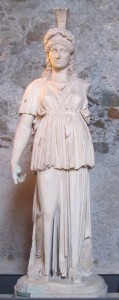
 Minerva/Athene, goddess of wisdom (Capitoline Museum, Rome) A poster “in another place” commented about the Roma Nova books: “They sound great, but I can’t help but cringe at the titles. Not quite Latin. I suppose that’s probably the point, but ouch. Intriguing, though.“
I admit, I thought ‘ouch’ back, but also smiled to myself. Perhaps she hadn’t looked them up on one of the excellent online dictionaries such as
Perseus (Tufts University), LatDict, Notre Dame University or a good paper Latin dictionary (OLD or Collins).
So what’s the Latin behind the Roma Nova titles?
INCEPTIO
inceptio, inceptionis
noun, 3rd declension, gender: feminine
Definitions: start, beginning, an undertaking, enterprise
Age: In use throughout the ages/unknown
Area: All or none
Geography: All or none
Frequency: For Dictionary, in top 20,000 words
Source: “Oxford Latin Dictionary”, 1982 (OLD)
SUCCESSIO
successio, successionis
noun, 3rd declension, gender: feminine
Definitions: succession (to position/ownership w/GEN), successors collectively
Age: In use throughout the ages/unknown
Area: Legal, Government, Tax, Financial, Political, Titles
Geography: All or none
Frequency: For Dictionary, in top 10,000 words
Source: “Oxford Latin Dictionary”, 1982 (OLD)
Perseus also gives us
PERFIDITAS
I’ll admit PERFIDITAS is partly made up! It’s based on
perfidia, perfidiae
noun, 1st declension, gender: feminine
Definitions: faithlessness, treachery, perfidy
Age: In use throughout the ages/unknown
Area: All or none
Geography: All or none
Frequency: For Dictionary, in top 20,000 words
Source: General, unknown or too common to say
The trouble was there was a very popular song called ‘Perfidia‘ written by Mexican Alberto Dominguez and which has been recorded by countless artists. I didn’t want the book to look as if it was about a girl called Perfidia, so I piggy-backed perfidia onto the form used in romanitas (‘Roman-ness’) to change the word but retain the meaning.
Two and a half out of three ain’t too bad, I think.
Alison Morton is the author of Roma Nova thrillers, INCEPTIO, and PERFIDITAS. Third in series, SUCCESSIO, is now out.
Find out about Roma Nova news, writing tips and info by signing up for my free monthly email newsletter.
If you enjoyed this post, do share it with your friends!Like this:Like Loading...
 Although it seems ages ago, the Romantic Novelists’ Association Conference was only a couple of weeks ago! It took place at the Harper Adams University, a renowned agricultural college near Telford, Shropshire – a beautiful setting, plus a light whiff from the animal areas! Needless to say, our meals had the shortest food mileage ever and were wonderful. Although it seems ages ago, the Romantic Novelists’ Association Conference was only a couple of weeks ago! It took place at the Harper Adams University, a renowned agricultural college near Telford, Shropshire – a beautiful setting, plus a light whiff from the animal areas! Needless to say, our meals had the shortest food mileage ever and were wonderful.
I’ve sorted through my photos and here are some of the more respectable ones…
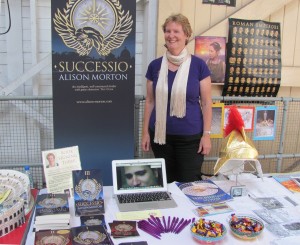 At ‘Love the Past’ event, Blists Hill Victorian Town on the Friday 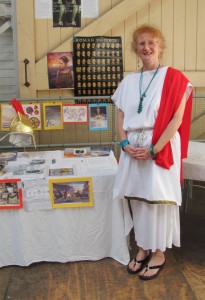 My Roman table-mate, Jackie Farrell
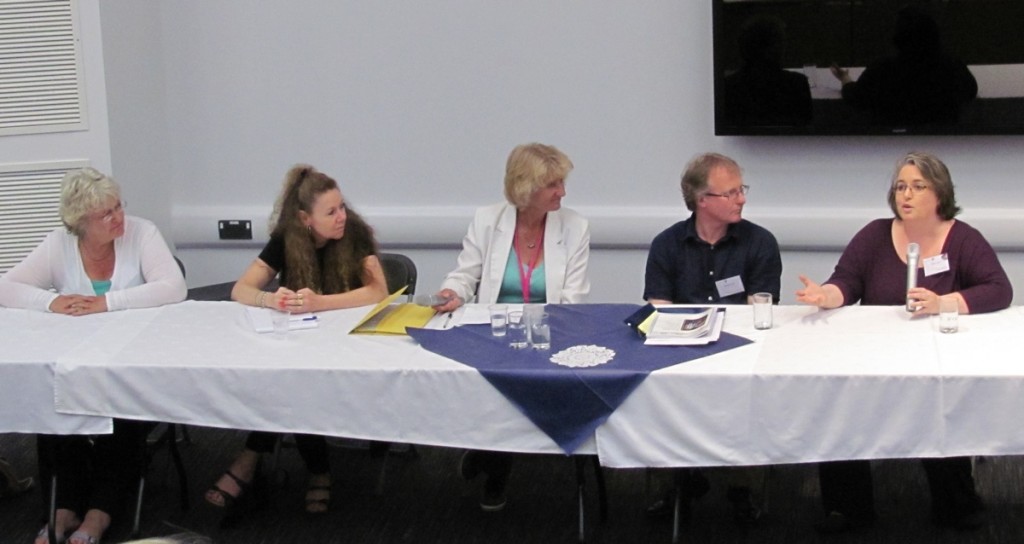 Katie Fforde (RNA president), Pia Fenton (RNA chair), Jenny Barden, Richard Lee (Historical Novel Society), Nikki Logan (Romance Writers of Australia)
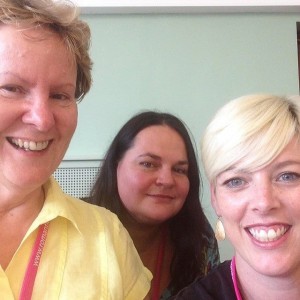 Brilliant selfie by Talli Roland, with me and Liesel Schwarz (Photo courtesy of Talli Roland)
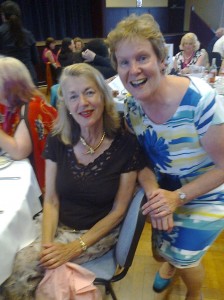 Critique partner Denise Barnes and I at the gala dinner
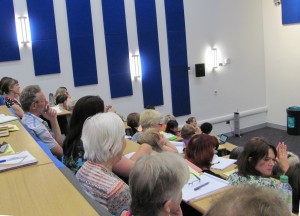 Listening intently 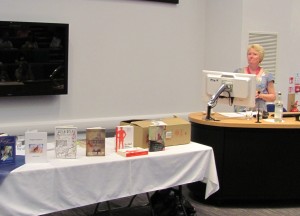 Dr Alison Baverstock preparing to start her talk
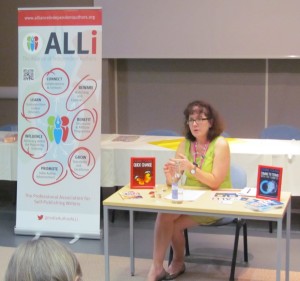 Debbie Young from the Alliance of Independent Authours (ALLi)
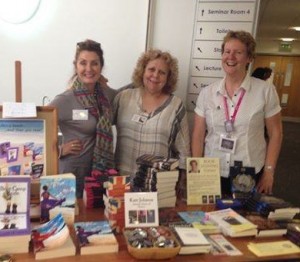 Adrienne Vaughan, Lizzie Lamb and me, selling our books (Photo courtesy of Lizzie Lamb)
Except where attributed photos (c) Alison Morton 2014
More conference reports from the RNA blog
Alison Morton is the author of Roma Nova thrillers, INCEPTIO, and PERFIDITAS. Third in series, SUCCESSIO, is now out.
Find out about Roma Nova news, writing tips and info by signing up for my free monthly email newsletter.
If you enjoyed this post, do share it with your friends!Like this:Like Loading...
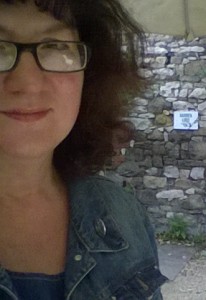 Today, I’m delighted to welcome Debbie Young as my guest. Author, journalist and blogger, she’s especially keen on short-form writing, such as flash fiction, short stories and blog posts. Commissioning editor of the Alliance of Independent Authors’ (ALLi’s) blog of self-publishing advice at www.selfpublishingadvice.org, she has co-authored ALLi’s groundbreaking new book, “Opening Up To Indie Authors”. Today, I’m delighted to welcome Debbie Young as my guest. Author, journalist and blogger, she’s especially keen on short-form writing, such as flash fiction, short stories and blog posts. Commissioning editor of the Alliance of Independent Authors’ (ALLi’s) blog of self-publishing advice at www.selfpublishingadvice.org, she has co-authored ALLi’s groundbreaking new book, “Opening Up To Indie Authors”.
She has a special interest in Type 1 Diabetes, which affects both her husband and her daughter. Her acclaimed ebook, “Coming To Terms With Type 1 Diabetes”, will be released as a paperback, with new material added, in November 2014.
Welcome, Debbie!
You help independent authors market their books via your Off the Shelf services. So what is the one thing that you think really helps sell most books?
The most essential thing is the right attitude. Too many authors fail because they have a sense of entitlement to sales, simply because they’ve written a book. No matter how good the book, all authors need:
• determination
• staying power
• a good understanding of sales strategies and tactics
• time to throw at the challenge (money’s helpful, but not essential)
• a thick skin
Whether they’re trade-published or self-published, authors must be prepared to actively pursue sales, in the flesh or online. They must also discard any rose-tinted spectacles and view their book from the perspective of other players who are critical to their success: bookshop proprietors, librarians, festival organisers, and so on.
These messages are at the heart of both my self-help books for authors, designed to equip them to be more confident and effective in promoting their work:
• Sell Your Books!, published by SilverWood Books
• Opening Up To Indie Authors, which I co-authored with Dan Holloway for the Alliance of Independent Authors
You are a notable reviewer of long fiction as well as a non-fiction and flash fiction author. Have you ever wanted to write a novel yourself and what would it be about?
Short-form writing is my comfort zone, because I’ve had a long career in journalism and PR in which space has always been at a premium. Until recently I’ve proclaimed that I’d never tackle a novel. My schedule is so busy that I’m not sure where I’d find the time. But I think I’m quietly moving towards that goal without consciously planning to.
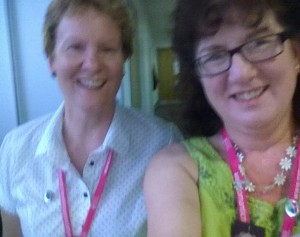 Debbie (with me) at the Romantic Novelists’ Association conference earlier this month You see, I don’t view my short stories as stand-alone pieces, but weave them into themed collections. This approach adds coherence for the reader and, I hope, makes the whole greater than the sum of the parts. As writer Denise Barnes recently remarked to me at the Romantic Novelists Association annual conference, where I was a guest speaker, there’s not that big a leap from writing themed collections of short stories to producing a novel. And as Orna Ross, who writes terrific novels, said to me when the subject came up over lunch last week, “Never say never!” So the pressure is on…
I did in fact write a novel many years ago, before self-publishing took off in its modern form. This light romantic comedy about thirty-somethings in crisis was too dull and clunky to be worth querying with publishers, so it’s been left to compost down in a drawer somewhere – best place for it!
Next time I’d go for edgier themes, probably with a little bit of magical realism thrown in, which is great fun to write. I’m quite taken with the idea of a story about a flying carpet. We have lots of exotic rugs in my house, following my husband’s trip to India, which are constantly teasing my imagination.
Alternatively I’d like to write a novel about relationships fostered through online book reviews. As a busy book reviewer, I enjoy reading other people’s reviews, which often say far more about the reviewer than the book, if you read between the lines. I can’t stop myself filling in their back stories in my head. There again, this could be a great theme for a flash fiction collection, each story focusing on a different reviewer of the same book.
I constantly ping back to the short form story as if attached to it with elastic, but watch this space…
Look forward to reading it, Debbie!
Debbie’s blog Off The Shelf Book Promotions helps other authors market their work. Her promotions blog is full of top tips from indie authors.
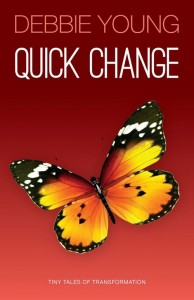 Debbie published her latest book, Quick Change – Tiny Tales of Transformation – to mark National Flash Fiction Day. Quick Change comprises 20 very short stories ranging from 100 to 1000 words in length. As its title suggests, it turns the spotlight on moments of change, whether physical, emotional, or psychological. To add shape and order to the collection, the stories are arranged in chronological order by age of a key character in each story, from new-born baby to the newly deceased. Debbie published her latest book, Quick Change – Tiny Tales of Transformation – to mark National Flash Fiction Day. Quick Change comprises 20 very short stories ranging from 100 to 1000 words in length. As its title suggests, it turns the spotlight on moments of change, whether physical, emotional, or psychological. To add shape and order to the collection, the stories are arranged in chronological order by age of a key character in each story, from new-born baby to the newly deceased.
Quick Change is now available as an ebook from Amazon: mybook.to/QuickChange
Alison Morton is the author of Roma Nova thrillers, INCEPTIO, and PERFIDITAS. Third in series, SUCCESSIO, is now out.
Find out about Roma Nova news, writing tips and info by signing up for my free monthly email newsletter.
If you enjoyed this post, do share it with your friends!Like this:Like Loading...
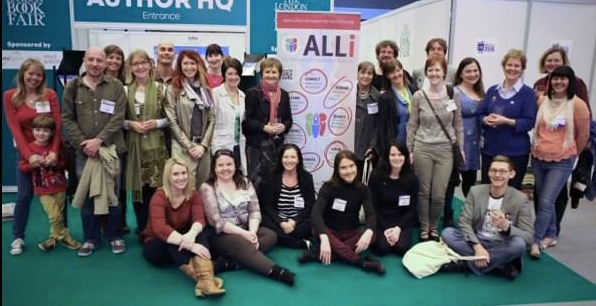 ALLI authors meet up at the London Book Fair April 2014 Writing is a solitary thing – it’s you, the writing medium and hard graft alone together. Your imagination/brain/mind/muse and the pen or keyboard are it. Perhaps you have a writing buddy, known sometimes as a critique partner, or belong to a writers’ circle or a writers’ association, but if you’re an independently published author, you have another layer of questions to ask and topics to discuss.
 I’ve found two groups for independent authors which I would recommend: both are friendly, open and collaborative. The Alliance of Independent Authors (ALLI) fosters the independent sector as a valuable, fruitful and contributing part of the publishing industry, but above all, it is driven by and for its authors – ‘connection and collaboration, advice and education,’. A blog about trends, successes, writing craft and marketing go hand in hand with member support and industry campaigns such as ‘Open Up To Indies‘. I’ve never regretted a penny of my £75 annual membership fee! And you get a great badge… I’ve found two groups for independent authors which I would recommend: both are friendly, open and collaborative. The Alliance of Independent Authors (ALLI) fosters the independent sector as a valuable, fruitful and contributing part of the publishing industry, but above all, it is driven by and for its authors – ‘connection and collaboration, advice and education,’. A blog about trends, successes, writing craft and marketing go hand in hand with member support and industry campaigns such as ‘Open Up To Indies‘. I’ve never regretted a penny of my £75 annual membership fee! And you get a great badge…
 As a self-publisher you are totally in control of publishing your books, but you don’t have the backing of a publishing house or their marketing and publicity services. Before somebody else says it, I know that all authors have to market themselves, however they are published, but indies have to be a tad more energetic about it. And they need to collaborate. Awesome Indies operates a quality control system for fiction – have a stroll through its website – but its director, Tahlia Newland, is very pro-active on marketing. If readers don’t know about a book, how can they buy and read it? As a self-publisher you are totally in control of publishing your books, but you don’t have the backing of a publishing house or their marketing and publicity services. Before somebody else says it, I know that all authors have to market themselves, however they are published, but indies have to be a tad more energetic about it. And they need to collaborate. Awesome Indies operates a quality control system for fiction – have a stroll through its website – but its director, Tahlia Newland, is very pro-active on marketing. If readers don’t know about a book, how can they buy and read it?
Recently, they interviewed some of their authors and posted the results on You Tube in a theme-based series of two-minute videos – start here. (I appear in most of them!)
 And, of course, the fabulous Indie B.R.A.G. which is primarily a quality vetting organisation for self-published books, but one which runs a splendid blog for authors, readers and anybody with an interest in self-publishing. This brilliant post on how to support authors is typical of their generous spirit. And, of course, the fabulous Indie B.R.A.G. which is primarily a quality vetting organisation for self-published books, but one which runs a splendid blog for authors, readers and anybody with an interest in self-publishing. This brilliant post on how to support authors is typical of their generous spirit.
My experience is that these international sites complement each other; I’ve met new friends, new colleagues and garnered some pretty savvy advice.
Alison Morton is the author of Roma Nova thrillers, INCEPTIO, and PERFIDITAS. Third in series, SUCCESSIO, is now out.
Find out about Roma Nova news, writing tips and info by signing up for my free monthly email newsletter.
If you enjoyed this post, do share it with your friends!Like this:Like Loading...
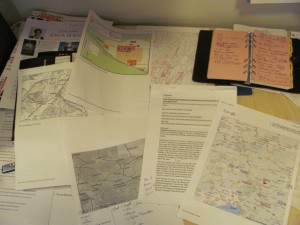 Research. Yeah, I know, a sticky subject in more ways than one. Writing of any sort needs research whether it’s a modern shoes-and-shopping story, crime thriller or a historical magnum opus. Research. Yeah, I know, a sticky subject in more ways than one. Writing of any sort needs research whether it’s a modern shoes-and-shopping story, crime thriller or a historical magnum opus.
Almost every story written hinges on a set-up or a problem the writer has purposefully created, but it must be plausible. Readers will engage with it and follow as long as the writer keeps their attention and, most importantly, their trust. So your story has to look and feel real (even the elves...).
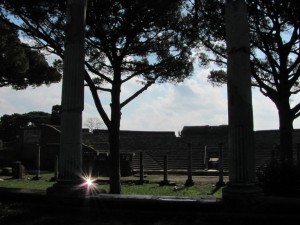 Strongly coupled with this is internal consistency, essential in any science fiction, fantasy or historical setting. Readers want to step out of reality for a few hours; investing their precious reading time in a rather strange place is high-risk for them. So build your world carefully and thoroughly or your credibility will crumble. Strongly coupled with this is internal consistency, essential in any science fiction, fantasy or historical setting. Readers want to step out of reality for a few hours; investing their precious reading time in a rather strange place is high-risk for them. So build your world carefully and thoroughly or your credibility will crumble.
Leaving aside the cracking story you’ve dreamed up or that tale from history you want to tell, what about the setting? It has to be woven into the story or there’s no point in using that background. So you have to know the scenery, weather, what the inhabitants and look like, their clothes, whether they accept strangers, what do they believe in, do they use buses, trains, horses, or just plod everywhere on foot? Can they vote and/or are they subject to a lord or lady’s whim?
I have a list of questions that I print out with space in-between each one. I then sit down and write a paragraph on each. This seems to go into my head better than if I type it on the keyboard.
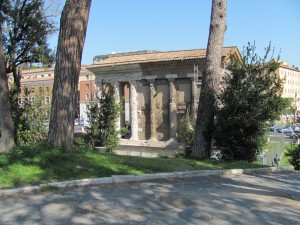 Temple of Portunus – In the Forum Boarium, site of ancient Roman cattle market Even though I write alternative history stories about Roma Nova, an imaginary country, and the first three are set in the present, I need to do research, especially if I’m dipping back into Roma Nova’s past before it diverged from the standard timeline. And if I’m researching modern surveillance equipment or sniper rifles, I need to check the specifications very carefully as they may be vital to the plot development.
I read around the setting(s), both good fiction and straightforward reference material. I’ll exclude everything else ruthlessly. I’m heard muttering in corners about Roman marriage customs, spotted looking up railway schedules or crop harvest times, how many days it took in ancient times to travel from Portus Itius/Gesoriacum (Boulogne) to Rome. Damn. Has Gesoriacum changed its name to Bononia by the 4th century? Maps of archaeological digs and airline timetables start littering my desk along with reference books on childhood illness and police procedure. My colour-coded Filofax pages fill up. Bookmarked articles gather in wobbly formation on my computer desktop…
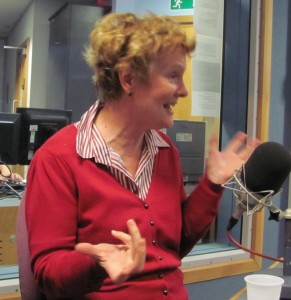 So where do you stop? Outside factors decide it sometimes – a publisher deadline, competition date, your own publishing schedule. But for me, a moment arrives when I have finished the first run-through of all my research notes and I’m ‘in the zone’. I’m ready to plunge into the writing. So where do you stop? Outside factors decide it sometimes – a publisher deadline, competition date, your own publishing schedule. But for me, a moment arrives when I have finished the first run-through of all my research notes and I’m ‘in the zone’. I’m ready to plunge into the writing.
When I emerge and re-read write that first draft, I mark up the bits of research I’ve allowed to make an appearance in the manuscript. Much of what I collected in my early research notes has gone into my mental and digital archive and will stay there.
Then I check everything again. I nearly had somebody sail from Rutupiae (Richborough) in the second half of 4th century. By then, Portus Dubris (Dover) was much more prominent as both a civilian and military port, even that late in the Roman occupation of Britain.
So my modus operandi (or M.O. for crime types) can be summed up in three points –
1. do your broad research;
2. write your story;
3. double check everything.
Happy writing!
Alison Morton is the author of Roma Nova thrillers, INCEPTIO, and PERFIDITAS. Third in series, SUCCESSIO, is now out.
Find out about Roma Nova news, writing tips and info by signing up for my free monthly email newsletter.
If you enjoyed this post, do share it with your friends!Like this:Like Loading...
|
Subscribe to Blog via Email
Join 368 other subscribers.
Categories
Archive
|