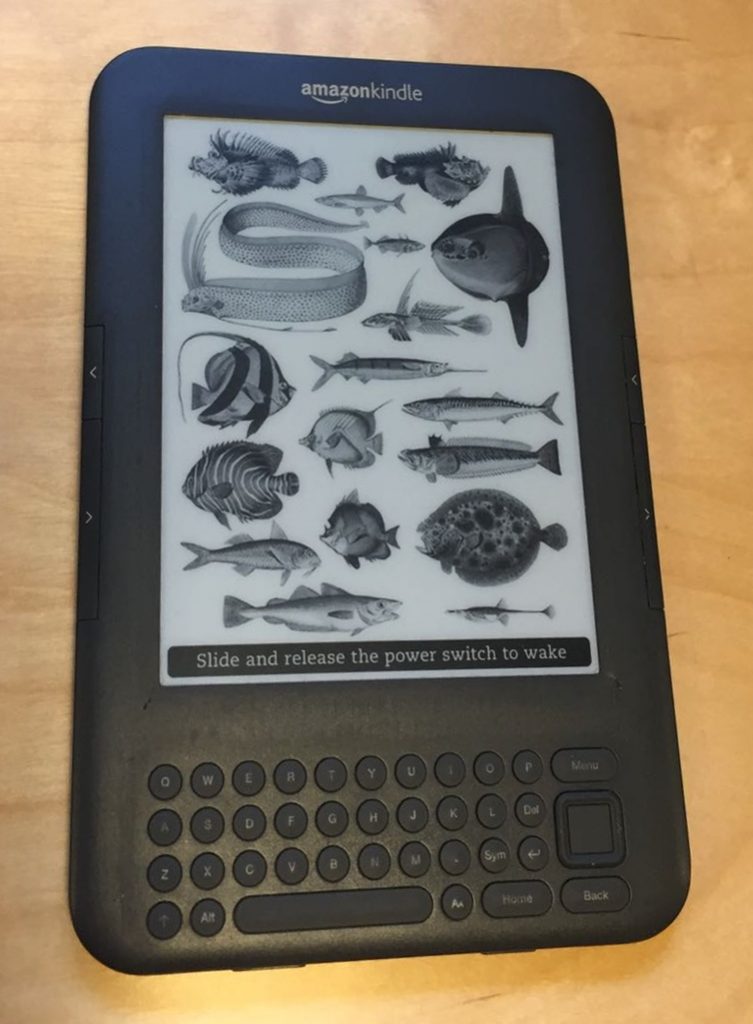
 I’ve been given a fab birthday present – a 3G Amazon Kindle. Thank you, Steve xx I’ve been given a fab birthday present – a 3G Amazon Kindle. Thank you, Steve xx
As a writer, I read a huge number of books; our house is groaning with them. As a plane passenger, it’s agonising trying to sift out the books to take (or, worse, leave behind). As a Luddite, it’s been a big decision to think about flirting with the dark side of electronic books.
But I’m having a ball, a ‘St Paul on the road to Damascus’ revelation. Already my paperback favourites are starting to look a tad quaint.
The clear screen and sharp type work in sunlight, under subdued light, in any light. I’ve already downloaded books and am finding them very easy to read. I’ve found no sense of distortion between the paper page and epage experiences.
As resident outside the UK, my buying channel is via amazon.com. Not quite sure whether or not that’s going to make any difference as the books I want appear on both amazon.co.uk and amazon.com.
I’ve explored the connectivity a little, but not very much beyond setting up and downloading books. When I go back to the UK, the download on demand anywhere feature will be an enormous benefit.
For a comprehensive review, including techie things, have a look at Steve’s blog post
Well, Captain Kirk, those handy little pads you read Enterprise crew reports on seem to have made it into the early 21st century. 😉
Alison Morton is the author of Roma Nova thrillers, INCEPTIO, PERFIDITAS, SUCCESSIO and AURELIA. The fifth in the series, INSURRECTIO, was published in April 2016.
Find out more about Roma Nova, its origins, stories and heroines… Get INCEPTIO, the series starter, for FREE when you sign up to Alison’s free monthly email newsletter
If you enjoyed this post, do share it with your friends!Like this:Like Loading...
The 1990s ride again. No, really. At a meeting yesterday evening for autoentrepreneurs (small business creators), I was dragged back to a business style that I thought had disappeared. By the end of the evening, I was having difficulty hiding my amusement. John Cleese’s Video Arts training company would have relished it as a ‘how not to do it’ example. I didn’t know whether to post this report on my property finding blog or this one.
Picture the scene: an excellent line-up of speakers from the chamber of commerce, the URSSAF, the RSI and the tax office gathered to inform existing and wannabe autoentrepreneurs about the scheme and to give pointers, tips and hints. They’d planned in a long question and answer session. So far, pretty classic for a business presentation cum seminar.
The meeting leader was clear and clever, the perfect understudy for Joel Grey’s MC in ‘Cabaret’. He kept his frustration with less talented presenters well under wraps. But still… First up was a tall, imposing speaker from the tax office. We listened respectfully as her 1990s-dressed figure paced up and down, reading out her notes and lecturing us in a way that strongly reminded me of my first year maths teacher. We hung on every word.
The next act was the trilling twins. Gaunt, nervy and very knowledgeable, one with space age spectacles and a nineteenth century voice, the other younger, much taller falling over her words when not swallowing them, they regaled us with their insights into the social security system. The French system is split into a multitude of different caisses, or social security departments, each dealing with different occupations. Even the French audience was baffled. The second tax speaker, a young man, capable, but evidently a fish out of water when surrounded by fifty of the real public, was soon snaffled by two of the audience to be initiated into their complex personal tax problems.
The audience responded, some asking sensible questions, some with off-this-planet ones. Few seemed to have read the excellent website http://www.lautoentrepreneur.fr/ which, if truth be told, provided all the information that the specialists were giving. Then the fun began in that inimitable French way where a question gets taken apart, by four or five people discussing it, conceptualising it, going all around it and finally coming to a mutually acceptable conclusion. Not always the definitive answer, though…
All the speakers were eager to impart information and anxious to help. They’d all come out on a wet evening after a long day at the office. But oh, dear, were they in need of some presentation training! My heart wept for ‘Joel Grey’ as he attempted to control his herd of cats. Perhaps someone ought to tell them that you don’t read from the Power Point slides or from printouts, that you outline your speech first, that you keep the information simple and to three points maximum, that you invite feedback, that you pause for breathe.
As an autoentrepreneur, I didn’t learn a great deal; as a creative writer, I garnered some great characters to use in my next story…
If you enjoyed this post, do share it with your friends!Like this:Like Loading...
 Despite the sight of rich red geraniums flowering on my kitchen windowsill, the fresh, strong sunshine and the delicious cup of coffee at hand, I am grumpy. Despite the sight of rich red geraniums flowering on my kitchen windowsill, the fresh, strong sunshine and the delicious cup of coffee at hand, I am grumpy.
Pourquoi?
Looking through my tweets this morning, I saw an anouncement from a famous bookshop part of which ran: “…is on it’s way for review.” My teeth couldn’t grind hard enough, the anguished sob couldn’t exit my mouth fast enough.
Let’s get this straight: “it’s” is short for “it is”. The apostrophe substitutes for missing letters. Other examples include don’t, can’t, they’re, we’re, isn’t.
So far, so easy.
I know it sounds the same, but “its” shows that something belongs to something else (We used to call this the genetive case, but that knowledge has faded away, unless you study Latin or German). So, two examples are “The cat sat on its mat” and “The burger came with its own portion of fries”.
Tip: If you can substitute his or her, even if it sounds a tad weird, then this “its/it’s” should be apostrophe-free.
The saddest thing is that the mis-use came from a bookshop.
Okay, I’m going to stop now and drink my coffee; it’s getting cold sitting there on its mat.
Please comment – I love comments – but don’t get me started on “your and “you’re”…
P.S. Said shop has acknowledged (and with a 🙂 )
Updated 2024: Alison Morton is the author of Roma Nova thrillers – INCEPTIO, CARINA (novella), PERFIDITAS, SUCCESSIO, AURELIA, NEXUS (novella), INSURRECTIO and RETALIO, and ROMA NOVA EXTRA, a collection of short stories. Audiobooks are available for four of the series. Double Identity, a contemporary conspiracy, starts a new series of thrillers. JULIA PRIMA, Roma Nova story set in the late 4th century, starts the Foundation stories. The sequel, EXSILIUM, is now out.
Find out more about Roma Nova, its origins, stories and heroines and taste world the latest contemporary thriller Double Identity… Download ‘Welcome to Alison Morton’s Thriller Worlds’, a FREE eBook, as a thank you gift when you sign up to Alison’s monthly email update. You’ll also be among the first to know about news and book progress before everybody else, and take part in giveaways.
If you enjoyed this post, do share it with your friends!Like this:Like Loading...
When you begin a new piece of writing, be it article, short story, press release or a 100,000 word novel, you start off with ideas, insights, energy which can sustain you to the end. Sometimes the oomph fades part-way through. Sometimes you start with a dragging reluctance because you have a deadline, a target or open mic at your group tonight. Or maybe it’s something you’re soldiering on with, snatching bits of time in a busy day, and feeling uninspired.
You read back what you’ve written. It’s codswallop.
Collins English Dictionary gives a succinct definition:
codswallop n.
Brit slang nonsense [of unknown origin]
According to Merriam Webstar online, synomyms of codswallop include: applesauce [slang], balderdash, baloney (also boloney), beans, bilge, blah (also blah-blah), blarney, blather, blatherskite, blither, bosh, bull [slang], bunk, bunkum (or buncombe), claptrap, nonsense [British], crapola [slang], crock, drivel, drool, fiddle, fiddle-faddle, fiddlesticks, flannel [British], flapdoodle, folderol (also falderal), folly, foolishness, fudge, garbage, guff, hogwash, hokeypokey, hokum, hoodoo, hooey, horsefeathers [slang], humbug, humbuggery, jazz, malarkey (also malarky), moonshine, muck, nerts [slang], nuts, piffle, poppycock, punk, rot, rubbish, senselessness, silliness, slush, stupidity, taradiddle (or tarradiddle), tommyrot, tosh, trash, trumpery, twaddle
But is it?
No, it’s a first draft, an outpouring full of your ideas, plot, passion. It’s meant to be raw and rough. That’s what editing is for – to polish, tighten and temper that first draft.
So next time you sigh dejectedly at what you’ve written, don’t feel badly. Swap to your slash and burn editor personality and polish it up to a sparkling gem.
You’ll find original codswallop has transmogrified into shining treasure.
If you enjoyed this post, do share it with your friends!Like this:Like Loading...
Okay, you’ve done your first draft, you’ve edited it, your aunt Mabel who taught English has checked it, your mate Bev says ‘It’s great!’. You’ve left it for a few weeks, come back, tightened the manuscript, checked for shockers and you’ve even written your synopsis. You’re on the starting blocks for publication, fame and fortune(!).
But….
A tiny nagging doubt is furkling around in between the two halves of your brain. No, it can’t be better, can it? Yours is better written than loads of books you’ve read (And you have been reading a lot of books in your genre/field, haven’t you?). But is it good enough?
I learnt a depressing statistic the other day from Nicola Morgan at Pen2Publication: the average reader buys only 6 books a year. So why should yours be amongst those six?
Hmm. Perhaps you’d better get a professional opinion on the quality of your book and whether it’s publishable before you start submitting to those important gatekeepers: the literary agents. Does your novel have PTQ (Page turning quality)? Are the pace and structure right? Are you characters appealing and your voice original and enticing? Is it a genre that sells? Will it appeal to a broad mass of people? Will it be likely to be placed where the public can buy it?
I’m a mere tyro, but I know experienced, tough experts who can help answer these questions. But first you must do your research, find out the basics of getting published and work out exactly what help you need. For starters, have a look at How Publishing Really Works blogger Jane Smith’s notes from her recent talk ‘The Writing Business’ at the Edinburgh Literary Festival. Nicola Morgan’s blog is bracing, refreshing and a source of gold nuggets (metaphorically speaking!). And I hope you read Carole Blake’s From Pitch to Publication while you were still writing your first draft.
Most importantly, you must be ready to accept what they say….
Expertise is out there, some better than others: I have only listed those sources I have found particularly helpful. You have to find the one you feel will help you most. But using the wisdom and experience of such experts not only saves you many a pratfall, but will probably save you time, money and heartache.
If you enjoyed this post, do share it with your friends!Like this:Like Loading...
|
Subscribe to Blog via Email
Join 368 other subscribers.
Categories
Archive
|
 I’ve been given a fab birthday present – a 3G Amazon Kindle. Thank you, Steve xx