Thinking about police, gendarmes and emergency services in the past few days brought me to the law enforcers of Ancient Rome. Faced with terrorist attack (or riot, revolt and rebellion), they would have been robust in their attitude and actions. So who policed Rome?
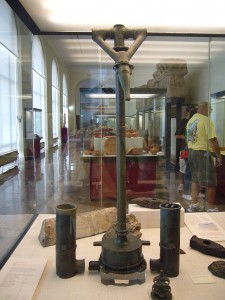
Portable Roman fire engine nozzle, Madrid Museum (Creative Commons)
Vigiles as a public service were founded by Augustus as a new firefighting force to replace the private, often haphazard, groups. In AD 6, he levied a 4% tax on the sale of slaves to finance the service. They were commanded by the praefectus vigilum, who was of equestrian rank, and organised into seven cohorts of 500, later 1,000 men, each commanded by a tribune. A cohort would patrol two of the city’s fourteen administrative districts (regiones) from sub-stations throughout the city, plus detachments were stationed at Rome’s ports of Ostia and Portus.
Vigiles were dual role: they also acted as a night watch, keeping an eye out for burglars, cut-throats and low-life, and hunting down runaway slaves. Sometimes, they were used to maintain order in the streets. As well as the power to break into houses if they suspected an out-of-control fire inside, and demolish property to create firebreaks, vigiles could also check if householders had firefighting equipment and a ready reserve of water. If not, householders could be punished for negligence. So there was an element of preventative work as well as powers of investigation and enforcement…
In their firefighting role, the vigiles had a variety of specialist troops such as sifonarii, who worked the pumps, uncinarii, men who used grappling hooks, aquarii who identified and supervised the supply of water. As with true military forces, the vigiles enjoyed the benefit of their own medical support with four doctors (medici) attached to each cohort. The ordinary firefighters were called milites (soldiers).
For firefighting, the vigiles used quilts or mats, (most likely soaked in water and used to smother flames), ladders, axes, fire buckets made of rope treated with pitch, poles and hooks to push and pull over fire damaged walls. The height of sophistication was a sipho, a fire engine, pulled by horses and consisting of a large double-action pump that was partially submerged in a reservoir of water and fitted with a directional nozzle.
 Recruited from the lower levels of Roman society, often ex-slaves, vigiles were not as highly regarded as their other policing colleagues. But their job wasn’t easy…
I heartily recommend reading Lindsey Davis’ Falco series which features Petro (Lucius Petronius Longus), a vigiles watch captain in charge of a disparate lot and who helps main hero Falco investigate dastardly deeds in Ancient Rome.
Cohortes urbanae, also created by the ever busy Augustus, were formed to counterbalance the enormous power of the Praetorian Guard. The cohorts’primary role was to police Rome and to counteract the roaming mobs and gangs that so often haunted its streets during the Republic. These urban cohorts thus acted as a heavy duty police force, capable of riot control duties, while their contemporaries, the vigiles, had the day-to-day role of policing the streets and protecting against fires.
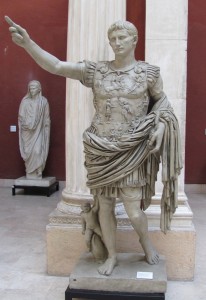
Augustus
Originally, the cohortes urbanae were divided into three cohorts of around 500 men, each commanded by a tribune and six centurions. In the time of the Flavians (Vespasian, Titus and Domitian), this increased to four cohorts. Only free citizens, mainly of Italian origin, were eligible to serve in their ranks.
The man in charge of all the cohortes urbanae was the urban prefect (praefectus urbanus or praefectus urbi), a magistrate tasked with maintaining order in the city and within a hundred mile circumference. He was also tasked with administering the emperor’s laws, superintending guilds and corporations (collegia), overseeing officials responsible for the drainage of the Tiber and the maintenance of the city’s sewers and water supply system, as well as its monuments. Most importantly, he was ultimately responsible for the city’s provision with grain from overseas for the city’s large population; if the prefect failed to secure adequate supplies, riots usually broke out.
Urban cohorts, (known as city cohorts in non-Roman cities) were later created in both the Roman North African city of Carthage and the city of Lugdunum in Roman Gaul (modern Lyon).
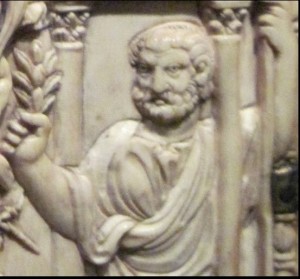
Symmachus
In Late Antiquity, when the imperial court moved from Rome itself, the office of urban prefect became more powerful, as it was no longer under the emperor’s direct supervision or even his eye. Interestingly, from the Roma Nova angle, the office was usually held by leading members of Italy’s still largely pagan senatorial aristocracy. In such a capacity, Symmachus played a prominent role in the controversy over the Altar of Victory in the late 4th century.
So there are some parallels and overlaps with modern day services. In the UK, police (regionally based), military, fire brigades and ambulance/paramedic services are separate. Here in France, there are two police services – municipal (local) and gendarmerie (paramilitary). Ambulances are organised privately and publicly, but it’s a firefighter who is likely to arrive first at an accident and carry out paramedic services.
Alison Morton is the author of Roma Nova thrillers, INCEPTIO, and PERFIDITAS. Third in series, SUCCESSIO, is now out.
Find out about Roma Nova news, writing tips and info by signing up for my free monthly email newsletter.