 I’m delighted to welcome Jane Davis to the blog today. She is the author of character-driven historical and contemporary fiction that bridges meticulous research with compelling emotionally-rich storytelling.
Her novels explore subjects ranging from the life of a pioneering female photographer to families searching for justice after a devastating disaster. Interested in what happens when ordinary people are pushed into extraordinary situations, Jane introduces her characters when they’re under pressure and then, by her own cheerful admission, throws them to the lions. Expect tangled relationships, moral crossroads and a smattering of dark family secrets!
Her first novel, ‘Half-Truths and White Lies’, won a national award established by Transworld in their quest to find the next Joanne Harris. Since then, her books have continued to earn acclaim. She was hailed by The Bookseller as ‘One to Watch’. ‘An Unknown Woman’ won Writing Magazine’s Self-Published Book of the Year in 2016 and was shortlisted for the IAN Awards. ‘Smash all the Windows’ won the first ever Selfies Book Award in 2019. ‘At the Stroke of Nine O’Clock’ went on to be featured by The Lady Magazine as one of their favourite books set in the 1950s and was a Historical Novel Society Editor’s Choice.
Jane lives in a Surrey cottage that was originally the ticket office for a Victorian pleasure garden, known locally as ‘the gingerbread house’. Her home frequently finds its way into her stories – in fact, it met a fiery end in the opening chapter of ‘An Unknown Woman’.
When she isn’t writing, you may spot Jane disappearing up the side of a mountain with a camera in hand, or haunting Victorian cemeteries searching for the perfect name for her next character.
Over to Jane to tell us about…
Forgotten Pioneers: 18th-Century Businesswomen in London
My novel The Temple of the Muses tells the second part of the life of Dorcas Lackington (c. 1750–1795), wife of the London bookseller, James Lackington. Although her name isn’t written in history books, she played an active role in his business, overseeing sales, stock, and customer service, helping turn Lackington’s into London’s most affordable bookshop – an idea that was radical in its day.
We imagine Georgian England as a time when a woman’s place was in the home, but the reality is very different. Dorcas was far from being alone. London was the largest city in Europe, a global trading hub that was fast becoming a consumer society. This created huge demand for small-scale trade and services — shopkeepers, market sellers, brewers, bakers, dressmakers, lodging-house keepers, pawnbrokers and moneylenders, retail assistants and apprentices.
It relied on the great number of working class women to provide the labour force. One of those women was Mary Collier (c.1688–1762), who came from a poor rural family, but found employment in London in manual labour and domestic service. A rare example of a working class voice, she wrote about women’s labour struggles, publishing The Woman’s Labour (1739) and Poems on Several Occasions (1762) defending women’s work and describing its realities, and writing defiantly in AN EPISTOLARY ANSWER To an Exciseman, Who doubted her being the Author of the Washerwoman’s Labour:
“Tho’ if we Education had
Which Justly is our due,
I doubt not, many of our Sex
Might fairly vie with you.”
I won’t trouble you with tales of upper class women born into aristocracy, inherited wealth and property, although it is true that some managed large estates and rental properties, lent money, handled investments and provided much needed patronage for the arts.
Instead, I want to delve into a chapter of history that has often been overlooked: the remarkable women who ran businesses, produced luxury goods, and shaped the city’s economy. From Cheapside to Chiswell Street, female entrepreneurs were the beating heart of London’s commercial life.
Discovering City Women in the 18th Century
Much of what we know about the sheer number of businesswomen in London comes from trade cards and directories, tax records, records of court cases and apprenticeship records. Thanks to archives like those collected by Sarah Sophia Banks at the British Museum, we can glimpse the vibrant world of 18th-century female entrepreneurship.
Imagine the streets of Georgian London bustling with workshops, shops, and trading activity and alive with innovation, and commerce. Cheapside, known for at least five centuries as a centre for luxury goods, was home to numerous businesswomen trading in furniture, printing, fan-making, silver and gold, millinery, and mantua-making, among other trades. It was there that Elizabeth Carter traded as a silk mercer and Mary Hilton as a milliner (hat and fashion seller). And in Fleet Street, Mrs Brown, milliner, sold the latest Paris fashions.
University of Cambridge historian Dr Amy Louise Erickson explains: “There was nothing unusual about these businesswomen at the time. They were members of trade families, and it was normal for women to be in charge.” Women were not just present, but essential architects of commerce.
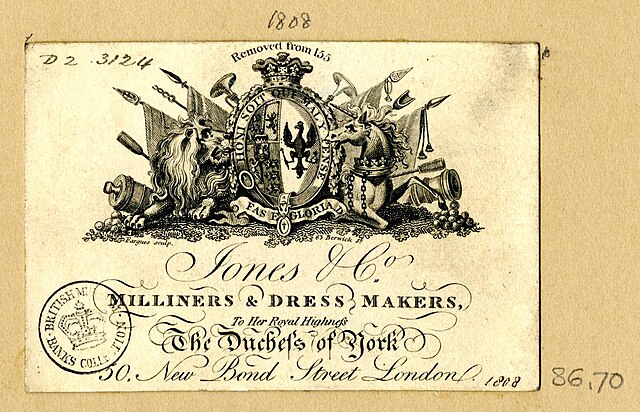
CC Wikimedia Commons
Families, Trade, and the Role of Women
Many businesswomen learned the trade from their families and were active in hands-on management, overseeing production, bookkeeping, marketing, and client relations. Legal structures allowed widows to inherit businesses, giving them formal authority and maintaining continuity. Marital status was no barrier: women were single, married, and widowed, and collectively they employed thousands of men and women across the city.
Although legal principles prevented women from owning property in their own right and signing legal contracts, many women traded as “feme sole traders” (recognised legally as independent in business), and we see examples of courts frequently enforcing women’s commercial contracts. Just as today, London’s economy increasingly ran on small transactions, not just big merchants — and women dominated this level.
One striking example is Mary and Ann Hogarth, sisters of the artist William Hogarth. In 1730, Hogarth designed their business card as they moved to new premises. The sisters sold fabrics and ready-made clothes, and even supplied uniforms for Christ’s Hospital School, which educated orphaned children of City freemen.
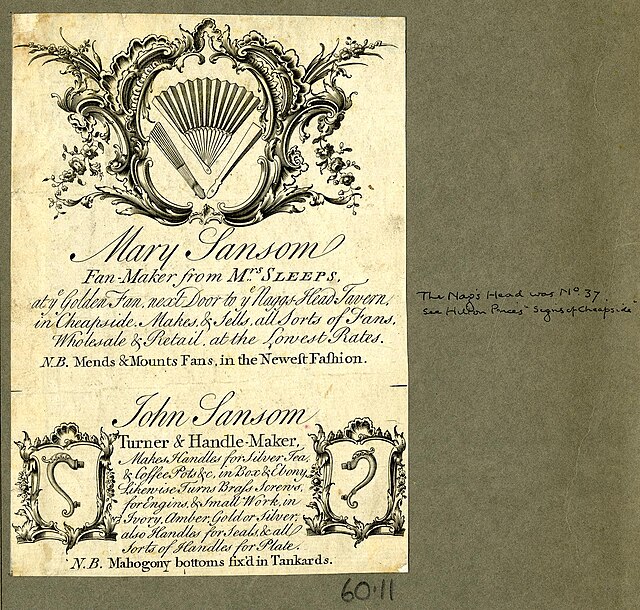
CC Wikimedia Commons
Equally remarkable were the Sleepe sisters—Martha, Esther, and Mary—who built on the legacy of their mother, herself a fan-shop owner. Martha traded independently for over 35 years in St Paul’s Churchyard. Mary created a joint business card featuring both her own trade of fan-making and her husband’s as a turner and handle-maker. Esther married Charles Burney and bore nine children, including the novelist Frances Burney, while maintaining her business interests.
Notable 18th-Century Businesswomen
These women exemplify the range and impact of female entrepreneurship in London:
- Elizabeth Caslon (1730–1795)
Elizabeth worked alongside her husband in the Caslon Type Foundry on Chiswell Street, supplying metal type for printing across Britain and the American colonies. After her husband’s death, she continued managing the business alongside her sons, ensuring the family’s typographical legacy endured. - Eleanor (Mary) Coade (1733–1821)
The daughter of a wool merchant and known as the “Queen of Artificial Stone,” Coade perfected Coade stone, a durable ceramic used for architectural ornamentation. Her firm, Coade & Co., produced statues, pediments, and decorative façades for royalty and public monuments, including St George’s Hall, Kew Gardens, and the Royal Pavilion, Brighton. Her success combined scientific experimentation with business acumen, navigating a male-dominated industry with extraordinary skill. - Mary Hayley (1728–1808)
After the death of her husband, Mary ran a transatlantic trading firm, importing tea and other goods, and later operated whaling and sealing ventures. She conducted her business across London and Boston, a relatively rare example of a woman leading international trade. - Martha Wray (1739–1788)
Martha inherited her husband’s medicinal warehouse and managed the sales of Turlington’s Balsam of Life, maintaining its popularity well into the 19th century. - Hannah Humphrey (1750–1818)
As a print seller and publisher, Hannah worked alongside her husband and later independently, publishing works by James Gillray and becoming a central figure in London’s print culture. - Elizabeth Godfrey (active 1720–1766)
A goldsmith and jeweller, Elizabeth ran her own workshop after her husband’s death, producing luxury items for aristocratic clients.
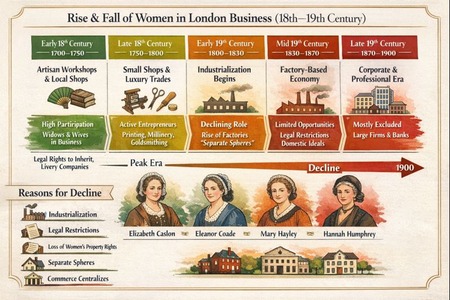
Patterns and Legacy
Several patterns emerge from these stories:
- Women often took over businesses as widows, but many were active co-managers during their husbands’ lifetimes. In the 18th century, widows and unmarried women could inherit property and run businesses in their own right, but upon marriage the common law principle of Coverture meant that her legal identity merged with her husband’s. This limited their formal control over property and business.
- Luxury and knowledge-based trades—books, printing, fans, jewellery, and fabrics—were common avenues for female entrepreneurship.
- The City of London’s livery companies and legal framework allowed women to inherit and run businesses formally, giving them real authority.
- Businesses were multi-generational, with workshops and homes often integrated under one roof.
As Dr Erickson notes: “These City businesswomen prospered and practiced a range of occupations in a way which would have been inconceivable in the middle of the 20th century. Historians still don’t understand exactly how or why women dropped out of the management of manufacturing and commerce.”
Part of the reason was that in the 18th century, trade was still largely artisan-based and workshop-centred, where family-run businesses were common, and women could contribute hands-on.
The 19th century saw the rise of industrial factories and large-scale commercial operations. Manufacturing became capital-intensive, increasingly male-dominated, and hierarchical. Women were often relegated to low-wage labour (assembly line, textile mills) rather than ownership or management.
In the 18th century, women were active members of livery companies, giving them formal recognition and networks. Over time, guilds became less central to commerce, removing a structure that had legitimised female business ownership.
Until The Marriage Property Act 1882 was passed, women did not have the right to full legal control over property they owned before marriage and property acquired after marriage. But by this time, cultural shifts had brought stronger ideas of “separate spheres”: men in the public sphere (commerce, politics, law) and women in the private, domestic sphere. Even women who had the skill or capital to run businesses were often discouraged from doing so because it was deemed socially inappropriate. Public respectability and social norms pressured middle- and upper-class women to focus on home, charity, and family.
Remembering London’s Forgotten Entrepreneurs
Late 18th Century life offers a vibrant snapshot of an era when women were vital participants in commerce, something that wouldn’t been seen again until the 20th century. I invite you to experience this extraordinary city – and one of its businesswomen – at a time of profound change.
The ebook of Jane’s novel The Temple of Muses is now out and the paperback will follow on 2 April 2026. See below for details.
———-
Connect with Jane
Website: https://jane-davis.co.uk
Facebook page: https://www.facebook.com/JaneDavisAuthorPage
Twitter/X: https://x.com/janedavisauthor
Pinterest: https://pinterest.com/janeeleanordavi/boards/
Get a FREE copy of her time-slip, photography-themed eBook, I Stopped Time, when you sign up to her newsletter
———-
About The Temple of the Muses
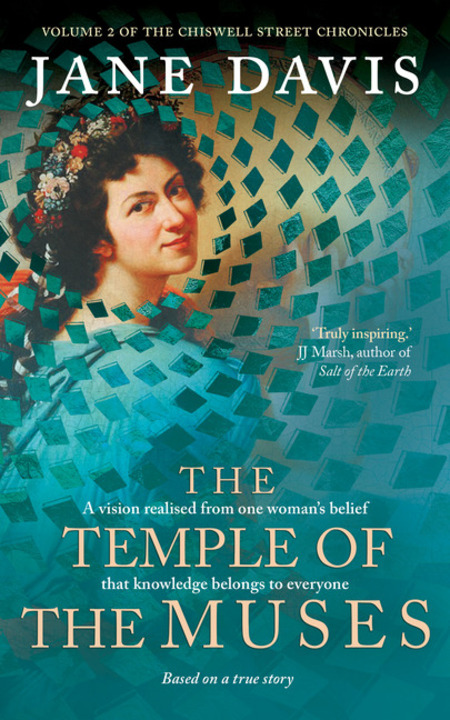 Volume 2 of the Chiswell Street Chronicles
The story continues…
London, 1780. As the city smoulders in the aftermath of the Gordon Riots, booksellers James and Dorcas Lackington refuse to answer despair with charity. Instead, they place their faith in something far more radical: books.
Convinced that reading offers the surest escape from poverty, the Lackingtons launch a daring experiment—pricing books so cheaply that even apprentices and servant girls can afford them. It is a bold challenge to the rigid social order of Georgian England, and one that places them squarely in danger.
Dorcas knows that life alongside James and his unshakable optimism will never be smooth. But she is no mere helpmeet. She is his compass, his conscience, and often the sharper mind. In a modest corner of Moorfields, their bookshop ignites a quiet revolution as ordinary people encounter philosophy, liberty, reason, and love for the first time.
Not everyone welcomes this awakening. The Junto, a powerful circle of men who believe that books breed dangerous ideas in the minds of the poor, move swiftly to crush the Lackingtons’ venture. As threats and intimidation escalate, Dorcas realises that survival will not come from retreat—but from becoming too large to silence.
Her answer is audacious: to build a cathedral to literature, not for kings or scholars, but for every woman and man who has ever been told that knowledge is not theirs to claim – The Temple of the Muses.
Perfect for readers of Maggie O’Farrell, Tracy Chevalier, Hilary Mantel, Sarah Waters, and Philippa Gregory, and for anyone who loves women’s historical fiction, book club fiction, and stories about books and the lives they change.
Buy the ebook here: https://books2read.com/thetempleofthemuses
You may also like to read the first book in the series, The Bookseller’s Wife which is only 99p until 15 March 2026.
Alison Morton is the author of Roma Nova thrillers – INCEPTIO, CARINA (novella), PERFIDITAS, SUCCESSIO, AURELIA, NEXUS (novella), INSURRECTIO and RETALIO, and ROMA NOVA EXTRA, a collection of short stories. Audiobooks are available for four of the series. Double Identity, a contemporary conspiracy, starts a new series of thrillers. JULIA PRIMA, Roma Nova story set in the late 4th century, starts the Foundation stories. The sequel, EXSILIUM, is now out.
Find out more about Roma Nova, its origins, stories and heroines and taste world the latest contemporary thriller Double Identity… Download ‘Welcome to Alison Morton’s Thriller Worlds’, a FREE eBook, as a thank you gift when you sign up to Alison’s monthly email update. As a result, you’ll be among the first to know about news and book progress before everybody else, and take part in giveaways.









I love hearing about all the many ways the true contributions of women have been buried by history (and men!)
We have the mistaken idea that events and developments all follow along a straight, upward progressive line. Yet these women prove how active they were in leading the commercial world. Then the lid was put on it in the nineteenth century.