Is it better to put a title at the beginning of each chapter in your book or should you merely put a simple number? I’ve never used chapter titles when writing my own books although I’ve absorbed them when reading other books.
What do chapter titles do?
 They can act as promises of what’s to come in the next few pages, be it a potential escalation (The Reading of the Will), an emotional disaster like loss or dread (The First Betrayal), or perhaps they point to an ironic promise that primes the reader for subversion (Happy Ever After?).
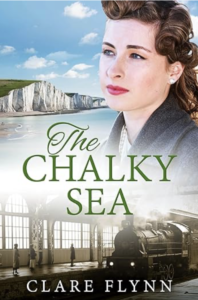
Clare Flynn’s The Chalky Sea set in southern England during the Second World War gives us The New Housekeeper, Raining Bombs and Sunday Roast with the Underwoods, all of which intrigue. Readers dive into the chapter already prepared for change, terror or a potentially joyful or awkward occasion. This can increase narrative momentum – especially useful in long novels.
Titles can give the author a chance to make a sly comment
Today, we are supposed to write from a distinct point of view – first person, third person, etc. and unlike in previous ages, the author is supposed to keep their nose out of the narration. However, chapter titles allow us to insert little comments in a sly way. Take, for instance In Which our Heroine Finds She has Made a Big Mistake, or If Only He’d Listened to the Weather Forecast or Losing your Camel in the Desert is Never a Good Idea. The author’s voice comes through clearly without seeming overtly intrusive.
Short, punchy titles can keep the pace going
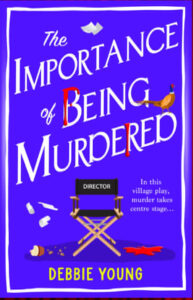 Debbie Young writes cosy crime stories set in a Cotswold village. Her next novel, The Importance of Being Murdered, set around the local amateur dramatic group putting on a play, has these chapter titles: 1 House-hunting, 2 Made Up, 3 Starstruck, 4 Caught in the Act, 5 Crushed, 6 Game for Anything… You can see the theatrical references, but my immediate reactions are to ask who and why. You can see the story has pace, just from these chapter titles.
Keeping the reader’s attention and interest
Titled chapters help readers navigate narratives that switch back and forth in time or where different characters tell their version of events in the story. Readers will feel guided rather than lost, especially in complex literary works. Sometimes they are downright intriguing such as A Surprise Involving Pink Lips from Mavis Cheek’s Amenable Women.
Contradicting expectations
 Sometimes, chapter titles can contradict the chapter’s surface action such as a chapter titled Safety that contains none, The Truth followed by lies or Home At Last in a place that isn’t safe. This can be the author being devious where they create irony, unease or moral tension without stating it explicitly.
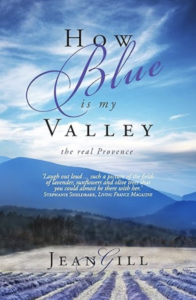
In her memoir about moving to France, How Blue is My Valley, Jean Gill uses chapter titles to contradict expected stereotypes: Connecting to Mains Alcohol, Interesting Things to do in a Bath, Over-sexed Foreign Bees.
Remembering where you are
These days, time can be at a premium and readers often consume one chapter at a time, and often at bedtime. Titles are more memorable than single numbers, especially if referring to an event: The Country Wedding, The Convoy North or That Day in Waitrose. This is more important for longer novels and for readers returning after a break.
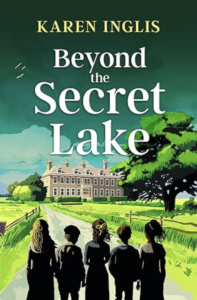 In children’s fiction, clever titles help keep young readers focused on the story. Good examples are The Trapped Pigeon, Jack’s Dream, Time Travel Plan, A Trip below Stairs in Karen Inglis’s Beyond the Secret Lake.
Historical fiction writers often put a time and place, e.g. Virunum, Roman Noricum 370 AD or The Gates of Vienna 1683. While not strictly chapter titles, they also serve to orientate the reader in time and place.
What are the disadvantages of using title chapters?
Chapter titles carry both power and risk. Could they be regarded as old-fashioned or pretentious – too clever by half? Authors often avoid titles when they want maximum immediacy or to keep the author voice interrupting the narrative or to avoid being perceived as guiding the reader how to feel. Plain numbered chapters, especially without even the word ‘Chapter’ can feel starker, colder, more relentless – a legitimate artistic style choice.
Too much information!
Used carelessly, a chapter title could remove any ambiguity/tension in the scene intended by the author, or explain a joke before the scene unrolls, thus making the scene flop. It could pre-empt an emotional discovery – spoiler alert! Thrillers and other suspense-driven fiction are particularly vulnerable. Unless the writer is skilful, titles can leak information. Even vague titles create expectations the author may not intend.
Chapter titles can slow momentum
Titles create a pause – the eye stops and the brain resets. That pause isn’t always welcome in, for instance, fast-paced thrillers as they rely on seamless chapter-to-chapter flow. The risk is a loss of urgency – particularly damaging in action-heavy or minimalist narratives.
But having said that, I found that techno thriller writer Tom Clancy used short chapter titles in some of his Jack Ryan blockbusters such as The Sum of All Fears and they are still among the most successful thrillers around.
Exposing the author!
In a way, the author is intervening and so becoming visible. This is fine if the novel is self-aware, such as Henry Fielding’s The History of Tom Jones where the author’s voice is highly visible and signals design and structure: Chapter iv. – The reader’s neck brought into danger by a description; his escape; and the great condescension of Miss Bridget Allworthy.
Mannered or decorative
Weak titles are worse than no titles. Vague ones such as ‘Change’, ‘Loss’ or ‘Becoming’ or overly poetic phrases risk looking like artificial frosting that doesn’t earn its place.
They are hard to sustain consistently
This is dear to my heart! I find thinking up book titles hard enough. Strong chapter titles require careful thought, discipline and coherence. The first few chapters may have clever, consistent and intriguing titles, but by Chapter 30, inspiration may have fled. Readers are fairly canny and will spot weaknesses in an instant.
Are chapter titles considered old-fashioned?
Ah, this may be the crux of the matter. Chapter titles were quite popular in 19th-century novels (Charles Dickens’ works), mid-20th-century children’s books (C S Lewis’s Narnia series), classic fantasy (Susanna Clarke’s Jonathan Strange and Mr Norrell) and comic and satirical fiction. Modern minimalist literary fiction, particularly American novels, has trained readers to see numbered chapters as more serious and titled chapters as ornamental and frivolous.
But…
This is genre- and culture-specific. In British fiction, titled chapters have never fully disappeared. They’re not strongly stigmatised and are often seen as confident rather than quaint. In fantasy, historical, and speculative fiction, they remain mainstream.
Are they considered pretentious?
They can be, but only when misaligned. Pretentiousness arises when the title sounds wiser than the chapter , the image conjured up by the title exceeds the scene’s depth or the title points to themes the novel doesn’t handle. For instance, a chapter title Ontology followed by a scene where two people argue over a meal about whether to go on holiday that summer is plain silly.
The unspoken modern ‘rule’
Contemporary readers are comfortable with chapter titles if at least one of the following is true: the book has a strong voice; the structure is complex; readers of the genre expect guidance or clues; or the titles perform by providing orientation, irony or rhythm. Readers dislike chapter titles when they distract from the flow, the prose is already heavy or the titles feel ornamental.
When would you use chapter titles?
Questions to ask yourself:
- Does a title add something the prose cannot?
- Does it frame rather than explain?
- Would the chapter be significantly diminished if the title were removed?
- Is the title doing work, not merely acting as a decoration?
My conclusion
Chapter titles are neither inherently old-fashioned nor pretentious but a craft choice, although one with a narrow margin for error. They should intrigue enough to keep the reader turning the pages without spoiling the plot or the flow of the narrative. Used well, they signal authority and design; used poorly, they signal self-consciousness and author self-indulgence.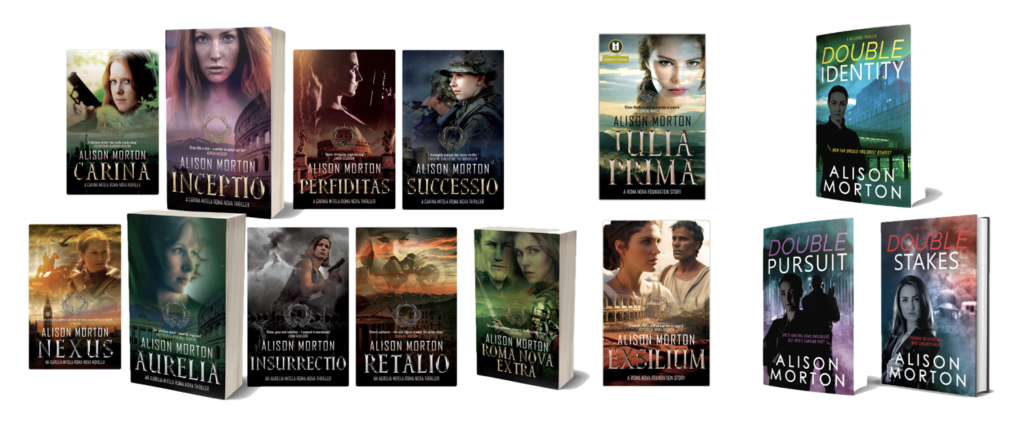 Although I do give parts in my Roma Nova thriller novels a title, I don’t use one for each chapter. The parts introduce distinctly separate acts of the story, but I want the narrative inside each act to flow, so the chapters are headed by a nice plain numeral. In my Mélisende Doubles novels, I take the minimalist route and readers get just a number as I don’t want to interrupt their reading pleasure.
What do you think?
Do you enjoy titles in the stories you read? Do you think they add or detract? I’d love to know your thoughts!
—————-
Note: Except where explicitly mentioned, all examples are made-up
Alison Morton is the author of Roma Nova thrillers – INCEPTIO, CARINA (novella), PERFIDITAS, SUCCESSIO, AURELIA, NEXUS (novella), INSURRECTIO and RETALIO, and ROMA NOVA EXTRA, a collection of short stories. Audiobooks are available for four of the series. Double Identity, a contemporary conspiracy, starts a new series of thrillers. JULIA PRIMA, Roma Nova story set in the late 4th century, starts the Foundation stories. The sequel, EXSILIUM, is now out.
Find out more about Roma Nova, its origins, stories and heroines and taste world the latest contemporary thriller Double Identity… Download ‘Welcome to Alison Morton’s Thriller Worlds’, a FREE eBook, as a thank you gift when you sign up to Alison’s monthly email update. As a result, you’ll be among the first to know about news and book progress before everybody else, and take part in giveaways.







Great post, Alison!
Thank you. And thank you also for letting me cite your titles.
Excellent piece, Alison. Used headings in my first novel and rather regret not using them in the second.
Thanks, Barry. It really is a book-by-book and author-by-author decision. Fielding breaks all ‘rules’ as we see them today, but we still itch to read on.
Perhaps you might return to chapter titles in your next novel?
depends on what type of book it is! I use chapter title/headings in my cosy mystery novellas series, because they’re light-hearted and ‘cosy’.
For my serious historical fiction and nautical voyages – no way, I think titles would ruin the flow. (Apart from location and time e.g The Caribbean May 1720)
For what it’s worth, yours are absolutely fine as they are – no headings needed!
This just shows how complex the subject is! It works for some books/series and not for others.
Great post, Alison, and thank you for including Beyond the Secret Lake. I loved the challenge of creating each chapter title, which needed to invite intrigue whilst not containing plot spoilers! They are a great marketing tool for children’s books too, and way back in 2011, before anyone I knew was sharing free content, I included the full chapter list for The Secret Lake (Book 1) on my Secret Lake website, along with the first three chapters. I guess that was a very early version of a Reader Magnet!
I think it must really help children by giving them a clue about what’s coming as well as positioning them where they are in the story.